History Feature
Why Tea Roasting Was Never Just “Drying the Leaves”: From Tang-Song Cake Tea Firing and Storage Roasting to the Long History of Tea as a Fire-Managed Commodity
When people talk about Chinese tea today, they usually reach first for mountains, cultivars, aroma, liquor texture, vessels, or more photogenic topics such as whisked tea, stove-boiled tea, or early spring tea. But if we move one layer deeper—into the middle zone between making tea and circulating it—we run into a word that is often mentioned lightly and almost never unpacked seriously: roasting. Many people today hear “roasting tea” and think of drying, finishing, adding fragrance, or adjusting fire. In Chinese tea history, though, roasting was never only that. It also had to do with whether tea could be stored, shipped, revived, compared, presented, and kept stable across time. The real question is not merely whether historical tea was roasted, but why tea in China gradually became a commodity that had to be repeatedly watched by fire, corrected by re-roasting, and managed through heat as part of a larger system.
That is why this topic deserves its own article. Looking backward, it connects to the Tang world described in the Classic of Tea, where cake tea had to be fired, ground, sieved, and boiled before drinking. In the middle of the story, it connects to Cai Xiang’s Tea Record, with its close attention to storage, roasting, grinding, and water timing, and to the world of Beiyuan tribute tea, where elite tea had to remain stable enough for repeated judgment. Looking forward, it leads into later Chinese tea traditions in which re-roasting, warming, restoring, and guarding tea against moisture became standard parts of tea maintenance. In other words, roasting is not a dialect term for one tea type. It is part of a long Chinese history of heat management.
For that reason, this essay is not written as a practical how-to guide. It is not mainly about ideal temperatures or modern roasting technique. Instead, it asks four larger questions. First, why did roasting in early tea history belong so closely to the world of cake tea and pre-drinking reprocessing? Second, why did roasting become more necessary once tea entered tribute, storage, and long-distance transport networks? Third, why did roasting stop being just a finishing step and become an ongoing maintenance logic—what later traditions would express through re-roasting and return-roasting? And fourth, why does re-reading roasting today help correct an overly light tea history that loves flavor and terroir but neglects stability, upkeep, and the cost of keeping tea alive beyond the workshop?
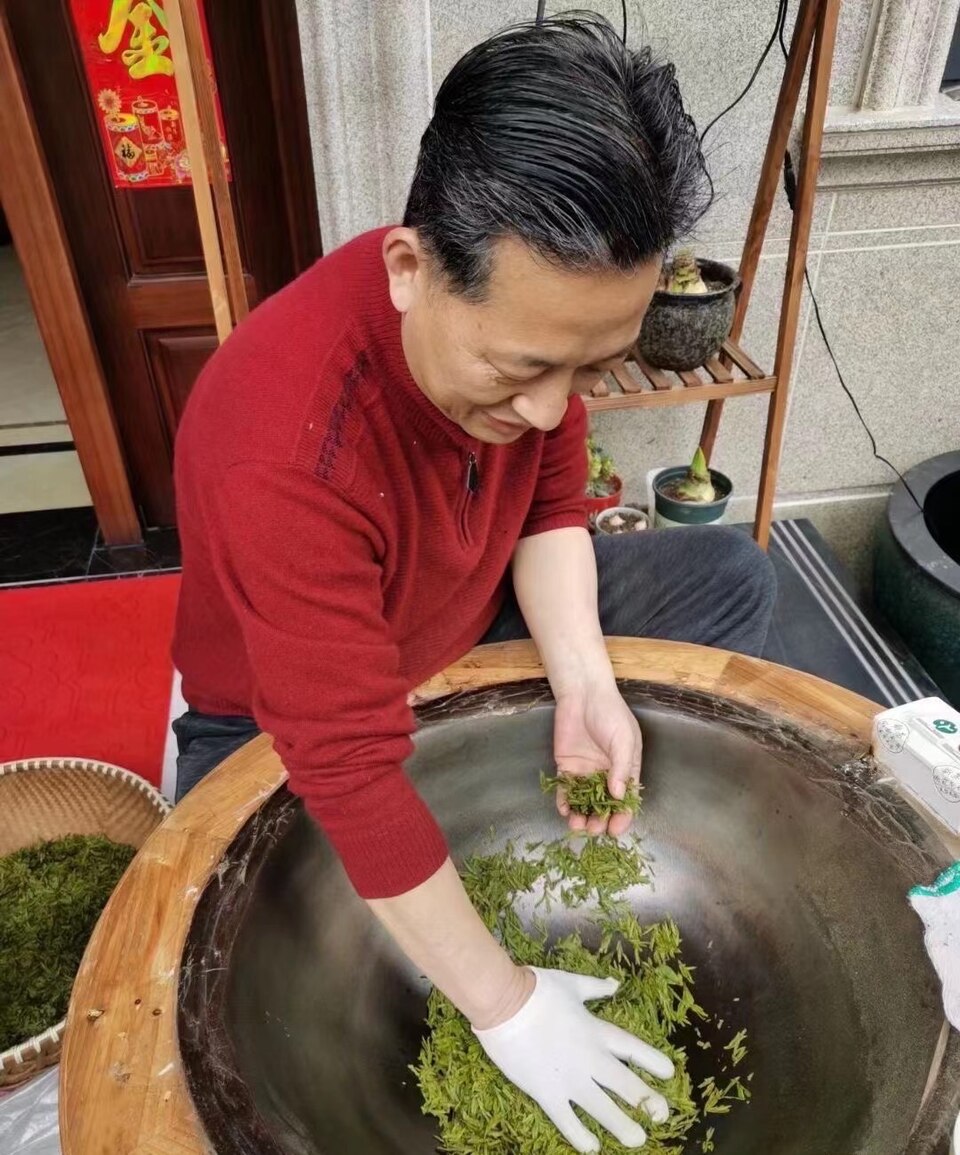
1. Why can tea roasting not be reduced to “drying”? Because in Chinese tea history it often governed whether tea could continue to hold together, not just whether it could be made in the first place
Modern people usually imagine roasting as a late production step: leaves are processed, shaped, and then heated again to push moisture down and lock the tea into a stable final state. That is true as far as it goes, but historically it is too late in the sequence. In Chinese tea history, roasting often dealt with a different question: once tea had already been made, could it continue to remain tea of the right kind? Could it survive storage, transport, waiting, and re-use? In that sense, roasting was often not the final flourish but the beginning of continued care.
This matters because tea is unusually vulnerable as a stored good. It can absorb moisture, lose aroma, pick up stale notes, flatten out, or simply fail to perform when reopened later. As soon as tea enters tribute systems, long-distance movement, batch delivery, extended storage, or repeated evaluation, the made product is no longer fully “finished.” It still has to be protected. Roasting therefore expands from a manufacturing step into a preserving step, a correcting step, and a way of renewing order. Tea is not always made once and then left alone. It often has to keep standing up across time, and roasting is one of the ways that Chinese tea traditions made that possible.
That is also why roasting in tea history should not be read only through the lens of modern flavor preference. Today people often speak of light fire, medium fire, or strong fire mainly in terms of style and taste. Historically, many tea systems were concerned first with stability: whether the tea would survive storage, whether it would travel well, whether it would reopen in a usable state, whether it would remain fit for grinding or later preparation. Flavor still mattered, of course, but flavor often depended on a more basic achievement—keeping the tea alive as tea.
2. Why was early tea roasting so closely tied to the world of cake tea? Because the Tang tea system was built around reprocessing before drinking, not direct brewing from fresh finished leaves
If we return to the Tang tea world represented by the Classic of Tea, the importance of roasting becomes immediately concrete. Tang elite tea was not usually consumed as loose leaves directly infused in hot water. Instead, tea was commonly steamed, compressed, stored, and later reworked. Before drinking, the tea cake had to be fired, ground, and sieved. Fire, in that setting, was not an afterthought. It was the first act in bringing stored tea back into a drinkable state.
Why was that step indispensable? Because a compressed tea cake was not automatically ready after storage and transport. Roasting helped drive off dampness and stale storage character, restored the tea to a more workable condition, and prepared it for grinding and boiling. In other words, Tang tea culture did not assume that tea would simply release itself once water met leaf. It assumed that tea would be reawakened by fire, reduced to the right form, and only then brought into water. Heat was already part of tea judgment before the tea reached the cup.
This is why tea roasting in early China cannot be retrofitted into a modern loose-leaf model. A great deal of its meaning belonged to this older reprocessing order. Roasting was not decorative polishing. It was a precondition for successful use. Without that step, the cake could not reliably re-enter the drinking sequence; and without that sequence, later judgments of texture, foam, or flavor would be unstable from the start. Early roasting, then, mattered not because it made tea more aromatic in a simple sense, but because it made tea processable again.
3. Why did roasting become even more important in the Song? Because tribute tea and whisked tea culture demanded extreme stability
By the Song, roasting did not fade into the background. It became more deeply embedded in another system. The reason is straightforward: high-grade Song tea, especially in the world of Beiyuan tribute tea, had to remain stable enough to survive tribute collection, storage, transport, grinding, whisking, and repeated judgment. Tea was no longer just something to make. It had to perform consistently across a chain of actions. Under those conditions, roasting could not remain a minor finishing gesture.
This is especially clear in Cai Xiang’s Tea Record. Cai was not writing abstract tea philosophy. He was recording the working vocabulary of a highly refined system. His attention to storing tea, roasting tea, grinding it, sieving it, and timing water shows that the success of elite tea did not depend only on harvest and manufacture. It also depended on whether the tea’s condition could be maintained. If it absorbed moisture, it could lose liveliness. If the roast was wrong, the tea’s nature could be flattened or thrown off. If roasting and storage failed, the tea would later fail in grinding and whisked presentation as well. Roasting had become part of quality governance.
That is why Song discussions of heat can seem fussy to modern readers. They are not fussy for the sake of rhetoric. They belong to a low-tolerance world. High-grade compressed tea, whisked tea judgment, dark bowls setting off white foam, and tribute rankings all intensified the cost of error. Roasting therefore served as an error-management system inside a refined chain of comparison. It helped keep tea fit to enter later judgment. Without comparability, there could be no ranking, no reliable textual standard, and no stable world of elite evaluation.
So what made roasting especially heavy in the Song was not simply a stronger love of fired fragrance. It was the combined pressure of state tribute, production discipline, textual knowledge, and aesthetic comparison. Roasting had moved from preparation into governance.
4. Why does the logic of re-roasting emerge so naturally once tea enters storage and long circulation chains? Because tea is not a momentary drink but a changing good across time
Any commodity that changes over time will generate maintenance problems, and tea is one of the clearest examples. It fears moisture, stale air, flattening, and transport instability. That is why tea roasting often does not end with a first firing. It grows into the logic of re-roasting, return-roasting, and protective heat management. Roasting becomes periodic care rather than a one-time step.
This is easy to miss in modern retellings because tea production is often narrated as a neat sequence: harvest, process, finish, sell. But historically a great deal of tea did not live like that. It had to be stored, shipped, sold in portions, opened later, or prepared again under new conditions. Some teas were meant to move across long distances. Others were held for later sale. Others had to survive until a later point of elite use. Once that chain lengthens, the state achieved on the day of manufacture is no longer guaranteed to survive. Re-roasting then appears not as a fussy extra, but as a way of preserving commercial life.
This is important because it shows that many historical tea systems did not treat tea as a fully sealed final product. They treated it as a material state that could drift and therefore had to be re-stabilized. In that sense, re-roasting is not only repair. It is an acknowledgment that tea remains vulnerable after manufacture. Rather than pretending that perfect production eliminates change, many Chinese tea traditions built a second layer of care that admitted change and responded to it.
5. Why did tea roasting increasingly become a form of circulation management rather than only a making technique? Because heat determined whether tea would still hold together at the next node
When tea is made for quick local consumption, roasting matters, but its consequences can often be absorbed nearby. Make today, sell today, drink soon: many errors remain local. But once tea becomes a commodity for storage, transfer, long transport, and staged distribution, the issue changes completely. At that point, roasting no longer matters only to the craft reputation of the producer. It matters to whether the tea is still viable at the next point in the chain. Will it dampen in storage? Will it go flat in transit? Will it survive reopening? Will it still resemble itself at the far end?
That is the moment when roasting ceases to be merely technical and becomes logistical in a deeper sense. The more nodes a tea passes through, the more dispersed responsibility becomes, and the more necessary it is to build a buffer into the tea itself. Roasting creates part of that buffer. It does not make tea eternal, but it can help tea survive moisture, waiting, handling, and delayed consumption without collapsing. Once that function becomes central, fire control naturally enters the same field as warehousing, transport rhythm, shipment responsibility, and state concern.
In other words, the historical weight of roasting is often not primarily aesthetic weight but nodal weight. If tea still has to travel, it cannot merely taste acceptable now; it has to remain legible later. That is why heat management becomes part of a broader order of circulation. Tea is no longer only a bearer of origin flavor. It is also a state-bearing commodity that must be kept alive across movement.
6. Why did later tea categories develop different languages of roasting? Because they did not face the same time structure, circulation pattern, or risk profile
At this point, another misunderstanding has to be avoided. If roasting mattered so much, does that mean all Chinese teas should be judged by one unified model of roast? Of course not. The reason roasting developed into so many different vocabularies is precisely that different tea categories faced different temporal and commercial conditions. Some teas depended on stabilizing fresh early spring material quickly. Some used roasting as part of style formation. Some relied on long storage, endurance in transport, or reawakening after waiting. In each case, heat did related work, but not identical work.
That means tea roasting in Chinese history is not a single line of technical progress. It is a branching family of responses. Different teas developed different forms of heat management because they moved through different climates, storage windows, market rhythms, and taste regimes. Roasting remains present throughout, but its historical task changes. Recognizing that point is crucial because it prevents us from mistaking the roast logic of one later tea type for a universal law of Chinese tea.
That is also why this topic belongs in a history section rather than in a narrow tea-craft note. The deeper question is not “how is this or that tea roasted?” but “why did Chinese tea repeatedly have to create vocabularies of fire control at all?” The answer lies in tea’s layered identity: it is at once a flavor object, a transport good, a storage good, a comparison object, and an institutional object. The more layered the identity, the more differentiated roasting has to become.
7. Why is tea roasting still worth revisiting today? Because it corrects a lighter tea history that writes terroir and taste but not stability, upkeep, or maintenance cost
Much current tea writing gets pulled toward two poles. One is aestheticized flavor writing: aroma, texture, mountain character, vessels, and lifestyle scenes. The other is grand route writing: caravan roads, frontier trade, and long-distance networks. Both have their place. But when the middle layer disappears—the layer in which tea has to be kept sound long enough to reach those beautiful endpoints—history becomes too light. Tea did not become historically important only because it was admired. It became important because it could be maintained, moved, reopened, and repeatedly reinserted into social life.
Tea roasting restores that missing layer. It reminds us that good tea is not automatically a finished object. However fine the harvest or terroir, tea can still fail if it cannot survive moisture, storage, shipping, waiting, and later use. Heat management is therefore not just a technical footnote for specialists. In many historical settings it was one of the conditions of continued value. It helped tea remain tea after leaving the workshop.
This does not make tea history dry. It makes it whole. A mature tea history cannot stop with where tea came from and who drank it. It also has to ask how tea was kept alive across time. Roasting is one of the clearest and most neglected places to ask that question. Once we put it back into the picture, many apparently separate subjects—from the Classic of Tea’s firing logic, to Cai Xiang’s storage and roasting language, to later ideas of re-roasting and firework—suddenly line up as one continuous thread.
8. Conclusion: tea roasting reveals not just that historical tea used fire, but why Chinese tea gradually became a commodity whose condition had to be continuously managed
If this article had to be compressed into one short conclusion, it would be this: tea roasting matters not because it proves that premodern people knew how to heat tea, but because it shows that Chinese tea was never simply a product made once and then left alone. As soon as tea had to be stored, transported, compared, presented, reopened, or consumed across time, it had to continue to hold together. Roasting was one of the methods that made that possible.
That is why roasting should not be confined to craft history alone. It also belongs to material history, circulation history, tribute tea history, judgment history, and institutional history. It shows that fire control was not merely the servant of flavor rhetoric. It was one of the conditions that helped tea become a stable commodity, a comparable object, and a manageable institutional good. Without that layer, many of the later high points of tea history would rest on air.
So when we revisit tea roasting now, the most important thing to remember is not simply that some historical teas were more or less fragrant under fire. It is that once tea had to live beyond the moment of manufacture, fire stopped being only a workshop heat source and became a management tool for quality, time, and circulation. That is where Chinese tea history quietly became heavier than a leaf.
Continue reading: Why the Classic of Tea Still Matters Today, Why Cai Xiang’s Tea Record Still Deserves a Close Reading, Why Beiyuan Tribute Tea Became So Important in the Song, and Why Tang Boiled Tea Later Left the Mainstream.
Sources and framing: written from standard tea-historical understandings of the Classic of Tea on firing, grinding, and boiling cake tea; the Tea Record on storing tea, roasting tea, grinding, sieving, and timing water; and the broader historical logic linking Tang-Song tribute tea, Beiyuan compressed tea, and later traditions of re-roasting and fire management. The focus here is the structural meaning of roasting as heat management in Chinese tea history, rather than a line-by-line reconstruction of historical roasting manuals.