History Feature
Tea whisks, whisked tea, and the “Song revival”: why young Chinese drinkers are fascinated again
Across Chinese internet culture, discussions of Song-dynasty aesthetics, whisked tea, jian ware, tea-whisk performance, and “new Chinese-style” lifestyle scenes have remained unusually active. Short videos show people whipping pale foam in black bowls; social feeds are filled with bamboo whisks, bowl stands, and carefully staged Song-style tea tables. On the surface this looks like an aesthetic wave. At a deeper level, it is also a contemporary attempt to reorganize tradition, rhythm, and self-experience through tea.
If a tea whisk is reduced to “that tool for making matcha,” the current fascination looks shallow, almost like a more antique version of lifestyle retail. But in the Chinese historical context, the whisk opens onto a much larger system: powdered tea and whisked tea techniques, Song standards for white persistent foam, the rise of dark jian bowls, and the later shift toward steeped loose-leaf tea that rewrote everyday tea actions in China.
That is why the real question is not whether the whisk looks beautiful. The question is what people are reviving when they pick it up again. Are they reviving a historical technique? Building a new aesthetic identity with Song symbols? Searching for a manageable form of slowness inside accelerated urban life? In practice, all of these motives overlap.
1. Why did the tea whisk suddenly become hot again?
The trend did not emerge in isolation. It sits at the intersection of several currents in Chinese internet culture: the broader fascination with Song-dynasty aesthetics, the rise of intangible-cultural-heritage content, the market for “new Chinese-style” lifestyle experiences, the popularity of traditional culture workshops, and a wider desire among young urban consumers to rebuild ritual in everyday life. Whisked tea works especially well online because it is visually legible. Powder, hot water, bamboo whisk, black bowl, and white foam create a clear sequence that short video platforms love.
Just as important, whisked tea offers a manageable entry point into tradition. It carries historical prestige, but it is easier to try than disciplines with much steeper learning curves. A person can buy a basic set, follow a few steps, and quickly produce a visible result. That makes it ideal for a culture that values participation, documentation, and self-stylization all at once.
2. What exactly is a tea whisk in Chinese tea history?
A tea whisk is not just a stirrer. In the older powdered-tea and whisked-tea system, it was a specialized tool used to beat fine tea powder and water into an even, dense, stable surface. Song tea culture did not judge success by “whether the powder mixed.” It cared about foam whiteness, fineness, persistence, and the way the surface met the bowl wall. Historical discussion of whisked tea often turns to signs such as how the foam held, how water marks behaved, and how complete the visual effect appeared.
That means the whisk was a technical instrument before it became a modern lifestyle symbol. Without the right tool and a trained hand, many of the aesthetic judgments central to Song whisked tea simply could not happen. Today, when the whisk is sometimes sold as an atmospheric accessory, its historical function gets flattened. It mattered because it did real work inside a real tea system.
3. Why did whisked tea peak in the Song period?
Whisked tea peaked in the Song not merely because emperors or literati liked it, but because technique, institutions, ceramics, writing, and sociability converged. Tribute-tea systems encouraged refined processing. Literati culture turned tea into something that could be discussed, compared, written about, and aesthetically judged. Ceramic production, especially the development of dark tea bowls, gave whisked tea a perfect visual stage. Tea, vessels, literary expression, and social display locked together.
Modern readers often imagine Song tea as excessively rarefied, as though it belonged only to elegant studies. But Song society also had vibrant urban commerce and a broad culture of consumption. Elite taste shaped the standards, yet the force of whisked tea came partly from its ability to circulate through wider social life. It mattered because it was both refined and shareable.
4. Why are jian bowls becoming fashionable again alongside the whisk?
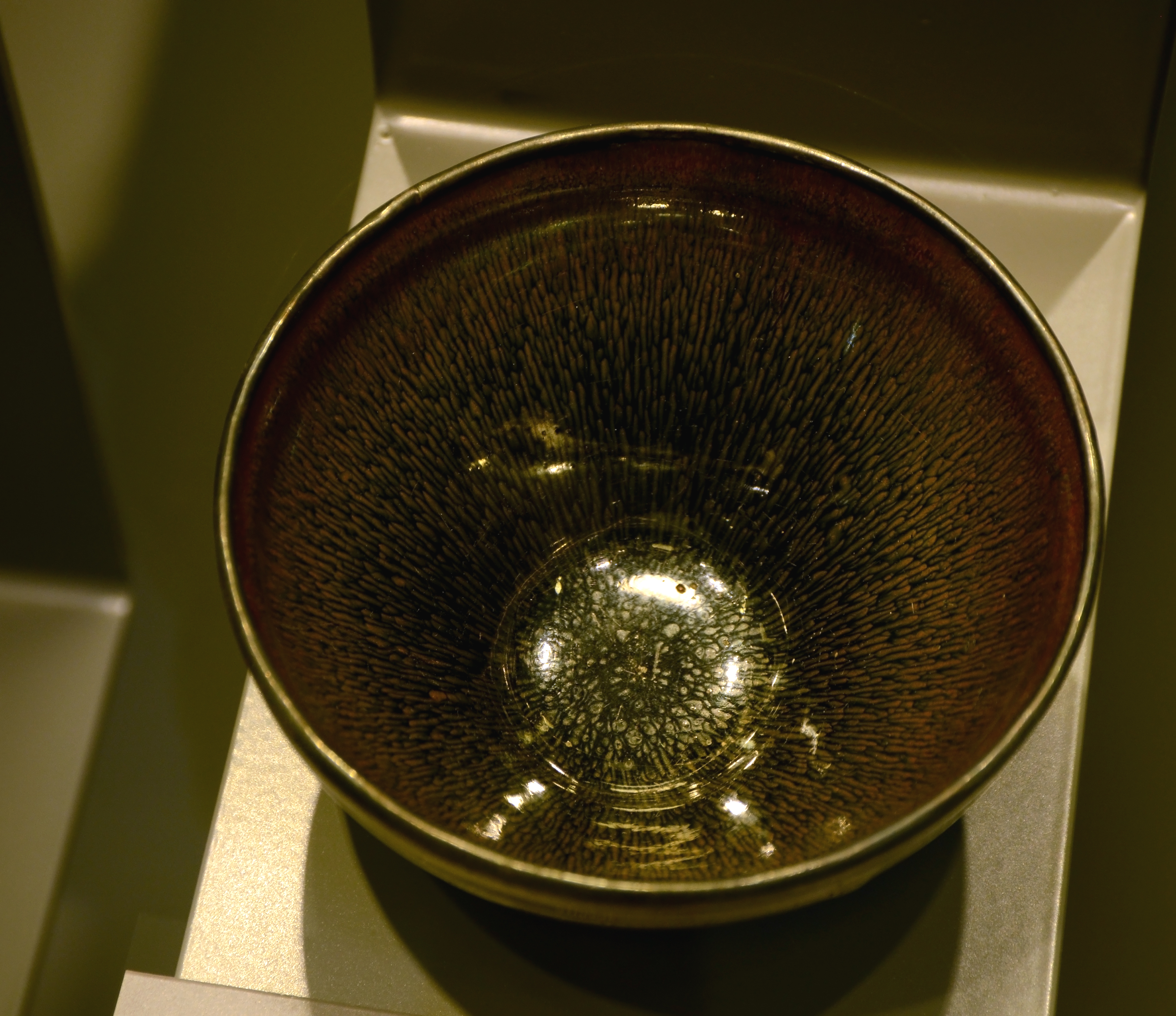
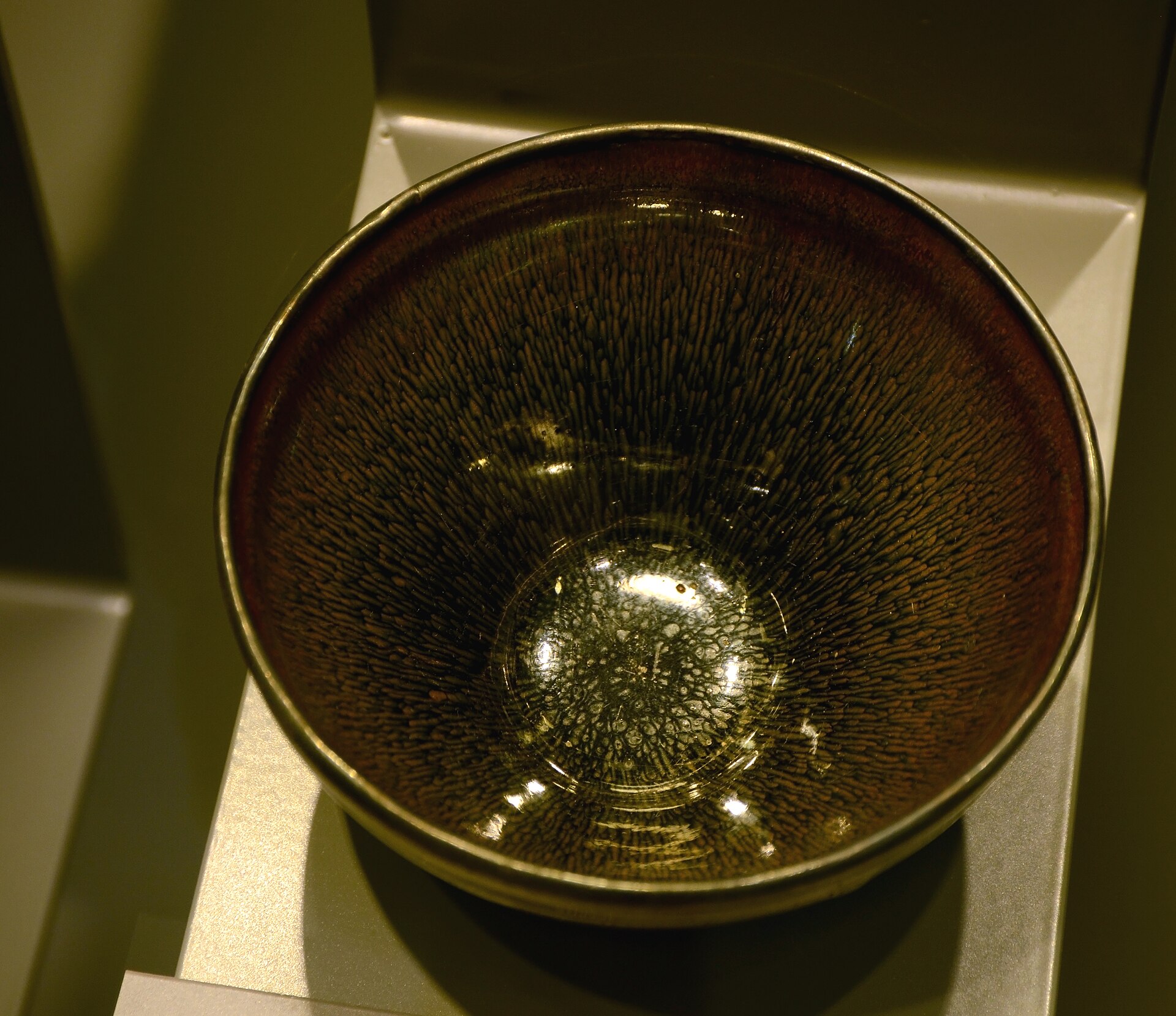
Because in the historical whisked-tea system, the bowl was functional, not merely coordinated décor. A dark glazed bowl made pale foam visible. Surface effects such as hare’s-fur streaking or oil-spot textures added further visual complexity. When Song drinkers compared tea, they were not comparing flavor alone. They were also comparing foam, surface, bowl interaction, and completion of the tea scene.
That helps explain the contemporary return of jian ware. People are not simply buying a bowl. They are buying into an integrated imagination of “Song-style tea.” Whisks, scoops, trays, bowls, stands, cloths, and table composition work together to create a recognizable visual language on social platforms. The trend spreads so well because it is material, teachable, photographable, and partially practicable.
5. Why did mainstream Chinese tea stop depending on the whisk after the Ming?
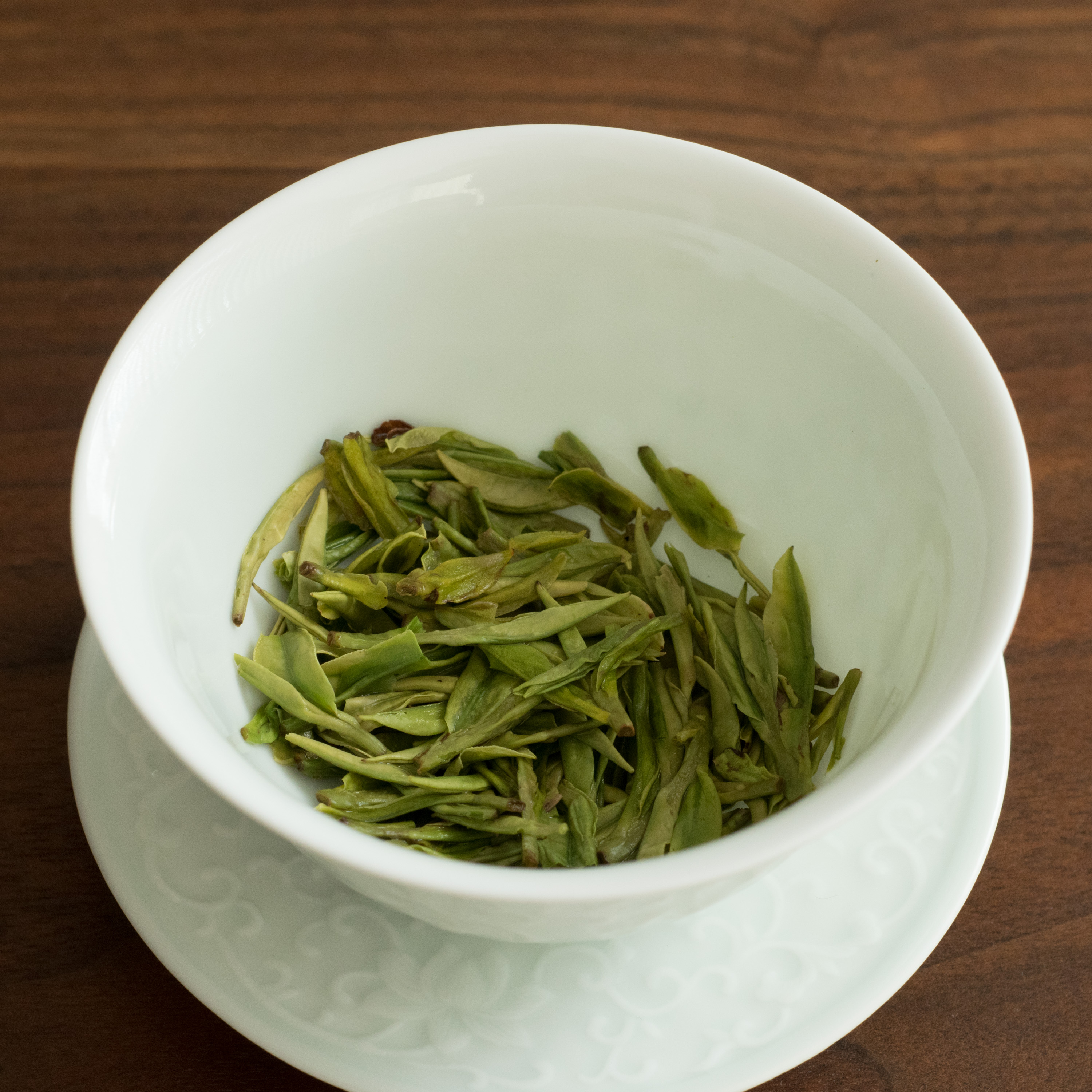
The answer is a larger shift in technique. As loose-leaf steeping became dominant from the Ming onward, the center of tea practice moved from grinding, sifting, whipping, and judging foam toward watching leaves unfurl, smelling aroma, controlling water, timing pours, and comparing infusions. Once the evaluative center changed, the whisk naturally lost its central role. It was not that the whisk became “backward.” The system it served was no longer the mainstream one.
This is one of the most important points for any serious modern revival. Whisked tea did not disappear because of one dramatic rupture. It was gradually displaced by another tea system better suited to changing materials, vessels, and everyday patterns. Tea history is not one method defeating another in simple fashion. It is a sequence of different systems taking the center under different historical conditions.
6. What does today’s “Song-style whisked tea revival” actually revive?
Strictly speaking, most current revivals do not restore the whole Song world. What they revive are the layers that contemporary people can still use: visual aesthetics, hand practice, body rhythm, social scenes, and cultural identity. A complete Song tea system also depended on tribute-tea institutions, period-specific materials, vessel ecologies, literary traditions, and shared evaluative communities. Those cannot simply be reproduced in modern life.
But that does not make today’s revival fake. Many traditions survive precisely by selective recomposition. The clearest way to describe the present moment is not “people are becoming Song people again,” but “people are building a contemporary practice with the Song as reference.” That distinction matters. It allows appreciation without naïve historical fantasy.
7. Why did tea-whisk performance become part of the same trend?
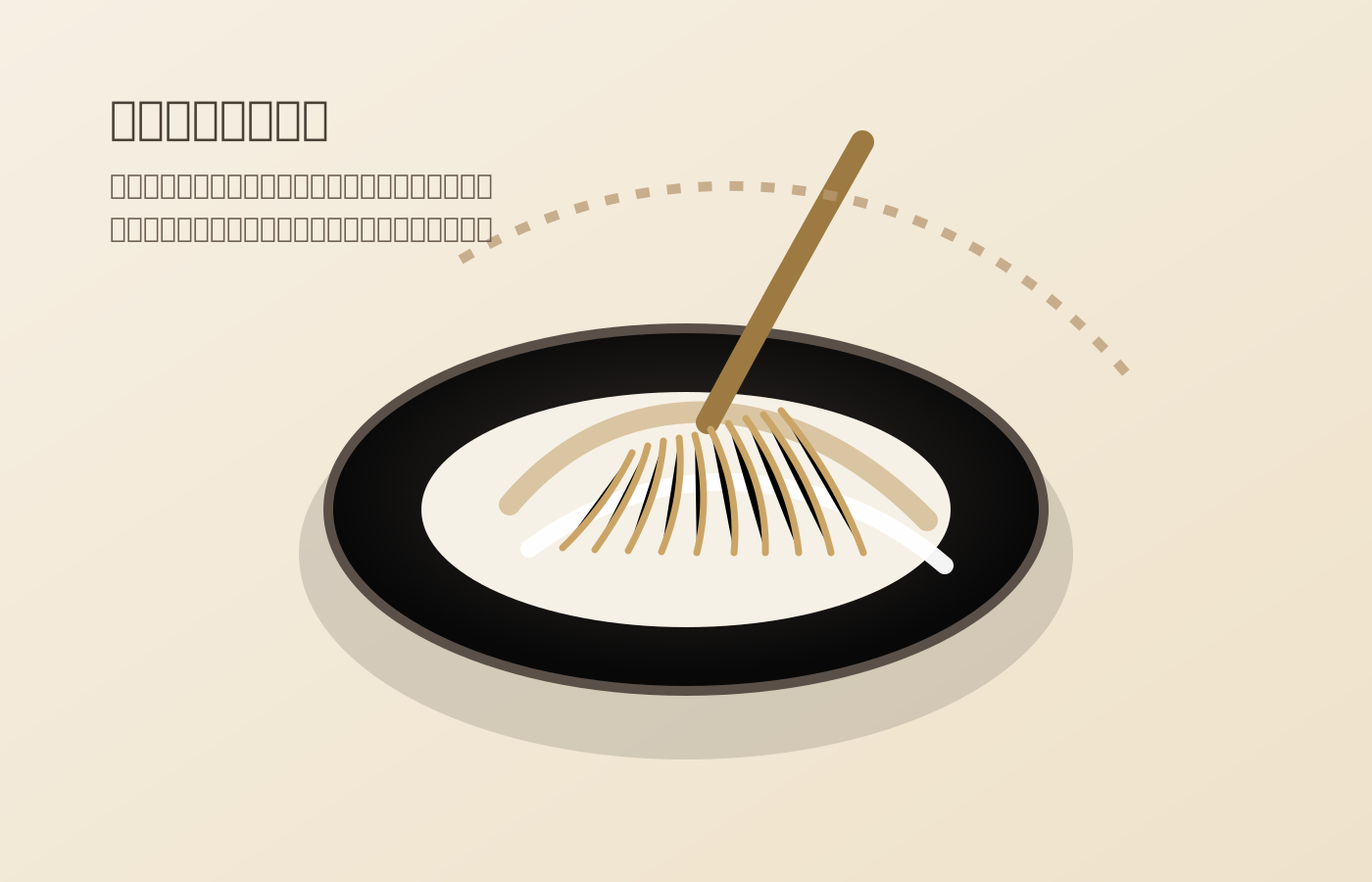
Because it is the dramatic extension of whisked tea’s visual appeal. Tea-whisk performance pushes surface control further, producing characters, birds, flowers, or simple motifs on the foam through water control, paste handling, and whisk technique. This works exceptionally well in the attention economy. It makes viewers feel that the historical tea world was unexpectedly playful and sophisticated, while also delivering clear visual payoff.
Still, if one sees only spectacle, the practice becomes flattened. Tea-whisk performance is not random doodling on foam. It depends on understanding bowl, powder, water, pressure, and surface behavior. It is a flourish built on technique. As an entry point it is valuable; as a complete explanation it is not enough.
8. Why is this worth treating as a historical-cultural phenomenon, not only a retail trend?
Because it reflects a broader shift in urban Chinese culture. Many young people no longer want tradition only as information. They want ways to enter tradition through actions they can perform. The same impulse drives interest in incense practice, seal carving, qin, flower work, and now whisked tea. Not everyone will continue for years, but these activities are changing the structure of cultural consumption. Tradition is being reintroduced as a set of life techniques rather than a museum object alone.
In that sense the tea whisk is highly symbolic. It is not the most practical everyday tool in modern life, yet it lets a person feel in a concrete way that they are doing something with historical depth. That feeling itself is part of the engine of revival. Commercial packaging and platform algorithms are certainly present, but they do not exhaust what is happening.
9. Will the current Song-style revival fade quickly?
Its surface heat will cool; that is almost inevitable. Any visually strong trend that spreads rapidly online goes through a phase of symbol repetition, template production, and commercial copying. But cooling does not mean leaving nothing behind. What usually fades first are the most easily replicated backdrops, filters, and “same-style experiences.” What can remain are new audiences for tea history, vessel history, and craft history, along with a wider vocabulary for talking about tea aesthetics.
So the better judgment is this: the trend is neither pure antiquarianism nor pure commercial stage design. It is a contemporary reinterpretation centered on Song tea symbols, pushed forward by platform culture, retail environments, and genuine historical curiosity. The whisk has returned not only because it looks beautiful, but because it allows people to touch history through action.
Continue with the history of matcha in China, what “tea dao” means in Chinese history, and why jian ware mattered in the whisked-tea era.
Source references: Matcha, Tea ceremony.