History feature
Why The Daguan Tea Treatise became the standard text of the Song whisked-tea world: from Emperor Huizong and Beiyuan tribute tea to white-foam aesthetics, Jian bowls, and the verbal fixing of tea order
When Song tea history comes up today, readers often think first of doucha, whisked tea and the tea whisk, the centrality of Jian tea, and tea baixi, and then mention The Daguan Tea Treatise in passing. But the book is often cited without being fully explained. Why does it matter so much? Is it only famous because an emperor wrote it? If we stop there, we miss its real historical weight. The crucial point is not simply that Emperor Huizong cared about tea. It is that the treatise compressed the most important lines of the elite Song tea world—Beiyuan tribute tea, refined compressed tea, whisked-tea procedure, white foam, dark-bowl contrast, and standards of judgment—into a set of portable, teachable, and comparable language.
In other words, the importance of this text lies not only in its content, but in the act of verbal fixation it performed. Song tea culture was already highly developed before it: Cai Xiang’s Record of Tea had already offered a compact and brilliant discussion, and the prestige of Beiyuan tribute tea, Jian tea, compressed-tea craft, and whisked-tea competition had already taken shape. What The Daguan Tea Treatise did was especially consequential: rather than merely noting scattered experiences, it reorganized an entire order of judgment and stated, with unusual authority, what counted as the best tea and the best way of handling it.
That is why this topic deserves its own article. The real questions are not shallow ones like whether Huizong was “good at drinking tea.” They are harder questions: why did this text appear at that specific moment, what exactly did it turn into standard, and why did it shape later understandings of Song tea more powerfully than many equally concrete but less authoritative sources. Once those layers are clear, The Daguan Tea Treatise stops being merely a frequently cited title and becomes visible again as a central document in the order of Song tea culture.
1. Why does The Daguan Tea Treatise deserve separate treatment? Because it was not an ordinary tea essay, but a standardizing text for the Song whisked-tea world
Many historical materials are important, but they are important in different ways. Some matter because they are early. Some matter because they preserve unusual details. Others matter because they stand at the center of an order and reorganize scattered practice into norm. The Daguan Tea Treatise clearly belongs to this third category. It does not merely describe tea. It defines tea. More precisely, it defines a highly specific, highly Song, and highly elite order of tea practice: what counts as good tea, what kinds of water handling and whisking count as superior, what sort of relation between bowl color and foam is most desirable, and what kind of judgment counts as truly informed.
This matters enormously because once an experience is written as norm, its mode of transmission changes. Things that once had to be learned in person—from teachers, friends, or competition settings—can now move through reading, quotation, and imitation. That means the deepest power of The Daguan Tea Treatise was not only that it recorded Song tea culture, but that it helped make Song tea culture reproducible.
This is also why it cannot be placed on the same level as miscellaneous notes or elegant anecdotes. Song materials on tea are abundant, but not every source combines three conditions at once: first, the backing of the court and the state center; second, deep engagement with the Beiyuan-Jian tea-whisking world at the heart of the period; and third, a sufficiently dense language able to compress technique, aesthetics, and hierarchy into short but forceful formulations. The Daguan Tea Treatise has all three, which is why its position in tea history is so heavy.
2. Why does the fact that Emperor Huizong wrote it change everything? Because the author stood at the center of the order rather than observing from outside
Any discussion of the treatise must pass through Emperor Huizong. But if we put all the emphasis on the fact that the author was an emperor, the point still remains too shallow. What matters is that Huizong was not outside tea culture, occasionally producing an elegant piece of writing. He stood in the center of late Northern Song court culture, aesthetic politics, and the Beiyuan tribute-tea order. In other words, he was not giving outsider testimony. He was speaking from the center. And when someone at the center speaks, the text is no longer just opinion. It acquires strong demonstrative and filtering power.
This is very different from an ordinary literatus writing about tea. However brilliant another writer might be, his text would still register mostly as cultivated opinion. But when the emperor writes a tea treatise, a certain view is elevated into something the wider world may quote, imitate, and quietly treat as authoritative. Tea practice in reality always remained more varied and messy than any text suggests. Still, once The Daguan Tea Treatise existed, later readers were bound to treat it as one of the clearest representations of the highest Song tea world. Not because it was the only voice, but because it occupied the most visible position of speech.
That is why the historical value of the treatise does not lie in court gossip about imperial taste. Its value lies in turning elite aesthetic judgment into public language. Beiyuan tribute tea, white-foam aesthetics, dark-bowl suitability, and whisked-tea method all existed before. But Huizong’s position gave them a higher degree of legitimacy. He did not invent the tea world from nothing. He reinforced it by writing it from the center.

3. What does The Daguan Tea Treatise actually discuss? Not tea knowledge in general, but a full structure of judgment from leaf and water to bowl and foam
Many modern references treat the treatise simply as a “book about tea.” That is true but too vague. More precisely, it organizes an interlocking structure of judgment. It begins with tea itself: quality, refinement, making, hierarchy. It moves into whisked-tea procedure: how tea should be handled, entered into the bowl, and related to water. It then turns to one of the most characteristic aesthetic centers of the Song tea world—the foam on the tea surface: its whiteness, fineness, evenness, and duration. Finally, it also addresses the material conditions that support these judgments, especially the suitability of bowl color and form.
This is crucial because it shows that the treatise is not just collecting attractive details. It is organizing the whole chain of the Song whisked-tea world. Tea is not merely good tea as isolated substance; bowls are not merely beautiful bowls as separate objects; foam is not an accidental decorative byproduct. All are parts of a system: good tea makes possible good foam, good foam depends on water handling and whisking technique, and good foam becomes legible through the contrast of a dark bowl. Once these are placed into comparison, hierarchy becomes visible.
The power of The Daguan Tea Treatise lies in making this whole relationship sound like common sense. It does not always expand everything into encyclopedic detail. But it succeeds in persuading readers of something fundamental: elite Song tea practice was not a pile of disconnected preferences, but an internally ordered world. Once that is established, the text stops being merely documentary and becomes something like a structural manual.
4. Why does it care so much about white foam? Because much of Song whisked-tea beauty and competition was concentrated on the bowl surface
If we do not understand the visual logic of Song whisked tea, it can seem strange that the text cares so intensely about foam color, fineness, and surface behavior. But this was one of the central facts of the period. Unlike the later Ming-Qing world of steeped loose leaf, where aroma, layered taste, leaf-bottom reading, and infusion rhythm became central, Song whisked tea pushed attention toward the bowl surface. A tea was judged not only by taste in the mouth, but first by what could be seen, recognized, and compared on the surface.
Why did whiteness matter so much? Because in that system, white, fine, even, and lasting foam registered quality and control. It was not merely an empty preference for prettiness. It signaled that raw material, grinding, water handling, and whisking had all aligned. The foam was therefore not decoration but a display screen for the result. Whoever could produce such foam came closer to superiority.
This also explains why the treatise belongs in conversation with doucha. Doucha made superiority visible in live comparison, while The Daguan Tea Treatise translated superiority into language. One was the scene of contest; the other was the verbal standard. Read together, they clarify why the Song tea world cared so intensely about the bowl surface. That white layer was not simply something beautiful. It was the visual exit point of the whole order.
5. Why can the treatise not be separated from dark bowls and Jian ware? Because it is not describing abstract aesthetics, but a visual judgment supported by material things
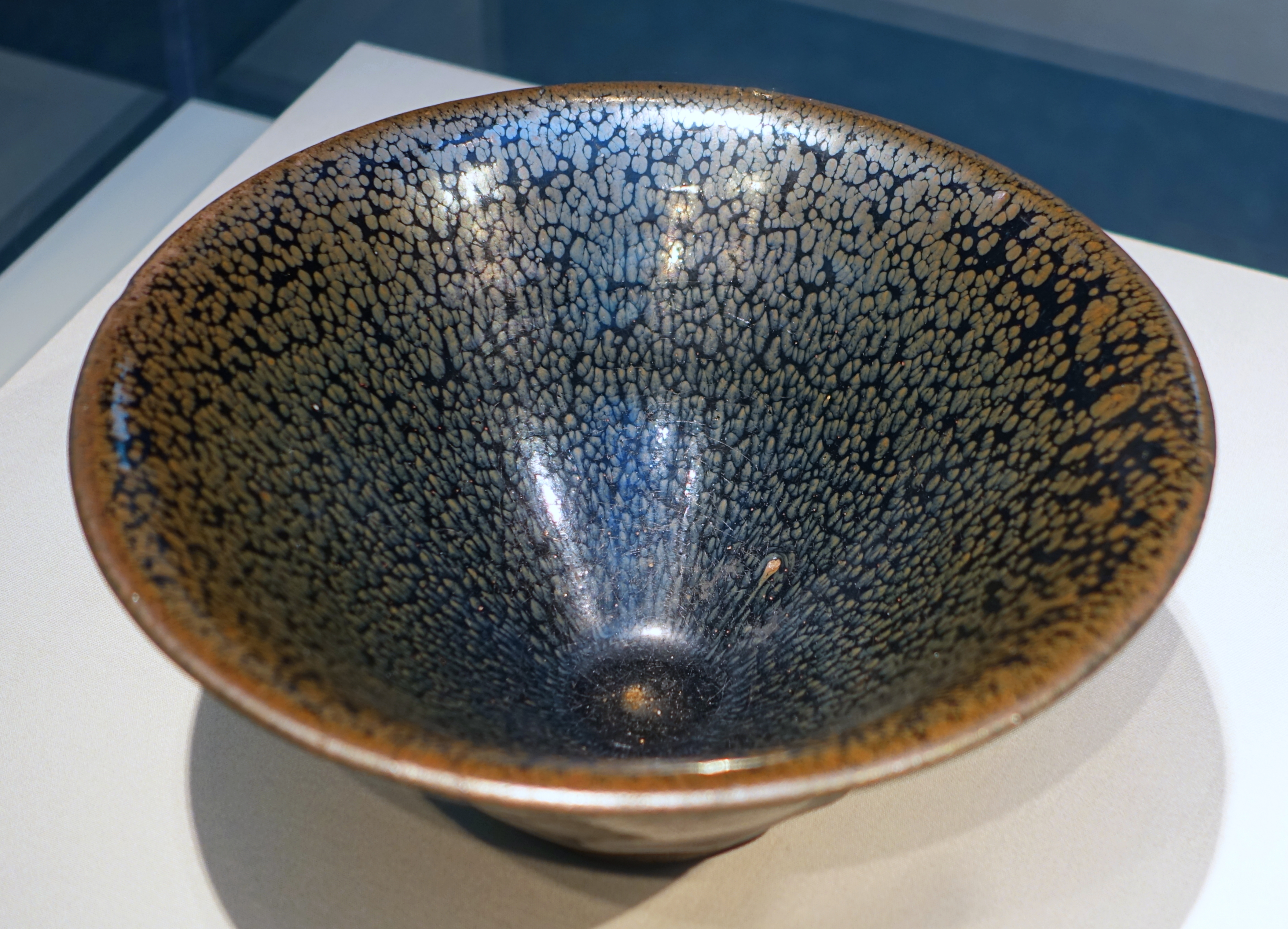
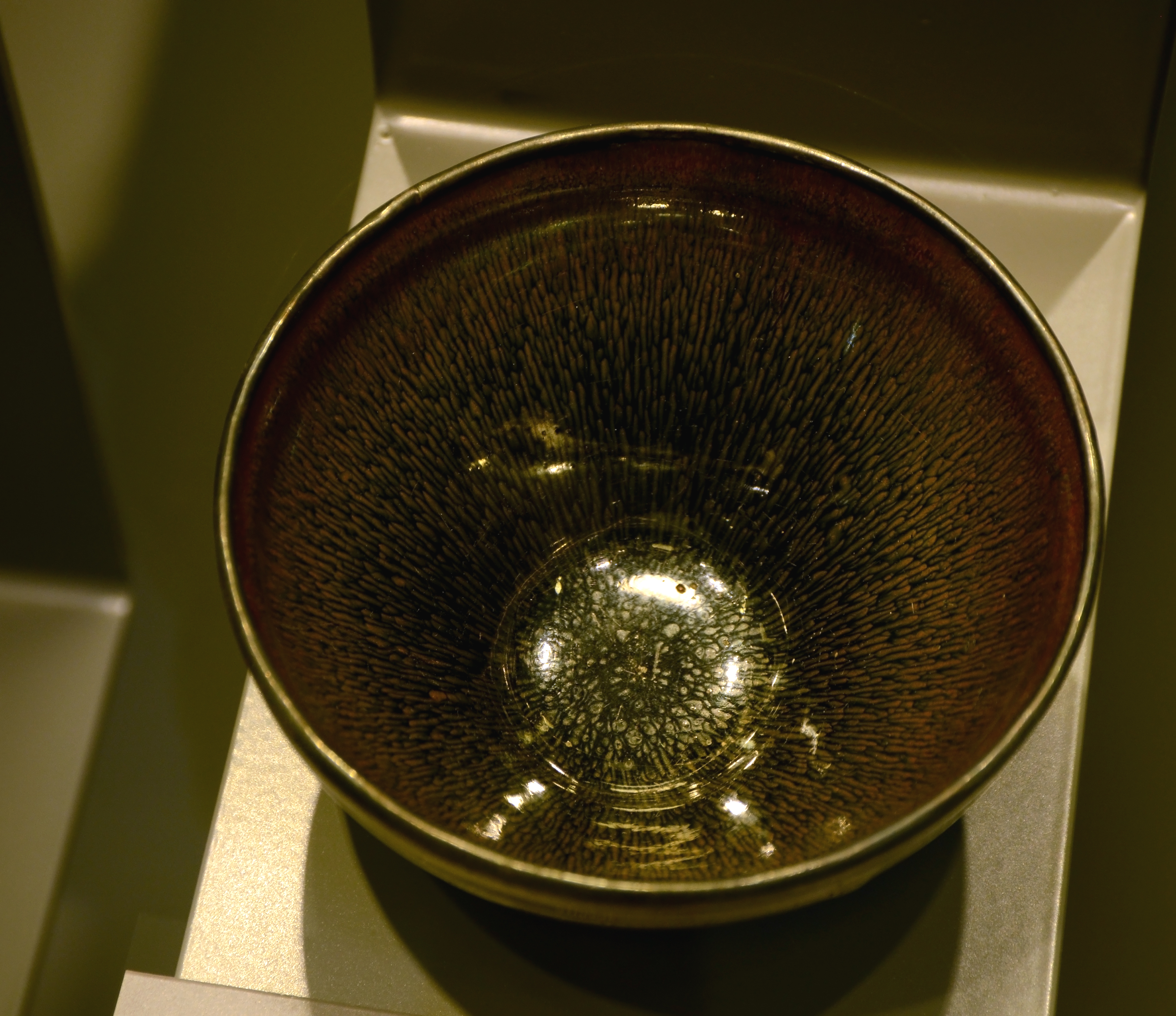
The Song tea world is often romanticized today as if it were some floating realm of refined mood. But once we follow the logic behind The Daguan Tea Treatise, it turns out to be very materially grounded. What it describes is not abstract beauty, but beauty supported by actual vessels. White foam matters because it becomes most legible on a dark bowl surface, and dark bowls—especially black-glazed Jian ware—were especially suited to that form of judgment.
This is why the treatise naturally belongs alongside topics such as the centrality of Jian tea and Jian bowls. Jian tea provided the high-grade raw material and institutional center. Dark bowls provided the visual contrast. Whisked tea provided the technical process. White foam provided the visible criterion. And The Daguan Tea Treatise turned the whole set into a coherent textual order. Remove any one part, and the force of the text weakens.
So Jian bowls were not just “Song-style accessories.” They were tools of judgment and part of standardization itself. Many people today first like them because they look beautiful. But in the world of the treatise, they were above all devices for making difference visible. The dark background lifts the white foam, clarifies superiority, and allows textual standards to land in practice.
6. Why can we say the treatise verbally fixed elite Song tea practice? Because it turned scattered experience into quotable and imitable discourse
No mature culture extends very far if it remains only in lived scenes. What travels across regions and generations are usually the parts that become verbal templates. That is the key historical work of The Daguan Tea Treatise. It compressed things that once had to be learned through court tea settings, tribute-tea systems, literati gatherings, or live competitions into a framework of quotable ideas and judgments. In doing so, it converted elite Song tea from a relatively bounded practice into a larger discourse.
The consequences were deep. Once such language exists, a culture develops a new kind of center. Later readers may not have access to the best Beiyuan tea, nor belong to the most privileged social circles, but they can still use the treatise to imagine what counts as more orthodox or more refined Song tea. Text redistributes reality. It projects central practices outward, and then draws peripheral practice back toward central standards.
From this angle, the importance of the treatise is not only documentary but ordinating. It helped elite Song tea perform a decisive move: turning “what the initiated know” into “what the reader also knows how to judge.” Once that norm exists, it continues shaping how later generations remember the period.
7. Why did it shape later understandings of Song tea so powerfully? Because later readers kept imagining the whole Song through its most standardized version
Later readers rarely return directly to the full complexity of Song tea life. What they grasp first are the parts that have already been strongly fixed in language. The Daguan Tea Treatise provided exactly such an entry point. That is why later discussions of Song tea so often move immediately toward white foam, dark bowls, Beiyuan, refined compressed tea, and careful procedural detail. The problem is not that these are false. The problem is that they are so strong that they often stand in for a more complex and stratified reality.
But this is also proof of the text’s power. Not every source can do this. Many precious materials remain just that—precious materials. The Daguan Tea Treatise, by contrast, became one of the principal versions through which later generations reconstructed Song tea. It not only recorded Song tea history; it selected Song tea history.
So when we reread it today, we should do two things at once. We should acknowledge its extraordinary importance, and we should recognize its slant. It is not a total panorama of all Song tea life. It is the strongest expression of elite Song whisked-tea order. Precisely because it expressed that world so successfully, later readers often mistook its strongest version for the whole of reality. To see that clearly is to understand the treatise more honestly.
8. Why is it still worth rewriting now? Because it can pull today’s “Song revival” back from staged aesthetics toward real historical structure
Interest in Song tea culture is very high in today’s Chinese internet world, but it also easily thins into surface aesthetics: dark bowls, white foam, bamboo whisks, whisked tea, and carefully styled “ancient” table settings. What The Daguan Tea Treatise can remind us is not mainly how to photograph the Song better, but why that aesthetic ever made sense in the first place. Behind it stood the institutional center of Beiyuan tribute tea, the technical conditions of refined compressed tea, the comparability of bowl-surface judgment, the vessel logic of dark bowls and white foam, and the power structure that wrote all of this into standard language.
In other words, what deserves revival is not only the visual shell, but the understanding of structure. Why did whiteness matter? Why did dark bowls matter? Why was whisked tea not just any foam? Why does this treatise carry more force than an ordinary tea essay? If those questions are left aside, then a so-called Song revival easily becomes pure staging. But once we reconnect current fascination to The Daguan Tea Treatise, popular interest can recover historical depth.
That is what this article is trying to do. The treatise should not remain a name-drop in introductions to Emperor Huizong, nor just a book title people vaguely recognize. It should be seen as a key node where the core order of Song tea culture was written, authorized, and projected into later memory. Once that is understood, even today’s scattered enthusiasms—whisked tea, Jian bowls, tea baixi, matcha—begin to reconnect to a deeper historical skeleton.
9. Conclusion: what truly matters about The Daguan Tea Treatise is not only that it wrote about tea, but that it turned elite Song whisked-tea order into the standard version later generations kept quoting
If this essay had to be reduced to one short conclusion, it would be this: The Daguan Tea Treatise matters so much in Chinese tea history not only because Emperor Huizong wrote it, and not only because it contains detailed observations, but because it performed a decisive act. It turned Beiyuan tribute tea, whisked-tea technique, white-foam aesthetics, dark-bowl contrast, and standards of superiority into a central and authoritative text. It was not only speaking about tea. It was setting tea.
That is exactly why its afterlife became so large. Later readers rarely encountered the full complexity of Song tea directly; they usually approached it through this highly standardized, highly refined, and highly representative version. The treatise clarified Song tea, but it also made some versions of Song tea stronger than others. That double function is why it should be read not only as an important source, but as a key ordering text.
So rereading The Daguan Tea Treatise is not about adding one more elegant anecdote to Emperor Huizong’s reputation. It is about understanding how a mature tea culture moves from production region, tribute system, vessel, and technique into language—and how, once it enters language, it begins to govern later memory and imagination. For Song tea history, this treatise is exactly the node where lived order became standard language. That is the deepest reason it has endured.
Continue reading: Why Jian tea became the national center of Song tea culture, Why Song doucha was not just a simple contest, Tea whisks, whisked tea, and the Song revival, and Why Cai Xiang’s Record of Tea matters.
Source note: this article is based on the standard historical status of The Daguan Tea Treatise as a tea text associated with Emperor Huizong, together with widely discussed lines of scholarship on Beiyuan tribute tea, the centrality of Jian tea, whisked-tea technique, Song doucha culture, and the relation between dark Jian bowls and white-foam aesthetics. The emphasis here is on explaining the treatise’s structural historical significance rather than producing a line-by-line annotated edition.