Why tea baixi is trending again: Song whisked tea, Jian bowls, and liquid painting in the short-video age
Created: · Updated:
Few Chinese tea-culture revivals have become as visually legible online as tea baixi. It has everything contemporary platforms reward: white foam against a dark bowl, rhythmic whisking, an image appearing on liquid for a brief moment, and the feeling that tea is no longer just being drunk but staged, watched, and shared. That is why tea baixi deserves to be treated not as a novelty clip, but as a serious historical return with a very modern media logic.
This is worth writing now because tea baixi has moved beyond a short-lived drama-driven fad. By early 2026 it was still appearing in youth tea gatherings, non-heritage classes, tourism programs, and regional tea events. A February 2026 China News report about a youth tea gathering in Nanping, Fujian still highlighted “Keshan whisked tea” and tea baixi as key hands-on experiences, with landscape-like patterns emerging on the tea surface. That matters. It suggests that tea baixi is no longer only a keyword online; it has become a repeatable offline cultural format.
The real question, then, is not whether it is popular, but why this practice in particular has returned so strongly. Why tea baixi, rather than some other more textually famous tea procedure? Why has a practice that combines whisked tea, visual patterning, performance, and literary imagination become the preferred entry point? The answer lies in three layers at once: the technical and aesthetic structure of Song whisked tea, the later disappearance of the system that supported it, and the short-video era’s appetite for a form of tradition that is instantly visible, tactile, and shareable.
Tea baixi works so well today because it was already built around strong visual contrast: pale foam on a dark bowl. Without that vessel logic, it would never be as legible on camera as it is now.
1. What exactly is tea baixi? Not random drawing on tea, but liquid image-making that grows out of whisked tea
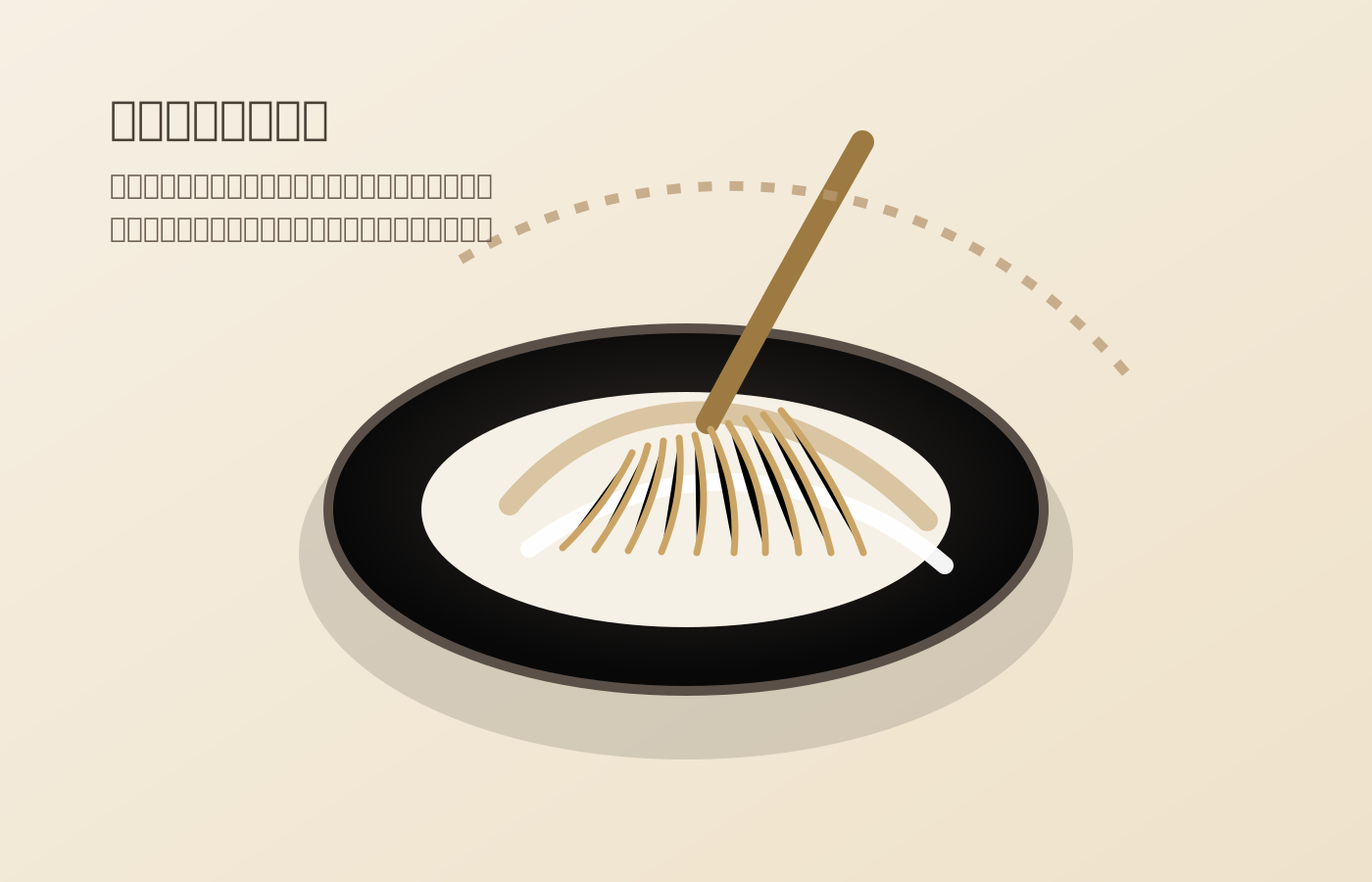
Many first-time viewers describe tea baixi as “painting on tea.” That is not wrong, but it misses the structure. Tea baixi is not an isolated decorative trick. It grows out of whisked tea itself. Before any image can appear, the tea surface has to be stable, fine-textured, and dense enough to carry water marks and foam patterns. In other words, first comes diancha, or whisked tea. Only then can baixi happen.
Historically, the practice is also described through related terms such as fencha, tangxi, or “water painting.” The common idea is simple: using only tea and water, without added pigments, a maker creates legible images or calligraphic traces on the surface of the bowl. The result may resemble clouds, mountains, flowers, fish, birds, or auspicious characters. What matters is not permanent representation but controlled emergence.
That temporary quality is central to its appeal. Tea baixi is neither a paper painting nor exactly the same as modern latte art. It depends on a surface that appears, holds for a moment, and then disappears. The delight comes from watching form arise from instability. It is a visual event built on evaporation, collapse, and timing.
2. Why is it tied so strongly to the Song dynasty? Because tea baixi belongs to a whisked-tea world, not a steeped-leaf world
To understand tea baixi, we have to return to Song whisked tea. The loose-leaf infusion style most drinkers now take for granted became dominant later. In the Song, an important elite tea practice involved processing compressed tea into fine powder, placing it in the bowl, adding water in stages, and whisking to produce pale foam. In that world, foam was not incidental. It was one of the key visible indicators of skill.
Once the tea surface itself becomes an object of judgment, refinement, and competition, tea baixi becomes imaginable. If drinkers care about foam density, color contrast, edge retention, and the technical control of the bowl surface, then making images on that surface is not a gimmick from outside tea culture. It is an intensification of what the culture is already doing.
That is why tea baixi should not be treated as a detachable flourish. It is an advanced extension of a foam-centered tea system. Without the Song sensitivity to whisking, bowl color, and surface behavior, tea baixi would not have had the historical conditions to flourish.
What supports tea baixi is not “decoration” but powdered tea, water temperature, and whisking control. Without that technical base, the image cannot hold.
3. Why do Jian bowls keep appearing in tea baixi revival imagery? Because they are part of the visual mechanism, not just props
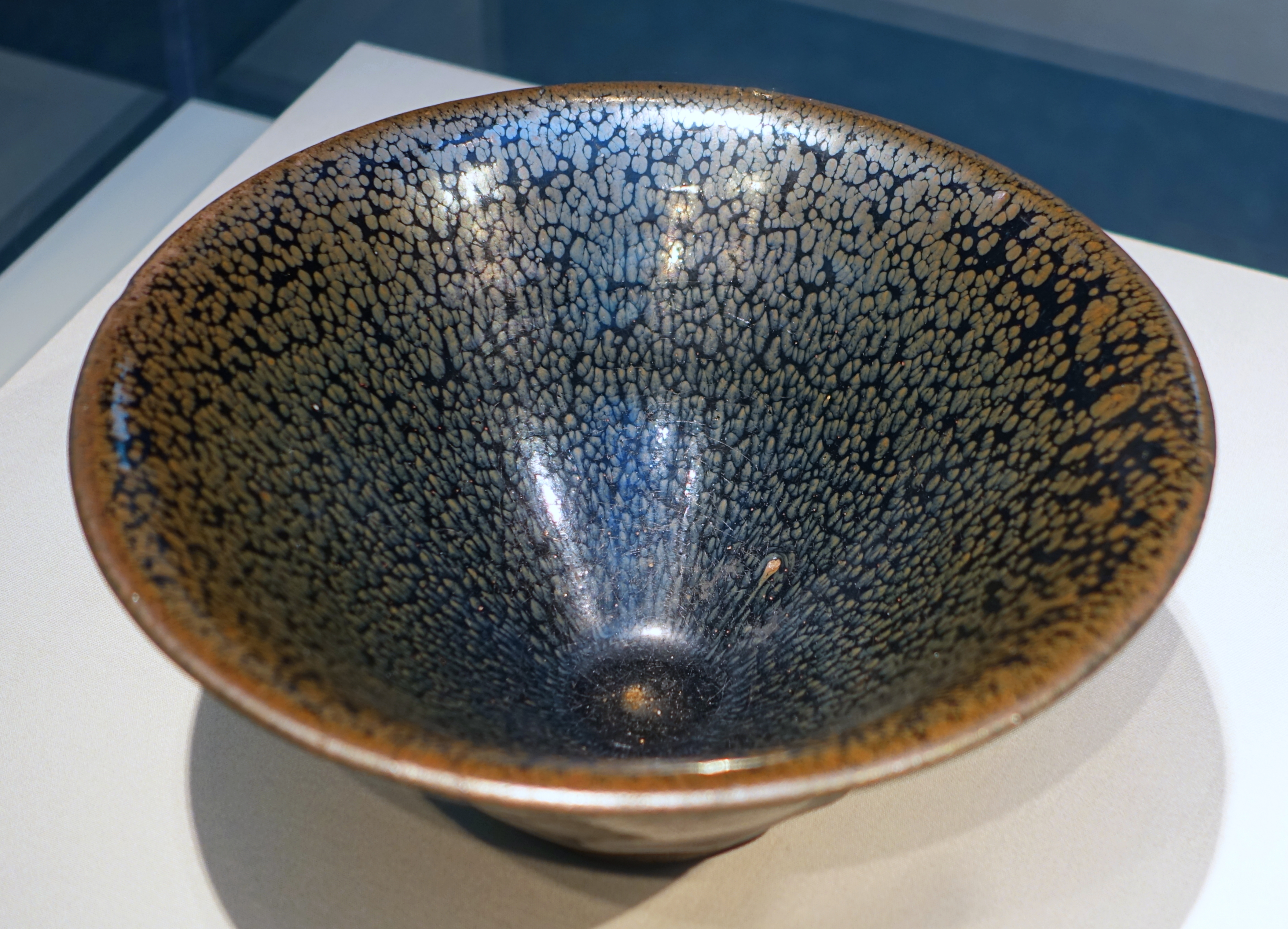
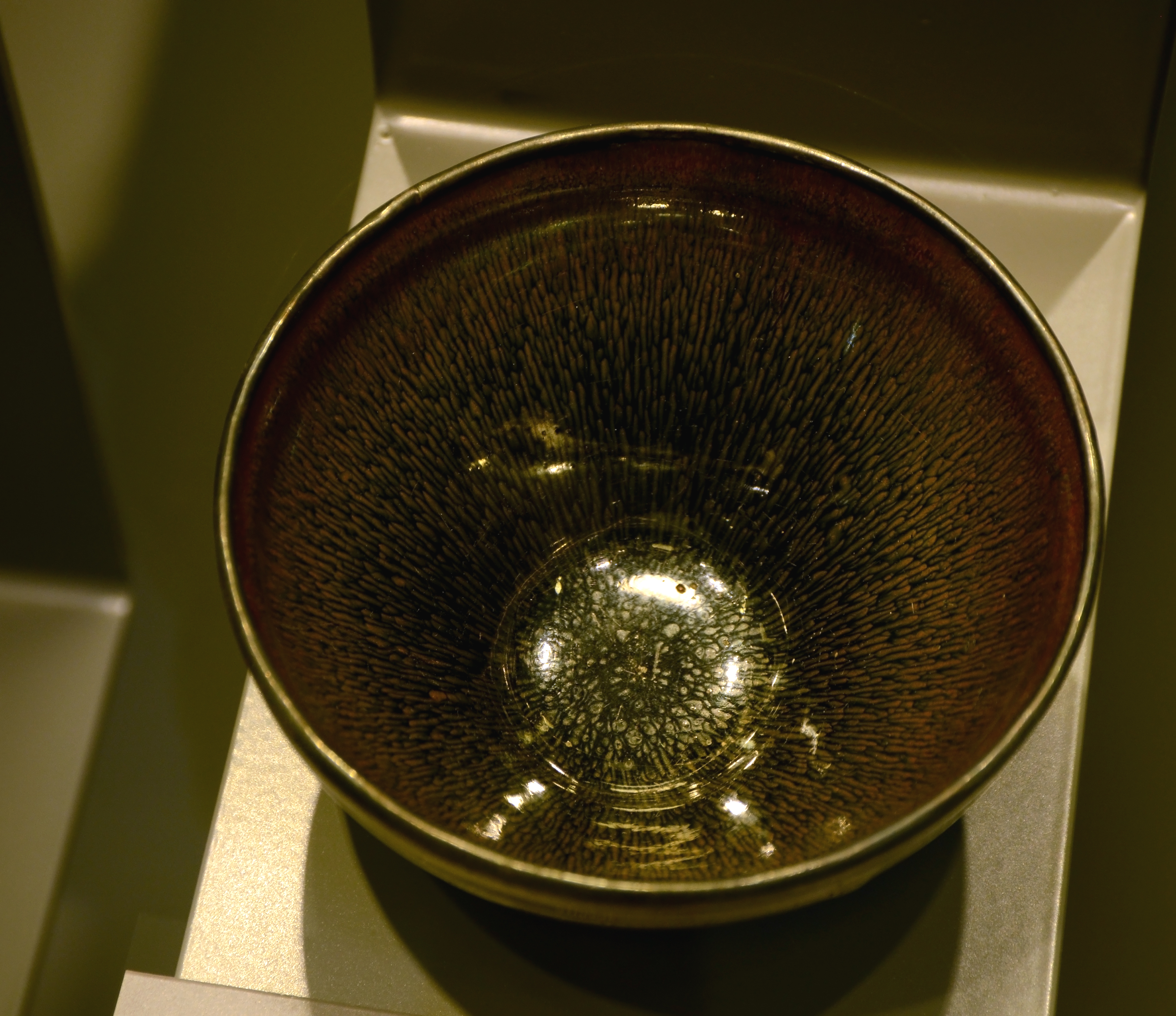
Whenever Chinese internet culture talks about Song whisked tea and tea baixi, Jian ware appears almost automatically. Part of that is fashion. But much of it is historical logic. Dark Jian bowls helped pale foam stand out. In a tea culture that paid close attention to the brightness, delicacy, and stability of foam, a dark-glazed vessel was not trivial. It made subtle differences visible.
For tea baixi, that contrast is even more important. The image emerges because the liquid surface can be seen. A dark bowl is not merely decorative “ancient style”; it is an optical support. Black or deep brown glaze makes the white foam and fine water traces readable from a distance and under changing light.
This also explains why tea baixi is unusually camera-friendly today. Some historically important tea practices are not visually self-explanatory. Their value lies in aroma, aftertaste, or long, slow procedural knowledge. Tea baixi, by contrast, is almost perfectly image-native: dark vessel, pale foam, visible motion, and a pattern forming in seconds. What was once a refined literati pleasure now also happens to fit platform aesthetics extremely well.
4. Why did it fade after the Song? Not because it was frivolous, but because the entire tea system changed
It is tempting to think that any interrupted tradition was simply forgotten or carelessly abandoned. Tea baixi faded for a more structural reason. The whisked-tea system that supported it gradually lost centrality as loose-leaf steeping spread and new tea preferences emerged. Once tea culture shifted toward leaves, infusion, aroma, repeated brewing, and different vessel logics, the tea surface was no longer the main stage.
That matters because tea baixi cannot be separated from the system that made it meaningful. When foam stops being one of the key sites of evaluation, the practice loses its wider cultural ground. It does not vanish because later people lack elegance. It weakens because they are drinking differently.
So when we look at tea baixi now, we should avoid imagining that “everyone in the past drank tea this way.” They did not. It was always linked to particular historical settings, technical expectations, and aesthetic priorities. Its importance lies in how densely it condenses the visual intelligence of the whisked-tea world.
5. Why has it returned now? Because contemporary culture wants a visible form of classicism
The return of tea baixi owes much to scholarship and reconstruction, but what pushed it into broad public visibility was a media environment hungry for experience and image. After the visual success of Song-themed drama and lifestyle content, whisked tea, tea whisks, Jian bowls, incense, flower arrangement, and literati interiors were reorganized into a mass-readable “Song style.” Tea baixi became one of the most effective moments in that package because it could deliver surprise immediately.
It is efficient culture in platform terms. Unlike historical systems that require long explanation, tea baixi can be understood at first glance: an image appears on tea. That first-glance readability is powerful. But it is not the whole story. Tea baixi lasts because it does three jobs at once: it offers historical depth, hand-made participation, and public display. Many revival formats manage one or two of those. Tea baixi manages all three unusually well.
That is why it fits contemporary experience culture so neatly. It lets participants feel close to history, but not only through reading. It lets them perform skill, but not only through expertise invisible to outsiders. And it produces a result that can be witnessed instantly by others in the room or on screen.
Today’s fascination with tea baixi is inseparable from vessel aesthetics. The bowl is not background decoration; it is part of the reconstructed historical feeling.
6. Why do younger participants like it? Because it turns tradition from something to memorize into something they can make happen
Many forms of heritage education remain abstract at the point of entry. People are first told what they should know, then asked to admire it. Tea baixi works differently. It lowers the threshold by making the first encounter bodily and visual. A participant does not need to master Song tea treatises before being moved. Once a pattern appears in the bowl under their own hand, history stops being remote vocabulary and becomes an event they helped produce.
That entry path is perfectly suited to the way many younger audiences approach culture now: first through image and action, then through deeper inquiry if the experience holds. Someone may arrive because the practice looks beautiful, then begin asking what whisked tea was, why Jian ware mattered, or why the system declined. That is not a shallow route. It is often the only workable route for serious historical curiosity to begin.
This is why tea baixi appears so often in youth gatherings, tea workshops, tourism spaces, and public heritage programming. It functions as a first key. It does not contain the whole of Song tea culture, but it can open the door.
7. Has it been over-shaped by internet aesthetics? Yes. That still does not erase its historical value
Tea baixi is undeniably vulnerable to flattening. Dress performers in Song-style robes, place a dark bowl on an old wooden table, add music, and many viewers will immediately read the scene as “cultured.” If the technique is used only as visual bait and the history is compressed into vague claims about refined ancients, then the result becomes shallow very quickly.
But that problem is not unique to tea baixi. Nearly every visible heritage revival now lives between reconstruction and commodification. The real question is not whether packaging exists, but whether the package still leads somewhere. A meaningful tea baixi encounter should at least leave room for three questions: why it depends on whisked tea, why vessel contrast matters, and why it declined once the tea system changed. If those lines remain visible, mass circulation does not necessarily damage the tradition. It can broaden the entry point.
Tea baixi today therefore sits in a familiar but productive tension. It belongs partly to non-heritage discourse and partly to experience commerce; partly to textual reconstruction and partly to platform amplification. It can become an empty check-in moment, but it can also become a genuine path into tea history.
8. What tea baixi really reveals is not only Song elegance, but why people today still want to see an image inside a bowl of tea
In the end, tea baixi is popular again not simply because people miss the Song, but because contemporary culture badly wants a form that can combine beauty, participation, and shareability in one brief scene. Tea baixi temporarily shifts tea from a taste event to a visual event. The bowl becomes something to watch, not just consume. The action serves not only drinking, but anticipation.
It also preserves a rare kind of fragility. Unlike durable craft, tea baixi disappears quickly. The image is there to be seen in a particular moment, not preserved forever. That evanescence is part of its power. In a world saturated with digital moments, people are still moved by forms that truly happen in front of them and only once. Tea baixi brings that kind of fleetingness back into shared physical space.
That is why its current revival matters. It reminds us how much Song tea culture valued attention, surface, tactility, and measured display. And it reveals something about the present too: even inside an accelerated media environment, people are still willing to pause for a bowl of white foam and watch a picture appear. If you want to continue along this line, read Tea whisks and the Song revival, The rise, decline, and return of matcha in Chinese history, and Why Jian ware became a signature Song tea vessel. Tea baixi is not an isolated trend word. It is one of the clearest modern returns of the Song whisked-tea world.