History feature
Why Song dynasty doucha was not just a simple contest: from Beiyuan tribute tea and Jian bowls to foam judgment and literati competition
When many people hear the term doucha today, they picture a vivid scene: two or more people comparing their whisking skills around a set of bowls, judging whose tea turns whiter, finer, and prettier. That image is not wrong, but if we stop there, the subject becomes too thin. What makes doucha historically important is not simply that it was lively. It mattered because it tied together several lines that were already maturing inside Song tea culture—Beiyuan tribute tea, powdered-tea processing, whisked-tea technique, Jian bowl use, foam judgment, literati sociability, and a consciousness of winning and losing—into a single structure that could be watched, compared, and discussed.
In other words, doucha was not a minor game attached to Song tea culture from the outside. It was one of the clearest forms taken by a highly mature tea world. It could only emerge once tea had been processed into sufficiently refined powder, once foam had become a recognized object of judgment, once the visual logic of white foam against dark bowls had stabilized, and once literati society was willing to treat technical distinction as part of elegant social life. Doucha was not entertainment outside tea culture. It was competition inside tea culture.
So the real questions here are not whether doucha looked fun. They are these: why did the Song dynasty, specifically, push tea culture to a point where it could be contested in this way? What exactly was being contested—not just whiteness, but far more? And why did doucha later fall from the mainstream while still returning so insistently in modern imagination? Once those layers are clear, doucha stops being a pretty label and becomes visible again as a crucial chapter in the history of tea technique, aesthetics, and social life.
1. Why doucha especially made sense in the Song
If we look back to the Tang, tea culture was already highly developed, and The Classic of Tea had already given Chinese tea a systematic intellectual framework. But the Tang world of boiled tea placed more emphasis on cake-tea handling, boiling order, water-stage judgment, and the overall rhythm of preparation and drinking. By the Song, with the development of powdered tea, bowl preparation, and whisking, the evaluative center shifted decisively toward the bowl surface. Tea was no longer simply prepared and drunk; it had to produce foam that was fine, even, and visually convincing. The tea surface became a primary site of judgment.
That shift was essential. Every competition requires a comparable object, and Song whisked tea created one. Was the foam white enough, even enough, stable enough, long-lasting enough? Did water traces appear too early at the edge? Did the surface hold or collapse? These made differences in skill visible to multiple observers at once. Doucha did not arise because people first wanted to compete and then happened to choose tea. It arose because whisked-tea technique had already made differences legible enough for competitive consciousness to grow naturally out of it.
That is why doucha depended on an entire technical background, not just on human competitiveness. Without mature whisked-tea technique, without close attention to foam, without stable vessel pairings and shared standards of judgment, doucha could never have cohered. It was not a game that could emerge equally in any tea age. It was a deeply characteristic result of the Song tea world.
2. What exactly was being contested
Today, short videos often present doucha as if it were a light visual performance: whisk the tea, make a pretty white surface, and whoever looks better wins. Put back into Song context, however, it was far richer than that. At least four things were being contested at once. First, the tea itself. How fine and clean the powder was, how strong the raw material and processing quality were—all of that shaped the final bowl surface. Second, water. The amount, temperature, timing, and rhythm of pouring were not trivial details. They were decisive conditions.
Third came hand technique: bowl preparation and whisking skill. When to build the paste, how to add water in stages, how to raise foam finely and spread it evenly, how to make it stand and last—these were the operational factors that separated levels of mastery. Fourth came judgment itself. Doucha was not only about doing; it was also about seeing. If those present did not know what counted as good or bad, what edge marks meant, what stable foam looked like, then no competition could truly exist. So doucha was both technical activity and trained evaluation.
In that sense, doucha was a way for Song tea culture to publicly display its own technical logic. It magnified differences that would otherwise remain hidden in an individual hand, a single bowl, or a fleeting moment, and brought them into a shared space of collective observation and judgment. It was never mere showing off. It brought tea-making, whisking, utensils, and aesthetic judgment to the front of the stage together.
3. Why Beiyuan tribute tea keeps appearing in narratives of doucha
Whenever Song doucha is discussed, Beiyuan tribute tea almost always appears. That is not because later writers wanted to decorate the topic with a more prestigious name. It is because Beiyuan truly represented the most refined and most institutionalized end of the Song world of compressed tea and powder tea. If tea itself is not sufficiently stable, fine, and comparable, doucha risks becoming mere accident. Once processing standards are raised, however, competition gains a firmer technical base.
This is also why texts like Record of Tea and The Daguan Tea Treatise matter so much. They do not merely tell us that Song people loved tea. They show that Song tea culture had already written powder quality, tea color, aroma, vessel logic, and whisking procedure into language that could be taught, compared, and corrected. Doucha became possible precisely because Song tea culture no longer accepted a vague standard like “good to drink,” but developed highly differentiated criteria.
So the relation between Beiyuan tribute tea and doucha should not be reduced to “elite tea for elite games.” It is better understood this way: institutionalized, refined, standardized tea production provided the material conditions for a cultural form that could compare, rank, and judge. Without those conditions, doucha would never have become the technically dense competition it did in the Song.
4. Why Jian bowls were nearly indispensable
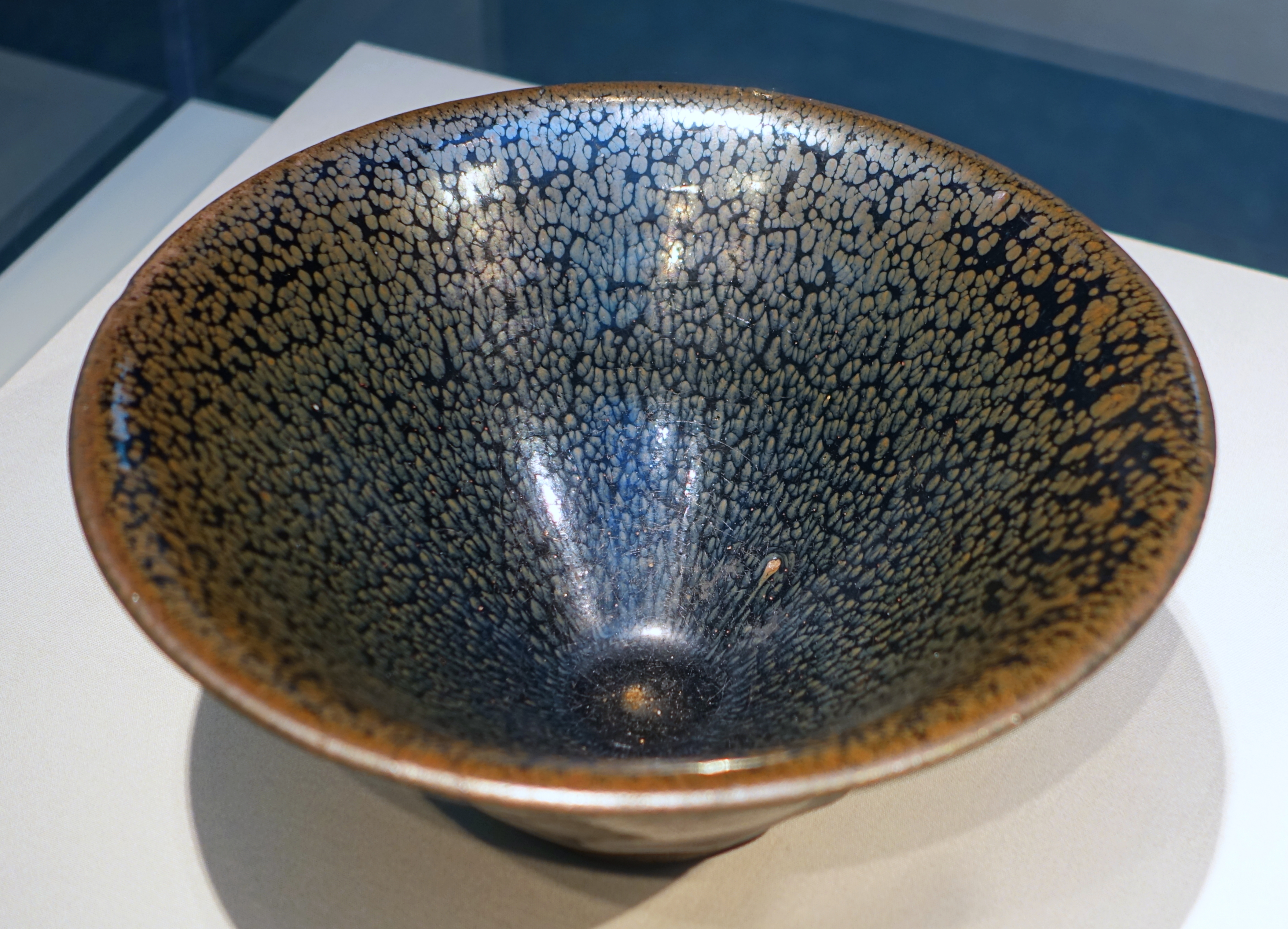
Today many people treat Jian bowls as emblematic objects of “Song-style” aesthetics. That is true enough. But in the history of doucha, their more important identity was as tools of judgment. Their dark glaze and strong internal contrast were ideal for setting off white foam. Was the foam truly white? Did it spread evenly? Did water traces appear too early at the edges? All of these became easier to see on a dark bowl surface. In other words, Jian bowls entered the center of doucha not because they were retro and beautiful, but because they were ideal for displaying differences clearly.
The logic is almost like that of a standardized examination surface. If competition exists, common visual conditions are needed. Dark Jian bowls supplied those conditions in the Song. They made subtle differences in foam easier to discern and helped produce consensus about quality. Without vessel support of this kind, many distinctions central to doucha would have been much harder to read consistently.
So the importance of Jian bowls in doucha is not merely a matter of vessel history or decorative taste. It is part of a technical-visual mechanism. Today people film bowls, white foam, and whisked tea and naturally feel that “the Song was so elegant.” A more precise statement would be this: Song tea culture had already built a visual system highly suited to comparison. Dark bowls holding white foam were not only beautiful; they were orderly.
5. Why doucha was both technical competition and literati sociability
If we treat doucha only as a contest among specialists, we again underestimate it. One reason it matters is that it entered literati gathering and social exchange. In other words, it was not just a technical test inside a production environment. It also belonged to the social world of educated elites. It turned tea into more than a quiet act of cultivated tasting; it became an activity around which distinction, judgment, and shared conversation could form.
This reveals something important about Song culture. Technique had not yet been pushed entirely beneath aesthetics. Knowing how to judge foam, choose bowls, prepare tea, and compete in doucha could itself become a kind of social capital within elegant gatherings. It was not “mere craft.” It was a recognized competence within the world of refinement. That is why doucha was not just lively. It was a structure in which technical excellence and social identity intertwined.
From this angle, doucha was not equivalent to performance. Performance mainly faces spectators. Competition implies that participants and judges are both present. And once doucha entered literati sociability, it gained another function as well: not only to produce a winner, but to generate shared topics, shared memories, and shared taste. One of the most attractive features of Song tea culture is precisely how tightly it braided technique, aesthetics, and sociability. Doucha was one of the clearest scenes in which that braid became visible.
6. Why doucha later receded
Like many Song practices tied to whisked tea, doucha did not fade because later generations suddenly found it superficial, nor because Chinese tea culture lost all interest in competition. The real cause was structural. From the Yuan and especially the Ming onward, loose-leaf infusion gradually became mainstream, and the center of tea culture shifted from powdered tea, whisking, and foam judgment toward leaf form, aroma, infusion rhythm, and the control of teapots and gaiwans. Once bowl-surface foam ceased to be the primary evaluative object, the competitive form built around it naturally lost its main arena.
In other words, doucha was not abolished by a single command. It was slowly emptied out by a broad historical turn. The new mode of tea drinking no longer centered on who could raise whiter or longer-lasting foam, but on who better understood the layered aroma of leaves, roasting changes, and infusion control. Once the standards that had supported doucha were no longer central, the practice itself could not remain central either.
This should also keep us from romanticizing doucha as if all premodern Chinese people drank tea this way every day. They did not. Doucha belonged to a particular historical configuration. Its importance lies not in ruling all of Chinese tea life, but in concentrating one powerful Song order of values: respect for powdered tea, whisked preparation, bowl-surface judgment, collective viewing, and technical comparison. Once that order shifted, doucha moved from the mainstream into history.
7. Why people keep talking about it again today
The modern return of doucha is obviously not the same thing as restoring the actual life structure of the Song dynasty. More often, it has been reorganized as a cultural scene: tea gatherings talk about it, whisked-tea classes teach it, Jian-bowl narratives use it, and film or short-video culture loves it as a marker of “Song-ness.” The reason is simple. Among Song tea elements, doucha is one of the easiest ways to compress a complex historical world into a scene modern audiences can grasp immediately. There is competition, there are viewers, there is suspense, there are dark bowls and white foam, and there is visible action. It is naturally suited to contemporary circulation.
But it deserves repeated attention not only because it circulates well. It also works as an excellent entry point into several core dimensions of Song tea culture at once. Once one starts explaining doucha, one is forced to explain whisked tea, Jian bowls, Beiyuan tribute tea, foam and edge marks, literati gatherings, and technical judgment. In that sense, doucha functions as a remarkably efficient general portal. It is not the whole history, but it pulls many of the key lines into view simultaneously.
That is one of its greatest values today. Instead of presenting Song tea culture as a static chain of terms, doucha offers a dynamic structure: how tea was made, how it was prepared, how it was seen, how it was compared, and how it entered sociability. It makes history live again not only because it is visually strong, but because it is structurally rich.
8. What is really worth retelling today
If I had to reduce this whole subject to one short conclusion, I would put it like this: what is most worth retelling about doucha is not the fact of winning and losing, but the way it lets us see how Song tea culture fused together things we often separate today. Technique was not merely technical; it had to be visible. Aesthetics were not merely aesthetic; they were grounded in craft judgment. Sociability was not empty talk floating above skilled practice; it could unfold around the outcome of a single bowl. Doucha compressed all three layers into one scene.
That is why doucha should not be treated as a decorative fragment of Song history. It is a window into the structure of Song tea itself. Through it, we understand more clearly why Record of Tea and The Daguan Tea Treatise cared so much about utensils and foam, why tea whisks and whisked tea are being reimagined today, and why tea play and surface-image traditions appear so “camera-ready” in modern revival. These are not isolated phenomena. They were always different faces of the same world.
So doucha should not survive today merely as a pretty old-style label. What it really reminds us is that Chinese tea history once contained a moment when drinking tea was not only about ingestion, but about a combined activity of hand, eye, vessel, foam, judgment, and sociability. For a history section, that is exactly what makes it worth writing.
Continue reading: Why Record of Tea deserves rereading, Why The Daguan Tea Treatise became the standard text of the Song whisked-tea world, Tea whisks, whisked tea, and Song drinking order, and Why tea play has become visible again today.
Source references: written from general historical knowledge of Song whisked tea, doucha, Beiyuan tribute tea, Jian bowls, and related tea texts, together with the site’s existing articles on Record of Tea, The Daguan Tea Treatise, tea whisks, tea play, and the Ming shift toward loose-leaf tea. The emphasis here is on the structural meaning of doucha, not on line-by-line textual annotation.