Teaware Feature
Jianzhan: black glaze, hare’s fur, and the afterimage of Song tea aesthetics
Jianzhan has returned to contemporary tea culture not only as a beautiful dark bowl, but as a vessel through which many drinkers try to reconnect with Song-era tea imagination, ceramic seriousness, and a slower, more tactile relationship with tea. Chinese-language discussion around Song-style tea, whisked tea, ceramic collecting, and black-glaze revival has made Jianzhan visible again, yet the bowl is still often misunderstood. It is treated either as a mysterious luxury collectible or as a simple black cup with dramatic texture. In reality, Jianzhan matters because it sits at the meeting point of firing chemistry, tea aesthetics, bowl geometry, historical use, and present-day desire.
Jianzhan bowls are loved today not merely because they are beautiful, but because they seem to carry a historical charge. Their dark glazes, hare’s-fur patterns, oil-spot surfaces, and inward depth instantly connect the tea table to older aesthetic worlds, especially the Song-era imagination around whisked tea, foam contrast, and concentrated visual attention.
Even many modern drinkers who do not actually practice whisked tea are drawn to Jianzhan because it makes the tea table feel older, quieter, and more storied. It is a vessel through which historical atmosphere re-enters contemporary taste. But that atmosphere is not accidental. It comes from the way glaze, firing, bowl form, and tea method once worked together.
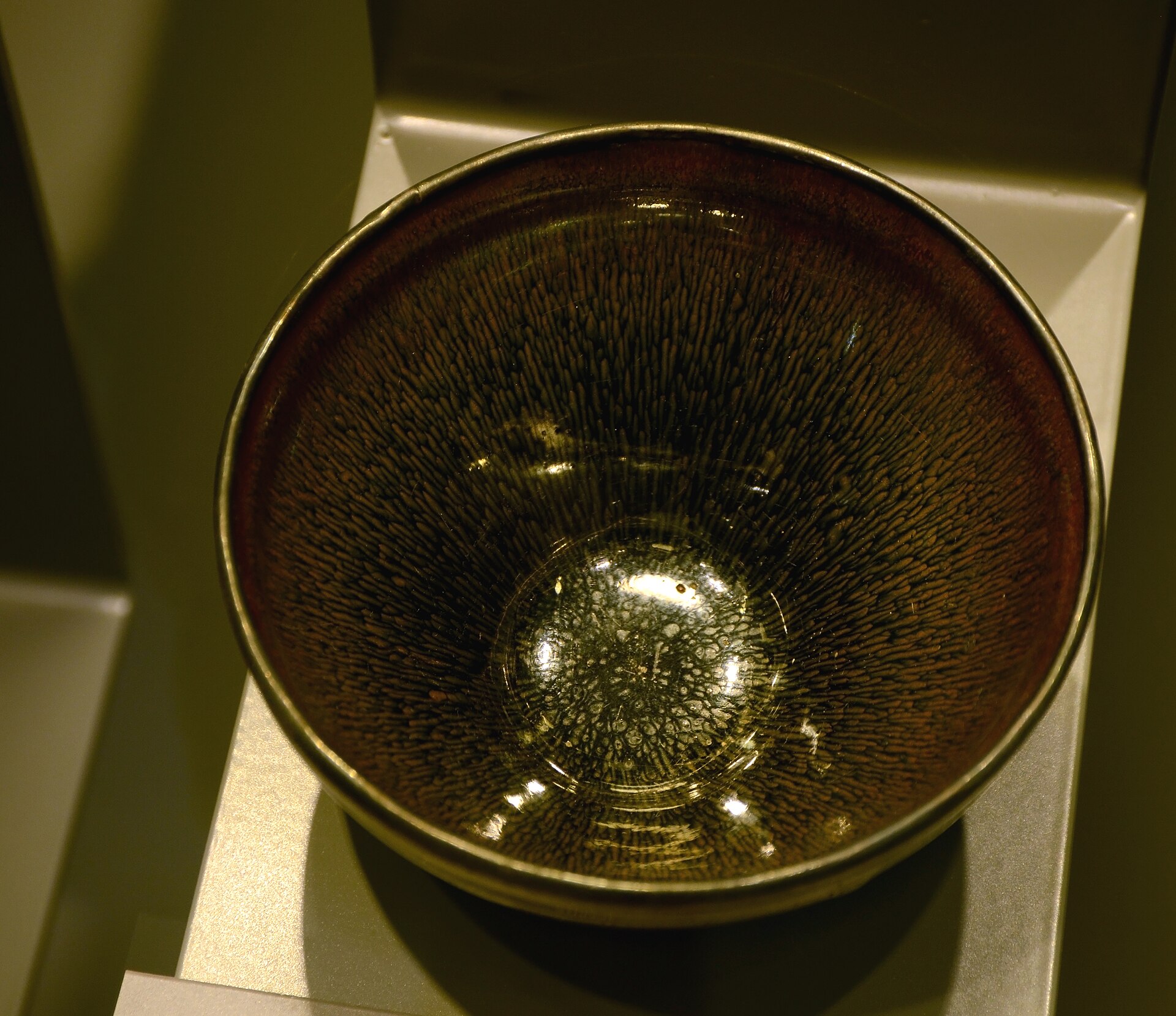
1. What Jianzhan actually is
Strictly speaking, Jianzhan refers to black-glazed tea bowls associated with Jian ware, especially those historically produced in the Jian kiln region of Fujian and strongly connected to Song-dynasty whisked tea culture. The bowl is not defined only by color. It is defined by a broader ceramic logic: iron-rich clay bodies, dark glazes, high-temperature firing, and surfaces that often develop directional or speckled effects through kiln conditions rather than painted decoration.
That matters because many contemporary buyers reduce Jianzhan to appearance alone. If a bowl is dark and dramatic, they may call it Jianzhan. But the real identity of the bowl depends on material, firing behavior, and historical use. Jianzhan is not simply a style label for any black tea bowl. It belongs to a specific ceramic lineage and a specific way of understanding what a tea bowl should do.
It is also worth remembering that the bowl was never only a collectible object. It began as a working tea vessel. Its later aura depends on use history, not the other way around.
2. Why Jianzhan is tied so closely to Song tea culture
Dark bowls made practical and visual sense in whisked tea culture because they set off foam, pale tea froth, and tiny surface details. In Song tea practice, where visual discrimination mattered and the bowl was part of an evaluative scene, a dark interior intensified contrast. Foam could be seen more clearly. Surface texture became legible. The bowl helped turn tea into something observed as well as tasted.
This is why Jianzhan is more than a container. It belongs to a method of seeing tea. The bowl teaches the eye to notice light, whiteness, movement, and instability against darkness. That older logic still shapes how people admire these vessels today, even when the exact historical tea method is absent. Many modern users are really borrowing the visual grammar of Song tea culture, whether or not they name it explicitly.
That also explains why Jianzhan so often appears alongside renewed interest in tea whisk culture and Song-style tea revival. Once whisked tea returns as a visible practice, the bowl that once made that practice legible returns with it.
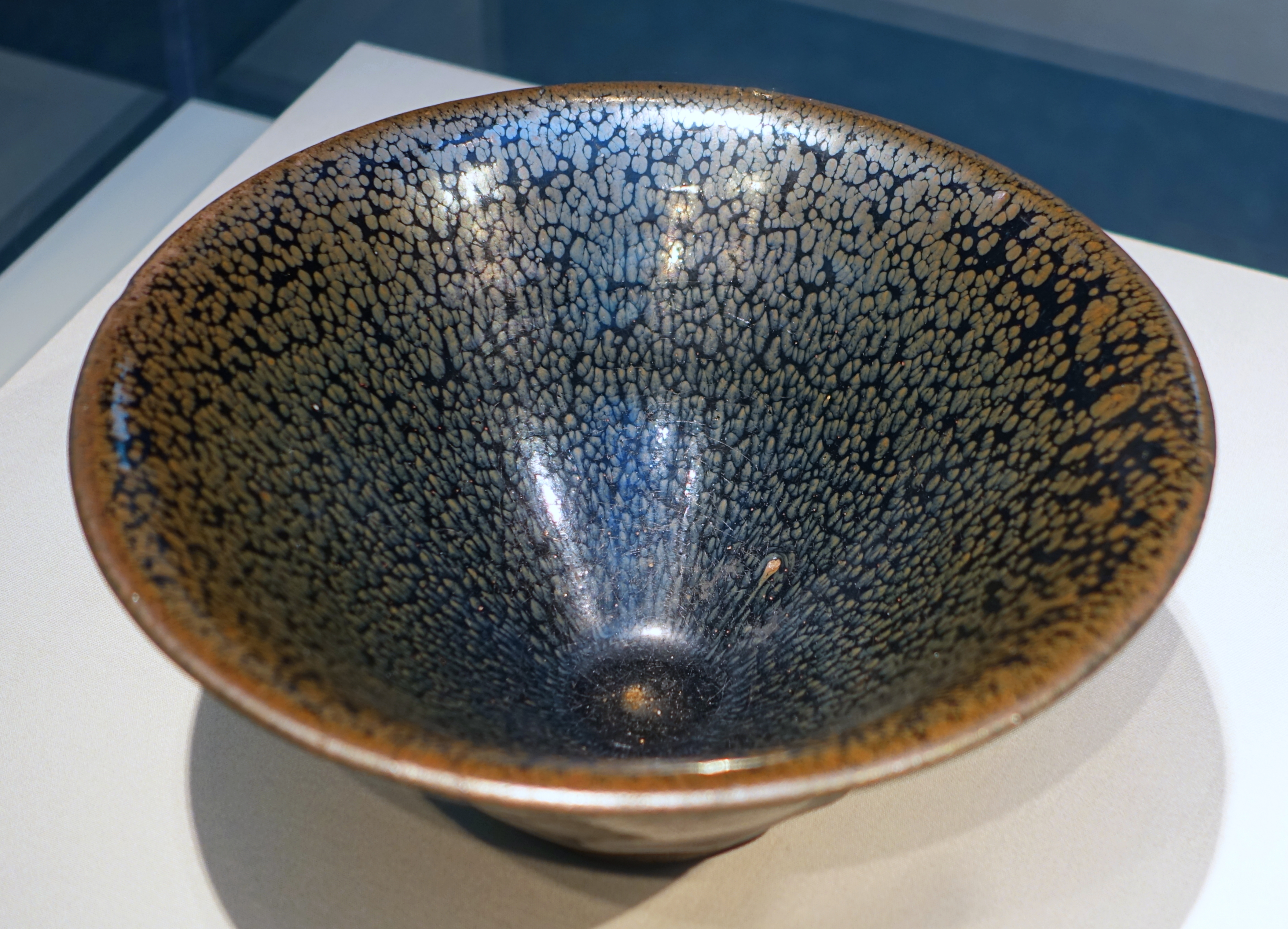
3. Why black glaze is never just “black”
People unfamiliar with Jianzhan often see only a dark bowl. But the most admired examples are not visually flat. They are full of internal variation. Hare’s-fur streaks, oil-spot effects, silvery or rust-like flashes, and shifting reflections all show that the glaze is active. The bowl changes under light, under tea, and under the angle of the hand.
This visual activity is one reason Jianzhan remains so compelling. A white porcelain bowl often communicates clarity through openness. Jianzhan communicates complexity through depth. It seems to hold more than it reveals at first glance. That hiddenness is central to its appeal. The glaze does not shout. It rewards looking.
For many contemporary tea drinkers, this is exactly the attraction. Jianzhan offers a dense visual experience without requiring applied ornament. The drama comes from kiln effect, not from added decoration. That makes the bowl feel both natural and rare: the surface appears to have emerged rather than been imposed.
4. Hare’s fur, oil spots, and kiln effect: why the surface matters so much
Chinese discussion of Jianzhan often turns quickly toward pattern names, and that can make the bowl seem like a taxonomy problem. But the deeper issue is not naming effects for their own sake. It is understanding that Jianzhan’s visual language comes from firing behavior. What people admire in hare’s-fur streaking or oil-spot effects is the record of high-temperature glaze transformation.
That is part of why Jianzhan is so often discussed with an almost reverent tone. The bowl appears to hold a visible history of fire. It does not just show an image. It shows an event. Even for readers who are not collectors, that difference matters. It helps explain why a Jianzhan bowl can feel more alive than a bowl whose beauty depends mainly on painted pattern or static shape.
At the same time, pattern obsession can become a trap. If viewers focus only on named effects, they may miss proportion, lip comfort, foot stability, interior depth, and whether the bowl actually works for tea. Jianzhan is not only a glaze display platform. It is still a bowl.
5. Why bowl shape matters as much as glaze
A good Jianzhan cannot be understood only by surface. Bowl geometry shapes the whole experience. The flare of the rim, the depth of the body, the curve of the wall, the weight in the hand, and the way the lip meets the mouth all change how the vessel functions. In whisked tea, these factors influence working space, liquid movement, and how the surface is seen. In modern drinking, they influence comfort, heat concentration, and the balance between visual presence and practical use.
This is another place where new buyers often get distracted. Dramatic glaze can make people forget to ask whether the bowl is pleasant to lift, stable to place, or reasonable in scale for actual drinking. Some bowls are admired more than used. Others are used more than admired. The most satisfying examples usually hold both qualities together.
That is one reason Jianzhan sits slightly differently on the tea table from more neutral vessels such as a gaiwan. A gaiwan is often valued for adaptability and transparency of method. Jianzhan is more concentrated. It gathers attention. It changes the emotional center of the table simply by being there.
6. Why Jianzhan feels so contemporary again
Its revival is not only antiquarian. Jianzhan fits several current tastes at once. It suits the renewed attention to Song-style tea practice. It fits the broader appetite for handmade-looking ceramic surfaces. It works well in photography and short-form video because the glaze responds dramatically to shifting light. And it satisfies a contemporary desire for objects that feel materially serious rather than merely polished.
Chinese internet discussion has also helped move Jianzhan out of specialist collecting circles and back into wider tea culture. More people now encounter the bowl through brewing videos, ceramic studio content, Song-style tea demonstrations, and comparisons of kiln effect rather than only through antique or auction language. That broader visibility changes the bowl’s role. It becomes not just a collector’s object but a shared visual reference in current tea aesthetics.
Even so, the present-day revival carries tension. Some people want Jianzhan as a usable tea bowl. Others mainly want a symbolic object that imports historical depth into a modern setup. Both desires are real, and much of the bowl’s current popularity comes from sitting between them.
7. The biggest misunderstandings around Jianzhan today
Mistake one: Jianzhan is simply any black tea bowl. This erases its kiln lineage, material logic, and historical context.
Mistake two: the more dramatic the surface, the better the bowl. Spectacle is not the same thing as ceramic quality or drinkability. A bowl still has to sit well, feel right, and function as a vessel.
Mistake three: Jianzhan is only for collectors. While some examples belong firmly to collecting culture, the bowl itself began as working teaware and can still be approached through use, not only prestige.
Mistake four: owning a Jianzhan bowl automatically means understanding Song tea culture. The bowl may open a door to that world, but it does not replace the study of method, historical context, or tea practice.
Mistake five: Jianzhan is universally suitable for all tea situations. It has strong visual force. That can be exactly right in some settings and too heavy in others. Not every tea table needs the same emotional density.
8. How Jianzhan changes the mood of a tea table
Different vessels organize attention differently. Porcelain often clarifies. Glass reveals. Yixing softens through clay intimacy. Jianzhan deepens. It makes the table feel inward, concentrated, and historically shadowed. Even one dark bowl can change the visual weight of a whole arrangement.
That is why Jianzhan is often paired carefully rather than casually. The bowl can easily dominate. On some tea tables, that intensity is the point. On others, it requires restraint in the surrounding objects. If everything around it also pushes too hard for drama, the arrangement becomes visually loud. If nearby objects are calmer, Jianzhan can serve as the anchor that gives the table gravity.
In this sense, Jianzhan is not only a bowl but an aesthetic decision. Choosing it means choosing a denser atmosphere. It asks the rest of the table to respond.
9. Why Jianzhan is worth understanding seriously
Jianzhan deserves more than shallow admiration because it reveals something central about Chinese tea culture: tea vessels are never just supports. They carry method, history, social tone, and ways of seeing. A bowl can shape taste indirectly, but it also shapes attention directly. Jianzhan is one of the clearest examples of that truth because its significance cannot be separated from visual contrast, firing effect, and historical tea practice.
To understand Jianzhan is to understand why tea culture repeatedly returns to certain objects even after habits change. The exact Song world is gone, but the longing for concentrated looking, tactile seriousness, and kiln-made beauty remains. That is why Jianzhan continues to attract modern drinkers. It offers not only a vessel, but a compact image of how ceramic depth, tea method, and historical imagination can still meet in one bowl.
Related reading: Why the tea whisk has become popular again, Jingdezhen and Chinese teaware, and What a gaiwan really is.
Source references: Wikipedia: Jian ware, Wikipedia: Song dynasty, Chinese Wikipedia: Jianzhan.