Why Jian tea became the national center of Song tea culture: how Beiyuan tribute tea, dragon-phoenix tea cakes, doucha, Jian bowls, and tea texts converged
Created: · Updated:
When people think about Song tea history, the first things that usually come to mind are doucha, whisked tea and tea whisks, The Daguan Tea Treatise, Jian bowls, or the whole aesthetic world built around white foam on the tea surface. But if we push one layer deeper, a more basic question appears: why was Jian tea, rather than some other regional tea, standing at the center of all this? In other words, why did the national center of Song tea culture come to revolve so heavily around Jianzhou, Beiyuan, dragon-phoenix compressed tea cakes, and the Jian’an-Jianxi zone? This is a harder question than simply asking what Song people liked to drink, because it is about how a center was actually made.
Jian tea matters not only because it was famous, and not only because emperors favored it. The real point is that it occupied several positions that did not have to coincide: it was a tribute-tea center, a center of highly refined compressed-tea craftsmanship, one of the most weighty reference points in the evaluative world of doucha, and the tea most tightly linked to dark-glazed Jian bowls, white foam aesthetics, whisked-tea technique, and Song tea writing. Put simply, Jian tea did not win in just one dimension. It won across institutions, craft, texts, vessels, and taste.
That is exactly why Jian tea should not be written merely as a kind of prehistory to later Fujian famous teas. It is actually one of the best keys for understanding how Song tea culture formed a national center. Without Jian tea, many of the Song tea scenes we now treat as familiar—from Beiyuan tribute tea to doucha contests, from Record of Tea to The Daguan Tea Treatise, from compressed-tea craftsmanship to the use of Jian bowls—would lose their common pivot. The Song whisked-tea world became a coherent order largely because Jian tea pulled all of these otherwise separate elements together.
Jian tea became central not simply because it “tasted good,” but because it was embedded at the same time in tribute-tea institutions, whisked-tea technique, foam aesthetics, and Jian-bowl usage. It grew almost together with the most important lines of Song tea culture.
1. Why this subject deserves its own article: because the “center” of Song tea culture cannot remain an abstract matter of taste
Many accounts of Song tea focus on claims like “Song people were refined,” “whisked tea was elaborate,” “doucha was lively,” or “Jian bowls were beautiful.” All of those statements are true, but they can also leave history floating in the air as a kind of style study. The real issue is that a national tea-cultural center could never exist without a concrete base. It had to land somewhere—in a producing region, in a craft system, in institutional arrangements, and in a repeated textual language. In the Song, that place was Jian tea.
Without explaining Jian tea directly, many Song tea phenomena remain only loosely connected nouns: Beiyuan tribute tea as one thing, doucha as another, Jian bowls as another, Cai Xiang and Emperor Huizong writing tea texts as yet another. But once Jian tea is brought into focus, those things stop looking parallel and start looking tightly linked. Jian tea supplied the tea itself, Beiyuan supplied the institutional center, doucha supplied a competitive and evaluative social form, Jian bowls supplied the most suitable visual vessel, and tea texts wrote all of that into language that could be taught, compared, and spread.
So what this article really tries to restore is the layer of how a center forms. Song tea culture did not simply become refined in some vague collective way. The productive, tributary, technical, textual, and material chain around Jian tea gradually pushed itself into a national center. Once that is clear, Song tea history stops looking like a pile of elegant symbols and starts looking like a structured world.
2. What exactly was Jian tea? Not a single tea name, but an entire refined tea world centered on Jianzhou, Jian’an, Jianxi, and Beiyuan
If the term “Jian tea” is used too casually, it can sound like the name of a single famous tea, as if it belonged to the same category as simply naming Longjing or Tieguanyin today. That is misleading. In the Song context, Jian tea is closer to a whole refined tea world centered on the Jianzhou region, especially the Beiyuan system, with highly processed compressed tribute tea at its core. It was at once a regional label, an institutional label, a technical label, and a cultural one.
This matters because Jian tea became powerful not through one single product that suddenly grew popular, but through the maturation of a regional high-end tea system. Beiyuan tribute tea, dragon-phoenix tea cakes, large and small dragon cakes, the associated steaming, paste-making, pressing, and firing processes, and the social prestige and evaluative language built around them all together formed the real weight of what Song people meant by Jian tea. Its importance did not rest on a loud name. It rested on a complete order of sustained production, sustained tribute, and sustained textual attention.
In other words, Jian tea was not an isolated tea name but the most stable center of the high-grade tea world in the Song. Because it was a system rather than an accidental product, it had the capacity to dominate other regions for a long time and become a national standard of reference.
3. Why Beiyuan tribute tea became the first pillar of Jian tea’s central status: because the state kept fixing the highest-grade tea there
The first layer of Jian tea’s centrality clearly came from the tribute-tea system, especially the durability of Beiyuan tribute tea. Once one producing region is repeatedly treated by the court as the main source of the highest-grade tribute tea, it ceases to be merely a local excellent tea zone. It becomes a national benchmark of rank. The key thing about Beiyuan is not that it was once used for tribute, but that it occupied the core of tribute production in a stable, institutionalized, long-term way. Every year, the court’s repeated linking of the most valued teas with this place acted as a powerful amplifier of hierarchy.
The effects went much deeper than mere reputation. Tribute status meant that workmanship had to be continually raised, harvesting windows had to be tightly controlled, quality judgment had to be increasingly refined, and the whole production organization around the tea had to become more demanding. In other words, the tribute system did not simply attach a prestigious label to Beiyuan. It actively pushed Jian tea toward an extreme level of refinement. Later, when Jian tea became central to whisked tea, doucha, tea writing, and vessel aesthetics, that development rested first on the pressure and support of this institutional structure.
So the importance of Beiyuan should not be understood merely as “imperial endorsement.” More precisely, it kept Jian tea inside the strongest mechanism in the empire for reinforcing quality and symbolic rank at the same time. Other producing regions may also have made excellent tea, but very few could enjoy this kind of sustained central institutional backing.
The real force of Beiyuan tribute tea was not only that it brought Jian tea into the palace, but that it kept Jian tea fixed inside the highest order of production, selection, and judgment. Its centrality was first made institutionally.
4. Why dragon-phoenix tea cakes became the second pillar: because Jian tea was not simply “good tea,” but tea whose craft complexity had been pushed extremely high
If Beiyuan gave Jian tea its institutional center, dragon-phoenix tea cakes and the associated high-grade compressed-tea workmanship gave it a technical center. Jian tea dominated not only because it was offered as tribute, but because the kind of compressed tea it represented was extraordinarily complex, refined, and costly. It was not just picked, processed, and sent onward. It passed through highly controlled harvesting, steaming, paste-making, molding, firing, packing, and transport orders, finally emerging as a product that was deeply artificial in the strong sense: highly worked, highly standardized, and highly symbolic.
That is crucial because tea becomes much more likely to define a national standard once it has become a high-technology product in this historical sense. Mere pleasant taste may not secure durable authority. But when tea is made into something requiring intricate labor, difficult replication, and the joint support of institutions and resources, its central position becomes harder to challenge. Dragon-phoenix tea cakes show exactly that. They pushed Jian tea from being an excellent regional product into a high-grade crystallization of craft.
That is why speaking of Jian tea in the Song often means speaking not just of a region, but of a whole world of highly disciplined compressed-tea manufacture loaded with symbolic force. Jian tea was not “naturally the best.” It was made into something of extremely high rank. That manufactured rank is one of the key reasons it became central.
5. Why doucha pushed Jian tea even further into the national center: because Jian tea could become not only tribute, but a visible standard of victory and defeat
Tribute tea alone might still have left Jian tea mainly as a court center. What truly carried it into broader social imagination was doucha. The importance of doucha is that it brought high-grade tea, which might otherwise have remained meaningful mainly inside institutions, into a visible culture of comparison, contest, and judgment. Once Jian tea became a major reference point within the world of doucha, its authority was no longer only a matter of imperial preference. It became something no serious tea knower could avoid.
That change was substantial. Tribute tea tells us how elite power ranks things. Doucha tells us how social evaluation forms. If Jian tea had remained merely a refined product for palace use, it would have been prestigious, but not necessarily enough to govern the larger Song imagination of tea. Once it entered doucha and became fundamental to foam quality, color, endurance, and technical performance, however, it gained much broader cultural persuasive power. In short, Jian tea moved from being the highest-grade offering to being the tea most capable of representing evaluative standards themselves.
That is why Jian tea and doucha are so hard to separate in Song tea history. The former provided the high-grade material and technical basis; the latter converted that high grade into a socially visible structure of winning and losing. Once a center becomes visible, it becomes harder to dislodge. Jian tea gained exactly that kind of visible centrality through doucha.
6. Why Jian bowls were bound so tightly to Jian tea: because the white-foam aesthetic of the Jian tea age needed dark bowls to make it visible
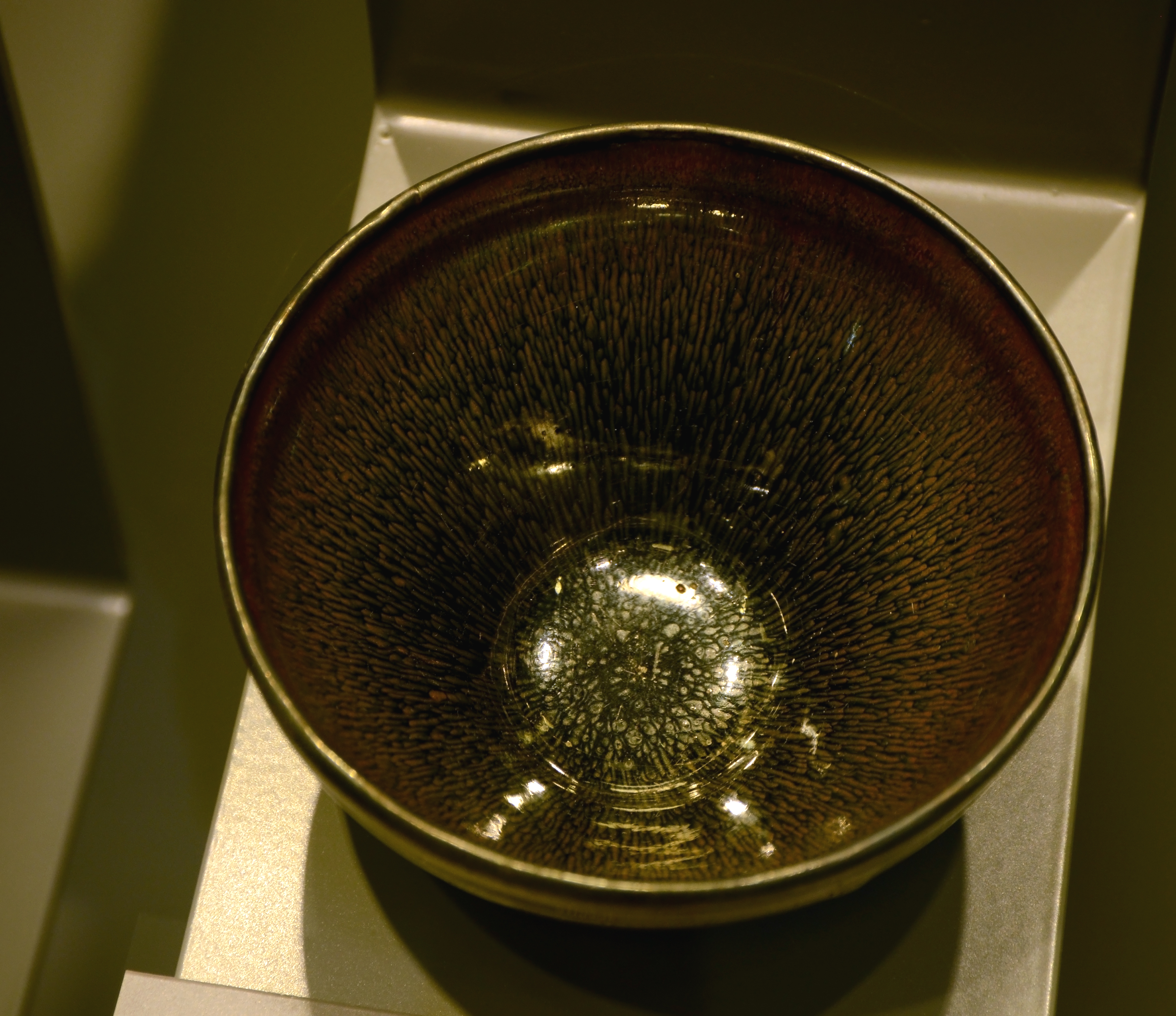
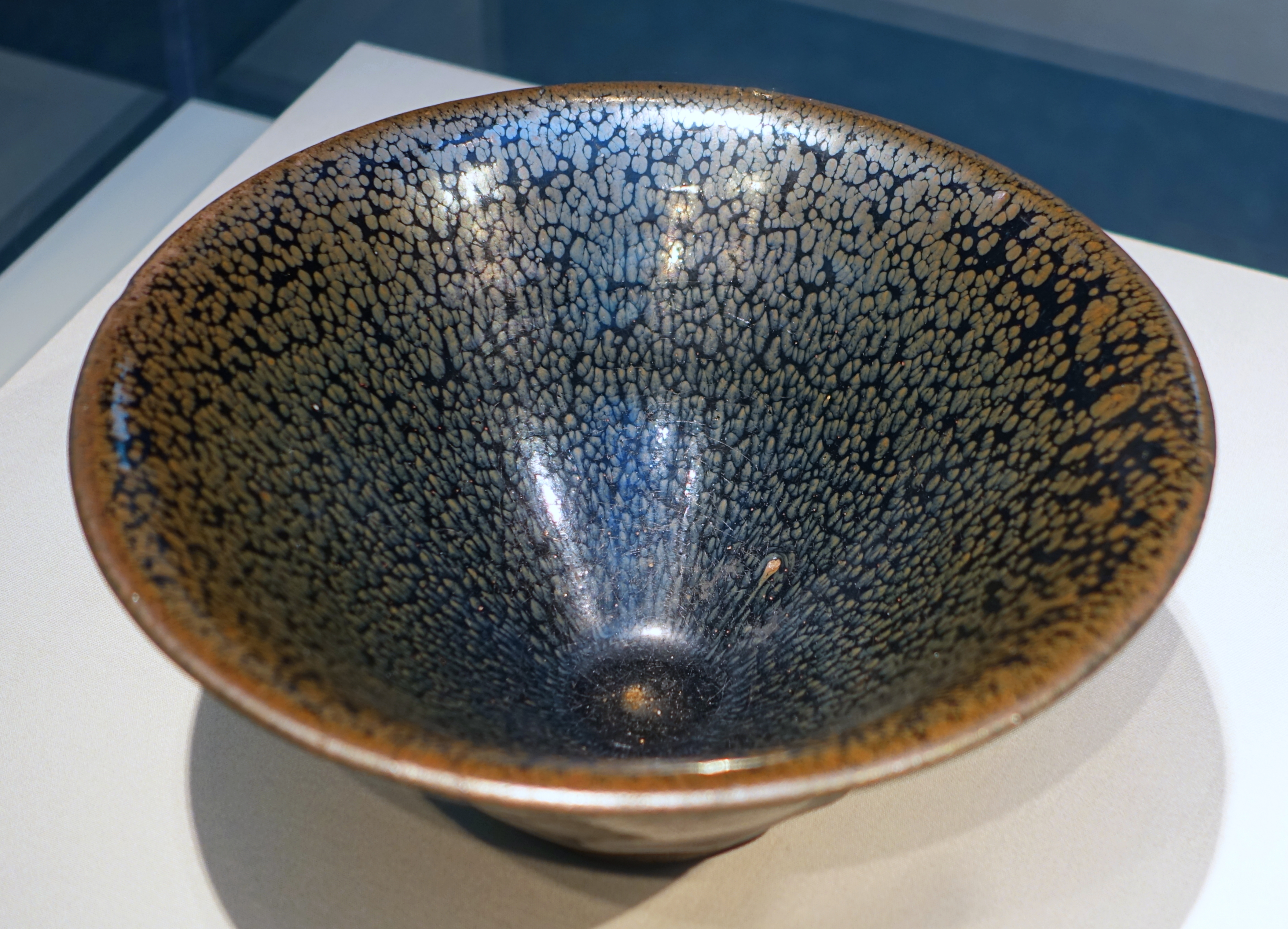
Jian tea cannot be treated as an isolated tea-history subject because it formed an unusually strong reciprocal relation with Jian bowls. In the age of whisked tea and doucha, judging whether foam was white enough, even enough, and stable enough depended on the visual support of a dark bowl interior. In other words, Jian bowls were not later decorative additions attached to Jian tea for the sake of “Song-style aesthetics.” They were the most effective visual instrument for making the white-foam aesthetic of the Jian tea world legible.
This fixed Jian tea’s centrality even more firmly in material culture. Many regional teas may become famous, but they do not necessarily form such a strong tea-vessel coupling. Jian tea did. It was bound almost naturally to dark-glazed Jian bowls, the look of whisked tea, and the judgments of doucha. As a result, Jian tea did not dominate only taste and institutional prestige. It began to dominate visual order as well. The moment one speaks about white foam, dark bowls are nearly unavoidable; and once one asks what tea world most suited those dark bowls, Jian tea returns immediately to the center.
This matters because truly powerful cultural centers usually do not produce only valued content. They also produce the vessel systems best suited to carrying that content. Jian tea and Jian bowls form exactly this kind of rare high-intensity pairing: the tea raises the vessel into a standard, and the vessel enlarges the tea’s aesthetic logic into a national visual consensus.
Jian bowls were not a side branch of the Jian tea age. They were one of the main visualization tools of that cultural center. Dark bowls carrying white foam made Jian tea’s advantages not only drinkable, but visible.
7. Why texts like Record of Tea, Dongxi Shicha Lu, and The Daguan Tea Treatise made Jian tea’s centrality increasingly stable: because once a center enters texts, it becomes a discourse order
Another frequently underestimated reason Jian tea moved from regional center to national center is that it was repeatedly written into tea books—and not just into ordinary local records, but into texts that helped define evaluative language, technical standards, and the meaning of refinement itself. Works such as Record of Tea, Song Zi’an’s Dongxi Shicha Lu, and The Daguan Tea Treatise do not merely mention Jian tea. They help restate what good tea is, what good whisked tea is, and what kinds of vessels are most appropriate—and the answers repeatedly circle around the Jian tea world.
What does that mean? It means Jian tea stopped being merely the strongest producing region in reality. It became a setter of standards in language. For any producing region to become a true national cultural center, having good goods is not enough. Others must also learn to speak, judge, and compare through its terms. Jian tea achieved exactly that step. Tea books wrote the Jian tea world into a textual order that could be imitated, taught, and quoted, which means its influence expanded far beyond the producing region itself.
That is why Jian tea’s greatest strength was not only production or quality, but its simultaneous hold over both the real center and the discursive center. Once those two merge, dominance becomes extremely strong. When later readers try to re-enter Song whisked tea, they are often re-entering a language system whose shape Jian tea helped create.
8. Why other teas did not surpass Jian tea in the Song: not because other regions lacked good tea, but because very few could unite institutional, technical, material, and textual centrality at once
To say that Jian tea was central is not to say that only Jian tea was good. The key issue is not that other teas were poor, but that very few other regions could hold so many kinds of centrality at the same time. A place may enjoy strong natural quality but lack tribute backing. Another may have local fame but not enough textual amplification. Yet another may produce excellent tea but fail to generate a vessel system strongly bound to it. Still others may enter markets but never become national standards in doucha or whisked tea.
Jian tea is rare precisely here: it did not become central because one thing about it was unusually strong, but because multiple factors necessary for centrality came into place at once. The state pushed it upward, craft refined it continuously, society evaluated it competitively, vessels suited it perfectly, and texts kept enlarging it. Such a structure—many lines all becoming central together—was very difficult for other Song tea regions to reproduce. Jian tea did not become central because of temporary fashion. It became central because it grew first into a complete hegemonic structure.
This helps us avoid a simplistic “famous tea ranking” model of history. Historical centers do not grow from quality alone. They are built through the joint accumulation of institutions, techniques, material forms, and cultural discourse. Jian tea dominated in the Song not just because it was superior, but because it was superior in the most systematic way.
9. Why Jian tea did not continue ruling later centuries in the same way: because it depended on the Song world of compressed tea and whisked tea, not the later world of loose-leaf tea
Any serious account of Jian tea as center also has to explain why it later receded. Otherwise it becomes easy to mistake Jian tea for the eternal axis of Chinese tea. In reality, what Jian tea most powerfully represents is the Song world of compressed tea, powdered tea, whisked tea, doucha, and dark bowls setting off white foam. As long as that whole world stayed central, Jian tea stayed strong. Once later loose-leaf tea and infusion-centered orders became dominant, the central structure that had sustained Jian tea was rewritten as a whole.
In other words, Jian tea’s peak was isomorphic with the larger structure of Song tea culture. It did not fall alone. It lost the center as the entire evaluative system changed tracks. Later centuries still had Fujian tea, still had Wuyi tea, still had new systems of famous tea, but that was no longer the same as Song Jian tea ruling as the national center of whisked-tea culture. Its retreat did not mean it suddenly became bad. It meant the historical axis moved from the world of compressed tea to the world of loose tea.
That in fact proves Jian tea’s importance in the Song even more strongly. When a tea rises and recedes together with the central structure of an age, it is not a marginal phenomenon. It is one of the main beams of that age. Jian tea was exactly that: not a decorative side note in Song tea history, but one of its central supports.
10. What is most worth remembering today: not merely an “ancient famous tea,” but a complete example of how a cultural center is made
If I had to reduce this essay to one short conclusion, it would be this: what makes Jian tea worth revisiting today is not simply that it was expensive, rare, or praised, but that it shows how a cultural center is fully manufactured. Such centers are not naturally given and do not spread by quality legend alone. They need a producing base, institutional elevation, high-level workmanship, socially visible scenes of competition, the most suitable vessels, and powerful texts that turn all of this into standard language.
Jian tea became the national center of Song tea culture because it possessed almost all of those conditions at once. Beiyuan tribute tea gave it rank. Dragon-phoenix tea cakes gave it craft height. Doucha gave it social visibility. Jian bowls gave it a visual instrument. Tea books gave it a discourse order. The result is that Jian tea became more than a tea. It became the strongest point of convergence in Song tea culture.
So to understand Jian tea is also to understand why Song tea culture could become so complete. It was not simply a society that “liked tea.” It built tea into a complex world where institutions, technique, aesthetics, vessels, and texts all worked together. Jian tea was one of the hardest, brightest, and most unavoidable centers of that world.
Source references: written by synthesizing common historical lines concerning Jian tea, Beiyuan tribute tea, dragon-phoenix compressed tea cakes, Song doucha, Jian bowls, and Song tea texts. The core historical judgments used here include: Jian tea gained long-term rank centrality through the Beiyuan tribute-tea system; its refined compressed-tea craft fit closely with whisked tea, doucha, and dark-bowl aesthetics; and texts such as Record of Tea, Dongxi Shicha Lu, and The Daguan Tea Treatise repeatedly reinforced its evaluative and discursive centrality. The article’s emphasis is on explaining how Jian tea became the center of Song tea culture rather than on line-by-line philological annotation.