Teaware feature
Why the tea simmering pot matters again: from aged white tea and dark tea to stove-top tea, rewriting simmering as a distinct teaware logic
For many years, modern Chinese tea tables treated brewing as the main line. The gaiwan, the teapot, the gongdao cup, tasting cups, the jianshui, and the hucheng together organized extraction, sharing, recovery, and table order. The simmering pot, by contrast, was often pushed to the side. It was treated either as a winter prop for a bit of atmosphere, or else absorbed vaguely into the categories of tea stove, silver kettle, electric hob, or kitchen saucepan. But once one looks seriously at recent Chinese-language discussions around aged white tea, dark tea, ripe pu’er, chenpi combinations, winter hot tea, and the renewed popularity of stove-top tea, it becomes clear that the simmering pot has returned to the foreground. It is not merely a vessel that can go over heat. It is an object that brings the logic of simmering back to the tea table.
The simmering pot matters again not only because stove-top tea became visually popular online, but because the modern tea table is re-acknowledging something important: not every tea is best handled only through quick infusions, and not every tea scene revolves around short, segmented extraction. For some leaf materials that are mature, durable, and suited to slower release, simmering is neither a nostalgic leftover nor an improvised rescue step. It is a fully different path. It changes not only how heat is used, but the tempo of the session, the boundary of the table, the density of the liquor, and the mode of sharing. The simmering pot matters because it allows that path to exist as a clear division of labor rather than as an awkward borrowing from kitchenware.
That is why the tea simmering pot deserves its own article. It is not the same thing as the tea stove, which supplies heat. It is not the same thing as the silver kettle, whose main contemporary role is still boiling water. And it is certainly not the same thing as the main brewing vessel, which is built around short-cycle extraction control. The simmering pot handles a different stage entirely: tea and water staying together under sustained heat. Its concern is not sharp cut-off but managed continuity. Once that is admitted, the simmering pot stops looking like a side note and regains a fully defensible place in the teaware system.
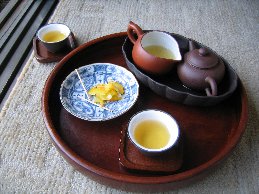
1. What exactly is a tea simmering pot, and why should it not be reduced to “any pot that can go over heat”?
At the most superficial level, a tea simmering pot is of course a vessel that can sit over heat and allow tea and water to remain together under continued warming. It may be a glass simmering pot, a ceramic one, a rough clay vessel, a small handled kettle-like form, or one of the electric tea-simmering systems now common in China. But if we stop at “can go over heat,” then nearly any small pot, pan, or heat-resistant container would qualify, and the category loses meaning. What makes a tea simmering pot distinct is not merely heat resistance, but whether it is designed or used around the logic of simmering tea itself: tea staying in a sustained heating environment, rather than water simply being boiled and then leaving the task.
That means the simmering pot faces a completely different set of questions from the main brewing vessel. The main brewer is about dose, pour angle, lid gap, pour speed, and how to control bitterness and aroma over very short windows. The simmering pot is about what happens when tea remains in contact with water over a longer time, under more total heat, and with a more continuous release pattern. It is not just an extended gaiwan session. It is a shift from segmented extraction to continuous release. That is why the simmering pot is not equivalent to any ordinary heat-safe pot. It has to support that logic in shape, capacity, heat behavior, pouring, and cleaning.
It is also, in an important sense, a sharing object. The beauty of many main brewing vessels lies in a few seconds of judgement during each pour. The beauty of the simmering pot lies more in a longer interval: heat is present, tea is present, aroma remains, and refilling for a small group can continue without reassembling the entire table every few minutes. That does not mean it is only for social scenes. It means its working structure naturally pulls the table from single-point brewing control toward steady ongoing provision. That structural difference is exactly why the simmering pot deserves to be treated as a distinct kind of teaware.
2. Why has the tea simmering pot returned to the center of discussion today?
One obvious reason is that stove-top tea opened a visual door. In recent years, large amounts of Chinese-language image and video content around small stoves, aged white tea, dark tea, ripe pu’er, chenpi, chestnuts, sweet potatoes, and winter tea scenes have returned the idea of simmering to public view. But if we treat this only as a social-media image trend, we still miss the deeper shift. What really matters is that many people who were used only to gaiwans and teapots encountered a serious practical question for the first time: perhaps not every tea should be handled only through quick infusions, and perhaps some teas do in fact unfold differently, and sometimes better, when moved into a simmering path.
A second reason is the growing presence of mature leaf materials, aged white tea, dark tea, liubao, ripe pu’er, chenpi combinations, and winter-oriented hot tea formulas in the market. Not all of these teas should be simmered, but a meaningful portion of them truly can be. That means the return of the simmering pot is not empty mood-making. It has a real tea basis behind it. Especially with teas that can feel tight, thin, or slow to open in ordinary brewing, simmering may reveal a different side: deeper sweetness, broader body, longer warmth, and a more stable drinking arc.
The third reason is that domestic tea spaces themselves have changed. More tea now happens on smaller tables, in living rooms, studios, winter evenings, and casual shared settings. These environments often need steady warmth and steady drinkability more than repeated fast re-organization. The simmering pot naturally fits such spaces: it lets heat, liquor, and refilling develop into a more stable working zone. That is why it has become practical again, not merely photogenic.
3. Which teas actually have a real relationship with the simmering pot, and why are not all teas suitable for it?
The teas most often placed into a simmering pot are usually aged white tea, certain dark teas, liubao, ripe pu’er, some fuller black teas, and chenpi-based combinations. They share an important feature: either the leaf itself is durable enough to take sustained heat, or the flavor structure contains elements that benefit from slower release, such as deeper sweetness, woodier notes, rounder texture, or a more stable winter-drinking body. For these teas, simmering is not necessarily “better” than brewing, but it may be more suitable in some contexts.
Many teas, however, are not well suited to simmering. Fresh green tea, many lightly roasted fragrant oolongs, and teas that depend on short-lived freshness or high aromatic lift often lose their best qualities quickly under continued heating. Aroma escapes too fast, freshness drops, and bitterness can become exposed in a blunt way. So the simmering pot is not a universal improvement device. It is closer to an amplifier: suitable teas can become fuller and more convincing, while unsuitable teas reveal their weakness more quickly.
That is why more mature discussion today often emphasizes “brew first, then decide whether to simmer,” or “choose the tea for simmering,” rather than throwing everything into a pot just because the weather is cold. Many people now first test a tea with a gaiwan or teapot to understand its boundaries, and only then decide whether it deserves a simmering path, how strong it should go, and whether it suits combination with chenpi or other ingredients. The real value of the simmering pot lies not in replacing judgement, but in executing a simmering path well once that judgement has already been made.
4. How is the simmering pot different from the tea stove, the silver kettle, and the main brewing vessel?
If this distinction is not made first, the simmering pot is almost guaranteed to be misunderstood. Start with the tea stove. The stove’s core task is to provide heat. Whether it serves a simmering pot depends on what is placed above it. The simmering pot is the vessel that receives heat and allows tea and water to interact under that heat. The two cooperate, but they are not the same kind of object. As for the silver kettle, its main role in the modern tea table is usually to boil water and deliver that water to the brewing zone, not to hold tea under sustained simmering. One can of course misuse or repurpose it, but that is not its clearest or most stable working boundary.
The difference from the main brewing vessel is even more decisive. The teapot and gaiwan belong to segmented extraction: quick in, quick out, with room for correction in each round. The simmering pot is closer to organizing an entire batch of tea at once. The main brewer works through discrete rounds; the simmering pot works through continuity. The main brewer is about stopping and controlling at the right second; the simmering pot is about maintaining and guiding over a longer span. Even if all of them may be called “pots,” they do not belong to the same working category.
That is why the simmering pot is not just an extra trick or decorative option. It represents another structure entirely. You are no longer organizing the table around the precision of each short infusion, but around the sustained drinkability of a longer, warmer, more continuous tea experience. Once that division of labor is taken seriously, many arguments around simmering pots become much calmer.
5. What makes a simmering pot actually good? First boundary, then material, then pouring and cleaning
The easiest mistake when choosing a simmering pot is to start by asking whether it looks like the beautiful vessel in a winter stove-top tea photograph. But the simmering pot is a working object with real demands. The first questions should be practical ones: will your tea be overcooked in it, is its capacity suited to the number of people you usually serve, and what kind of heat source will it live on? If those questions are vague, beauty quickly becomes short-term novelty.
Material comes next. Glass simmering pots are visually clear, relatively light, and especially useful for teaching and for understanding what simmering is doing in real time. Their weakness is lower thermal depth and a stronger bias toward visible process rather than retained warmth. Ceramic or rough-clay simmering pots are usually steadier, hold heat better, and create a more settled visual and tactile atmosphere, but if the walls are too thick, the pouring poor, or the cleaning awkward, they can become troublesome very quickly. Metal simmering vessels conduct heat directly, but then handle insulation, spout behavior, and hot-zone safety matter even more. No material is automatically the most elevated one. The real question is how you want the object to treat heat, reveal change, and fit your table rhythm.
Only after that should one talk about pouring and cleaning. A simmering pot does not only sit over heat. It still has to deliver tea gracefully at the end. If it pours messily, drags, traps residue, leaves too many cleaning corners, or clogs easily, all of those problems are magnified in simmering because the vessel often stays in continuous use for a while. If a simmering pot is meant to remain on the table in actual life, it has to end well too: easy to pour, easy to wash, easy to clear, easy to remove from the scene.
6. Why does the simmering pot also get dragged into arguments about fake wellness and staged tea aesthetics?
Because it is extremely easy to use it to tell stories that are not really about the pot itself. In recent Chinese internet culture, the simmering pot often gets wrapped into three overlapping narratives. The first is the winter-atmosphere narrative: fire, old wood, chestnuts, steam, and slow life. The second is the wellness narrative: aged tea, chenpi, jujube, warming the body, seasonal comfort. The third is the retro-social narrative: friends sitting together, relaxed images, and a stylized feeling of older domestic leisure. None of these narratives is entirely false, but all of them can obscure the actual object logic of the simmering pot.
Once only the narrative remains, the simmering pot can easily be reduced to a staging device. Find a pretty vessel, put in things that look warm, let steam rise, and no one asks whether the tea suits simmering, whether the heat has gone too far, whether the liquor is getting hollow, or whether the whole thing actually drinks well. It is in this context that skepticism appears: some people dismiss stove-top tea as pure styling, while others say simmering pots are merely kitchen logic repackaged as emotion. But very often, what they are really criticizing is not the simmering pot itself, but the burden of performance that has been placed onto it.
The mature answer is not to mythologize the simmering pot in reply, but to return it to its proper place. It is an object with clear boundaries. It suits some teas, some paces, some climates, and some social situations, and it does not suit many others. It is neither the ultimate answer to winter tea drinking nor a guaranteed fake-prop object. Once its boundary is written clearly, many arguments cool down on their own.
7. Common misunderstandings around the simmering pot
Misunderstanding one: the simmering pot is just any pot sitting on a tea stove. No. The stove is part of the heat system. The vessel is only the vessel. The simmering pot becomes a meaningful category only when continuous heated tea drinking is the actual logic in play.
Misunderstanding two: once the weather is cold, every tea should be simmered. Not at all. Many teas only reveal their weaknesses faster under simmering. The simmering pot is not a seasonal universal key, but an execution tool after tea choice has already been made.
Misunderstanding three: the simmering pot is automatically more advanced or more “tea-knowing” than the gaiwan. This is a very performative misunderstanding. The gaiwan and the simmering pot handle different paths. Neither is inherently superior. The only real question is which structure you actually need.
Misunderstanding four: as long as there is steam, atmosphere, and some added ingredients, the simmering pot makes sense. What actually decides the matter is whether the tea has been overcooked, whether the heat is under control, whether pouring is stable, whether the hot zone is safe, and whether the object can truly enter daily life.
Misunderstanding five: the simmering pot serves only social staging and cannot belong to serious tea drinking. Also false. With the right tea, sensible heat, and a competent vessel, the simmering pot can support a very serious and very honest tea path. It is not unserious. Its seriousness simply lives elsewhere.
8. Why does the simmering pot deserve a dedicated teaware article today?
Because it stands at a very revealing intersection in contemporary tea culture. On one side are increasingly mature gongfu-style brewing, dry-style table layouts, and refined division of labor. On the other side are increasingly visible needs for winter hot tea, slow-paced sharing, combination simmering, and long table companionship. The simmering pot connects these two sides, and also exposes the misunderstandings between them. People want warmth and slowness, but fear empty atmosphere. They want to admit that tea has more than one valid path, but fear everything becoming wellness-flavored sweet talk. They want visual beauty, but do not want the table to collapse back into disorder and performance. The simmering pot puts all of those tensions onto the table at once.
It deserves to be written about not because it is new, but because it is honest. It forces a set of practical questions: what exactly are you simmering, why are you simmering it, what is the purpose of this batch of tea, and have you actually organized the table for a sustained hot zone and sustained service? If those questions are not asked, the simmering pot easily becomes an excuse. If they are asked clearly, it becomes a very complete and defensible position in the teaware system.
If the gaiwan trains immediate judgement, the gongdao cup trains stopping and distribution, and the tea stove trains boundary around heat, then the simmering pot trains a different and less often discussed ability: whether one can accept that tea does not always have to be justified by speed and high-control precision, and whether one can also organize a slower, warmer, more shared path with clarity and restraint. Because that question has become important again, the tea simmering pot fully deserves its own article now.
Related reading: Why the tea stove matters again, Why silver kettles are trending again, Why the gaiwan remains one of the most important Chinese tea vessels, and Why the teapot is still one of the most misunderstood main brewing vessels.
Source references: synthesized from public Chinese-language discussion traces on stove-top tea, simmering aged white tea, dark tea and ripe pu’er simmering, chenpi tea combinations, winter tea-drinking scenes, and tea-simmering vessel choice, checked 2026-03-31, and cross-aligned with the site’s existing article logic on the tea stove, silver kettle, and main brewing vessels.
Image sources: internal repository images already stored on the site — assets/img/photos/china-tea-service-v1.jpg, assets/img/photos/tea-service-closeup-v2.jpg, and assets/img/photos/tea-service-tray-v2.jpg — used here to illustrate how simmering vessels relate to the heating zone, brewing zone, and serving zone on a contemporary tea table.