Why jianshui has become a central object again in the age of dry brewing: workflow, aesthetics, and common mistakes
Created: · Updated:
Many people still describe a jianshui simply as the vessel that holds waste water. That description is no longer enough. As dry brewing has become the default language of many urban tea tables, studio tea settings, and everyday home setups, the jianshui is no longer a hidden accessory. It has become one of the objects that most clearly determines whether a tea table stays clean, whether movements remain fluid, and whether the whole scene feels composed rather than messy.
In recent Chinese-language discussions about tea-table layout, dry brewing, and beginner equipment, jianshui appears more and more often. The reason is straightforward. Once the tea table stops depending on a large draining tea tray, every bit of warm-up water, rinse water, discarded liquor, and extra splash from service has to go somewhere intentional. Jianshui becomes that point of return.
What makes the topic interesting is that this is not merely a nostalgic revival. Jianshui has returned because it answers several contemporary needs at once: the rise of dry brewing, the preference for cleaner-looking tables, the desire for visible functional logic, and renewed curiosity toward old tea-object names that still solve present-day problems. In other words, jianshui matters now not because it sounds classical, but because it works.
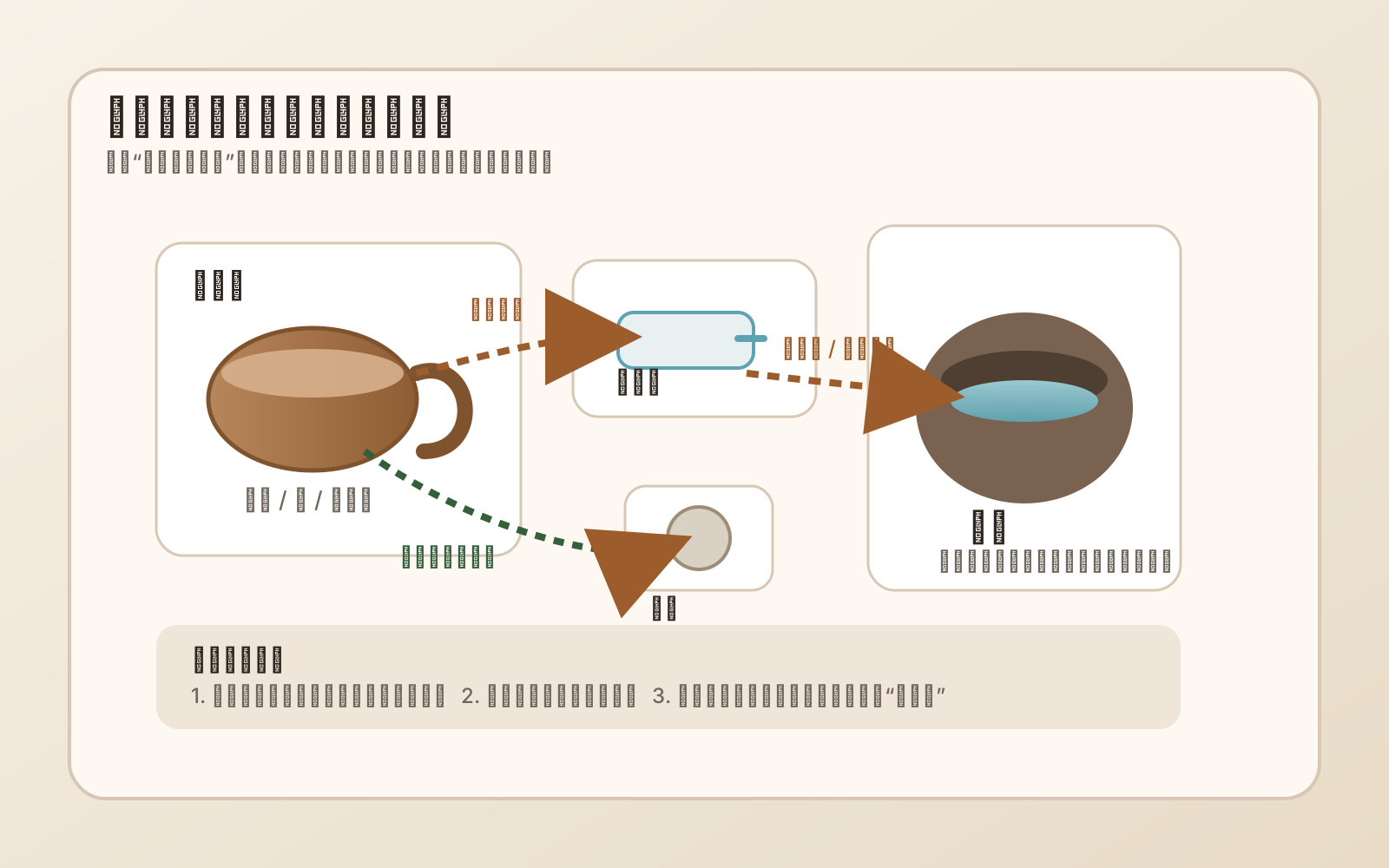
Jianshui changes more than where waste water goes. It reorganizes the whole working grammar of the tea table: where liquor moves, where rinse water lands, and how the table stays visually dry while tea service remains active.
1. Why jianshui has become visible again
A practical change comes first. Many tea drinkers no longer use the heavy old-style draining tea trays that dominate the entire table and treat water disposal as a hidden infrastructure problem. In apartments, studies, offices, studio shoots, and compact daily setups, people increasingly prefer lighter tea-table arrangements that coexist with ordinary furniture. Dry brewing fits that condition because it lets a tea table feel more like part of life and less like a dedicated drainage device.
But once that shift happens, jianshui changes role. It stops being an optional side container and becomes a vessel of order. The table no longer relies on full-surface drainage. Extra water must be gathered, not simply tolerated. Jianshui therefore moves from the edge to the center of the system. It quietly keeps the table from slipping into low-grade chaos.
That is why it appears so often in recent discussions alongside words like clean, restrained, minimal, and professional. It addresses hygiene and convenience, but also the visual discipline of the contemporary tea table.
2. What jianshui is, and how it differs from a pot stand or tea tray
Beginners often collapse several objects into one category: jianshui, pot stand, tray, and sometimes even decorative bowls. All of them relate to water, but their functions differ. A tea tray is a broad support and drainage system. A pot stand supports a specific hot vessel and catches local overflow. Jianshui is the designated return point for rinse water, discarded liquor, and spent tea residue. It is less about where vessels stand and more about where wet actions end.
Put even more simply: a pot stand solves the problem of placement; jianshui solves the problem of disposal. A tray is background infrastructure; jianshui is a working node. This distinction matters because many tea tables look fine in still photographs while functioning badly in real use. Jianshui is often the object that reveals the difference.
In many small modern setups, jianshui also overlaps functionally with nearby supporting objects. It may sit close enough to the brewing zone to catch rinse water, cup water, and occasional temporary wet movements. That is not laziness. It is spatial intelligence.
3. Why dry brewing amplifies the importance of jianshui
In a wetter tray-based system, many small mistakes disappear into the overall drainage logic. A slight spill while warming cups, a drip from the lid, a little extra pour from the fairness pitcher: the table absorbs the cost. The system provides tolerance, and users can remain vague about their own movement quality.
Dry brewing reverses that logic. It does not eliminate water. It refuses to let water spread everywhere. That means every extra movement must have a destination. Jianshui becomes both a safety device and a disciplining device. If your route is too long, your angle too careless, your vessel too far away, or your habit too vague, the problem shows immediately.
For that reason, many people initially find dry brewing awkward. The issue is not that jianshui is fussy. It is that it removes the illusion that vague gestures are good enough.
The lighter the tea-table arrangement becomes, the more jianshui matters. Once the whole surface is no longer a drainage zone, order has to be maintained by object logic and placement.
4. Why jianshui has become an aesthetic object as well as a functional one
Any object that sits on the table every day eventually becomes part of the visual composition. Jianshui has been taken more seriously because it has shifted from hidden utility to visible utility. In older habits, people often hid it under the table, off to one side, or replaced it with any random container. In newer tea-table arrangements, it is frequently left in open view alongside the gaiwan, fairness pitcher, and cups. Once that happens, lip shape, body profile, glaze, color, weight, and surface quietness all begin to matter.
There is also a notable aesthetic return toward forms that feel old without necessarily being antique: broad mouths, deep bellies, muted colors, and shapes that hover between flower vessel, bowl, crock, and service object. These forms feel capable of containing disorder rather than broadcasting it. That is why they appeal so strongly in the current tea-table mood.
Glass jianshui, by contrast, often makes waste water visually too explicit unless the entire table already commits to a transparent modern look. In many contexts, people do not actually want the tea table to perform raw waste visibility. They want controlled disappearance.
5. Why material and shape directly affect use
Jianshui is one of those objects that punishes purely theoretical buying. Something may look elegant in isolation and function poorly in practice. This is because the vessel deals with blunt physical realities: splashback, weight, cleaning, lip performance, depth, and how ugly or calm waste water appears after several rounds of use.
Ceramic and clay-based vessels are often the safest choices because they have enough mass to stay put and enough visual opacity to prevent the tea table from looking unpleasant too quickly. Shape matters just as much. A broader mouth makes target landing easier, especially for beginners. Adequate depth can reduce splashback. But excessive depth can make cleaning irritating. Tall narrow forms may look refined while behaving badly. Strong inward-curving rims may photograph well yet perform poorly in repeated pouring.
The main lesson is simple: choose by movement logic, not display logic. Jianshui is not a shelf ornament. It is a working mouth on the table.
6. Where to place jianshui so it actually works
Many guides offer fixed formulas: back right, back left, triangle with the fairness pitcher, line with the brewing vessel. These rules are only partially useful. The real criteria are more basic: which hand handles your discard motion, and how your main brewing route is organized. Jianshui should serve the shortest safe path and the lowest drip risk, not an abstract ceremonial geometry.
If you brew and handle the fairness pitcher mainly with the right hand, jianshui often works best on the rear-right side. If the table is narrow, placing it too far away defeats the point. A mature tea table is not one that copies a canonical layout. It is one that aligns object placement with actual body movement.
Another overlooked point is the short-distance cooperation between jianshui and the lid rest. Once that relationship is wrong, the table accumulates tiny water traces all session long. Many people think they need a better tea cloth when what they really need is a better jianshui position.
7. Common mistakes
Mistake one: bigger means more professional. In reality, oversized jianshui can consume precious negative space and destabilize the visual balance of the tea table. Most home tea sessions for one to three people do not need workshop-scale capacity.
Mistake two: jianshui should always be hidden. That assumption belongs to an older habit. If the object is well chosen and well placed, it can remain visible and still contribute to calmness rather than clutter.
Mistake three: any container can substitute permanently. Temporary substitution is fine. Long-term use reveals major differences in rim behavior, cleaning ease, weight, and visual composure.
Mistake four: jianshui has nothing to do with aesthetics. Quite the opposite. The quieter it looks while still functioning well, the more mature the whole tea table usually is.
Jianshui is often not the visual center of a tea-table image, but it determines whether that image represents managed order or the kind of arrangement that will become untidy as soon as service begins.
8. Why jianshui reveals aesthetic maturity
People usually choose the main brewing vessel and cups with care. Jianshui is often postponed, improvised, or treated as an afterthought. That is exactly why it reveals so much. It exposes whether the table has been built for sustained use or merely assembled for a nice-looking image.
A mature tea table gives every movement a destination. Jianshui is one of the clearest tests of that maturity. It must handle the messiest part of the session without spreading a sense of mess. It must offer capacity without becoming a bucket. It must clean easily without looking crude. If someone chooses, places, and uses jianshui well, it usually means the table has moved beyond surface taste and toward actual understanding.
9. Why many people should upgrade jianshui before buying something flashier
For many modern home tea tables, a better jianshui creates an immediately visible improvement. It changes workflow, cleanup effort, and table composure all at once. It is not like buying a more expensive cup, which mostly changes a local sensory detail, or adding another pot, which may mainly expand collecting variety. Jianshui changes how the whole session ends.
More importantly, once you choose jianshui seriously, you often discover that the rest of the table must be recalibrated around it. Is the fairness pitcher too far away? Do you actually need a lid rest? Is the towel always on the wrong side? Is the pot stand useful or just decorative? Jianshui pulls those questions into focus because it sits at the meeting point of movement and consequence.
The fewer objects a dry-brewing table uses, the more each object must carry its function clearly. Support objects become more important, not less.A good jianshui does not need to dominate visually. Its success often appears in the quiet absence of embarrassment: fewer drips, calmer cleanup, more confidence in motion.The ultimate value of jianshui is not simply how much waste water it can hold. It is how effectively it keeps group tea drinking bounded, tidy, and calm.
Why jianshui deserves serious attention today
It stands exactly at the intersection of several current changes: the spread of dry brewing, the rise of minimalist domestic tea tables, and renewed interest in classical object names and vessel order. Jianshui is not as universally recognized as the gaiwan, and it lacks the instant visual fame of Jianzhan. Precisely because it has long been underestimated, it is worth rewriting now. It reveals a basic truth: the objects that make a tea table mature are often not the most glamorous ones, but the ones that quietly absorb disorder.
If the gaiwan trains judgment, jianshui trains order. It does not make tea more fragrant. It makes the whole act of tea more complete, cleaner, and more disciplined. That is enough to make it a genuine lead object on the contemporary tea table.