History feature
Why Record of Tea singles out “timing the water”: from the three-boil method to Song whisked-tea judgment and why water timing became a trainable standard
Record of Tea is not a long book, but many first-time readers pass quickly over one of its most compressed lines: “Timing the water is the hardest. If underdone, the foam floats; if overdone, the tea sinks.” It is easy to treat that as a neat classical warning, as if Cai Xiang were simply telling people not to use water that is too cool or too old. But once the line is returned to the real world of Song whisked tea, it becomes much heavier. What it is talking about is not “whether one can boil water,” but why Song tea people made the moment of a kettle’s readiness central to success and failure in whisked tea, foam judgment, bowl appearance, and even a whole trainable technical standard.
That is why this article isolates “timing the water” as its own subject. The site already has pieces on Record of Tea, The Daguan Tea Treatise, Song tea competition, and tea whisks and whisked tea. But this small section deserves to be opened separately because it stands right at the crossing point of several lines: on one side, the earlier three-boil tradition in The Classic of Tea and Tang attention to water stages; on the other, the Song world of preparing powdered tea paste, pouring in stages, and whisking up foam; and further out, the visual standards of dark bowls and pale foam, the water-mark judgments of tea competitions, and the larger Song habit of turning technique into teachable language.
In other words, “timing the water” looks like a note about water, but it is really about judgment. It requires neither brute force nor mystical sensitivity in the empty sense, but an ability to calibrate fire, water, vessel, powder, and motion at exactly the right instant. Song writers insisted on this point not because they suddenly became obsessed with detail, but because the whisked-tea world had reached a stage at which even very fine tea powder, a good bowl, and a good whisk could still fail if the moment of pouring was not right. Timing the water therefore was not one step among others. It was the gate that connected all the other steps.

1. Why Record of Tea isolates water timing at all
Today, when people imagine Song whisked tea, they often begin with white foam, dark bowls, bamboo whisks, and an elegant tea surface. That is a fair point of entry, but it can also create a misleading emphasis: as if the essential thing were the whisking gesture itself, and as if good enough hand skill could produce the desired result regardless of everything else. Yet Record of Tea insists that what is hardest is not whisking in the abstract, but timing the water. That order matters. It tells us that in the Song understanding of whisked tea, the true point of difficulty lay not only in motion, but in entering the motion at the right moment.
Why would timing matter so much? Because whisked tea was not just a simple mixture of powder and hot water. It required forming a paste, adding water in stages, and then whisking the surface into a fine foam. Every one of those acts depended on the condition of the water. If the water was too “raw,” it lacked the right force and the surface would feel light, floating, and unstable; if the water was too far gone, the tea could sink and the foam would be harder to sustain. Cai Xiang’s line is therefore strikingly concrete: “If underdone, the foam floats; if overdone, the tea sinks.” The issue is not some abstract failure of “heat control,” but visible failure inside the bowl.
That is why water timing was not background work. It was the threshold that determined whether everything that followed could even enter a stable field of comparison. Song whisked tea could later become part of tea competition and shared judgment precisely because this threshold, while difficult, was not beyond language. It could be recognized through failure, and it could be trained through practice. Cai Xiang was not trying to mystify the reader. He was saying: if your eyes remain fixed only on whether the finished surface looks beautiful, and you do not learn to judge the instant at which the water should enter, then you have not really entered the core of Song tea technique.
2. What exactly makes “timing the water” so hard
Modern boiling habits tend to divide things in two: either the water has boiled or it has not. Song water judgment was clearly not so blunt. The very word “timing” implies something continuous rather than binary. Water moves from stillness to activity, from warmth to boil, from faint sound to rolling turbulence, through many stages. Whisked tea needed not just “very hot water,” but water at the stage best suited for forming paste, raising foam, showing whiteness, and sustaining the bowl surface. The difficulty lies in the fact that this ideal state is brief and can pass quickly.
This is one reason the line in Record of Tea goes on to say that what earlier generations called “crab-eye” water was already overdone. It is making two strong points at once. First, it is clearly in conversation with an older tradition of naming water states: fish eyes, crab eyes, and other boiling signs. But Cai Xiang warns that if such terms are applied mechanically, one may miss the actual needs of Song whisked tea. Second, he notes that when water is boiled in a deep bottle, it is hard to distinguish these changes clearly. That means water timing is never purely abstract. It depends on how one observes the water, what kind of vessel one uses, and at what exact point one chooses to pour.
This is a classic case of a mature technical world becoming more precise rather than more mystical. The hardest techniques are often not the ones requiring sheer force, but the ones demanding a cut into a moving process at the right instant. Water timing is exactly that kind of skill. It requires attention not only to sound, bubbles, and heat, but to what the water will do once it meets the tea powder and enters the whisking sequence. In other words, the Song claim that it is “the hardest” means not that it is unknowable, but that it demands the quickest and most consequential judgment.

3. Why this has to be read together with the three-boil method in The Classic of Tea
The best way to understand this part of Record of Tea is not to treat it as a sudden Song invention, but to reconnect it to the earlier world of The Classic of Tea. Lu Yu’s account of boiling water in Tang tea practice is famously fine-grained: first boil like fish eyes, second boil like linked spring pearls at the edge, third boil like surging waves. Whatever later shorthand readers use, the point is clear. In early Chinese tea thought, water was never an undifferentiated vehicle of heat. It was something that had to be observed in stages and entered at the right time.
That does not mean The Classic of Tea and Record of Tea are talking about exactly the same thing. Their shared ground is an insistence that water has to be distinguished carefully. Their difference lies in the tea method being served. The Classic of Tea belongs more to the Tang world of cake tea and boiling, where the central concern lies in the broader rhythm of adding tea, handling froth, and balancing water and salt. Record of Tea, by contrast, belongs to the Song world of powdered tea and whisking, where the concern lies more directly in how the powder receives water, how foam rises, and how the bowl surface stabilizes. The Song inherited the habit of reading water in stages, but they rewrote its technical goal.
This is exactly why Cai Xiang can say that what earlier people called “crab-eye” was already overdone. The ideal water state is not universal across all tea methods. One cannot simply carry earlier terms unchanged into the Song whisked-tea world. Cai Xiang is not rejecting older water observation. He is recalibrating it around a new technical end. That is historically important, because it shows Chinese tea tradition not as a static storehouse of repeated formulas, but as a sequence of changing sensory systems in which each tea method rewrites inherited language to serve new tasks.
That is one reason “timing the water” deserves new attention today. It reveals that Song tea culture did not abandon earlier sensitivity to water. It sharpened that sensitivity and redirected it toward the more immediate control of powdered tea, foam, and bowl appearance. Once that becomes visible, the three-boil method and Cai Xiang’s warning no longer look like old ornamental labels. They appear as related but distinct systems of judgment shaped by different technical worlds.
4. Why water timing became a trainable standard in the Song
If water timing were only the private intuition of a few masters, it would never have been written down in a compact instructional text like Record of Tea. The fact that it is isolated and named “the hardest” tells us something crucial: this difficulty was already publicly recognized inside a teachable technical system. People agreed that it mattered. They also agreed that it could be trained, even if it was the hardest thing to train. Only when a field has developed shared judgment does it begin to mark its hardest points so explicitly.
The structure of Record of Tea itself makes this visible. Color, aroma, flavor, storage, re-roasting, grinding, sifting, timing the water, warming the bowl, preparing the tea, and utensils are all separated into parts. That structure tells the reader that tea practice is not only talent. It can be divided into operational stages. Water timing is hardest not because it is higher than everything else, but because it is hardest to reduce to a fixed motion. Grinding can be explained in terms of fineness; sifting can be explained in terms of grain; bowls can be judged in terms of color and thickness; even whisking sequence can be described. But water timing happens inside change, so it depends more heavily on repeated, live calibration.
This also helps explain why Song tea culture could sustain such strong traditions of bowl-surface judgment and tea competition. Once technique can be divided, results can be watched, and failures can be discussed, “good” ceases to be only personal preference. It begins to harden into a shared standard. Water timing is one of the hardest links in that chain because it happens in real time and exposes whether a practitioner can actually mobilize experience at the necessary instant. That made it a perfect dividing line between novice and practiced hand.
In that sense, Cai Xiang’s line is a remarkably mature piece of technical writing. Its maturity lies in knowing what is hardest to teach but still must be taught; what is most dependent on live judgment but still must be written for others to practice. He is not displaying difficulty for its own sake. He is locating the pressure point that holds the entire whisked-tea system together.
5. Why “if underdone, the foam floats; if overdone, the tea sinks” matters so much
The most impressive old technical writing often does not simply say that something “requires care.” It says what failure looks like. Cai Xiang does exactly that. He does not present water timing as mysterious insight beyond language. He gives two visible consequences: if the water is underdone, the foam floats; if it is overdone, the tea sinks. That move is decisive. It turns experience from hidden expertise into something that any careful observer can begin to learn through diagnosis.
This matters especially in Song whisked tea because success and failure were already deeply tied to bowl appearance. Once failure signs can be named, technique can be corrected. Floating foam means the relation between powder and water has not stabilized properly: something appears on the surface, but it is light, loose, and hard to sustain. Sinking tea means the water has passed its best state and the relation between water force and powder has gone wrong; however skillful the later whisking may be, the surface will struggle to recover. This is why that single line is so important. It writes technical error as observable effect.
And that is one of the basic conditions for standardization. A technical world only becomes truly teachable when errors can be publicly recognized. Otherwise everyone can only say that something “feels wrong” without stabilizing shared instruction. Cai Xiang’s sentence gives the whisked-tea world a pair of negative indicators: what counts as too raw, what counts as too old. Through such indicators, personal experience begins to turn into common knowledge.
That is why the line should not be read merely as a beautiful classical remark. It is better understood as a mature Song technical sentence: brief, compressed, and diagnostic. Such language is one of the foundations on which later bowl-surface reading, water-mark judgment, and competitive distinctions could stand.
6. Why water timing leads directly to dark bowls, white foam, and tea competition
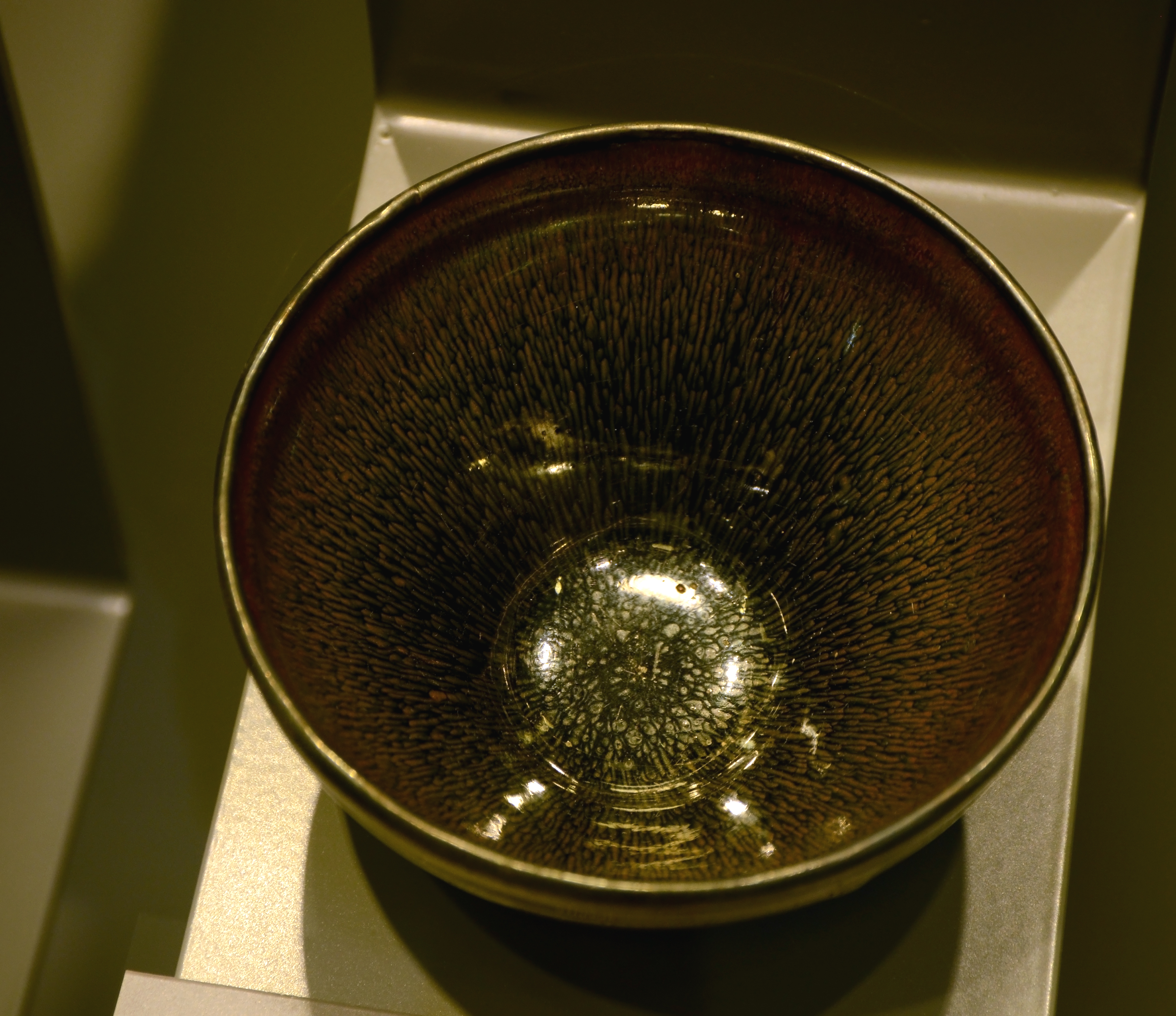
If “timing the water” is discussed in isolation, it can sound like a specialized note about boiling. But inside the world of Song whisked tea and tea competition, its real weight comes from the fact that the result does not remain in the kettle. It is amplified in the bowl. Whether the foam is fine enough, how quickly water marks appear at the rim, whether the foam clings to the bowl, and how long it lasts all make water timing legible as public outcome.
This is one of the most fascinating things about Song tea culture. Many technical worlds have “craft skill,” but not all of them have such a strongly visual endpoint. Song whisked tea did. Dark bowls acted as a deep background that made pale foam highly legible. Competition created a field in which such differences could be magnified. Texts like Record of Tea and The Daguan Tea Treatise then supplied the language for discussing those differences. As a result, something that begins between fire and kettle does not remain hidden there. It travels forward into the bowl and becomes part of visible judgment.
This is why the Song concern with water timing was never a narrow fascination with heat alone. It belonged to a broader technical culture that could transform small upstream judgments into public, downstream consequences. Water timing thus becomes part of what might be called the politics of the bowl surface. It is decided beside the kettle, but judged inside the bowl. Once that becomes clear, Cai Xiang’s line stops looking like a kitchen tip and starts looking like an upstream key to the entire evaluative system of Song whisked tea.
That is also why it deserves to be rewritten now. If one looks only at the finished contrast of white foam and dark bowl, Song tea can too easily be reduced to visual elegance. Once water timing comes into view, it becomes obvious that those graceful surfaces were supported by extremely hard real-time judgment. Beauty did not appear from nowhere. It emerged only after water timing, powder, pouring, and whisking all succeeded together.
7. Why this line deserves separate rereading today
Today’s internet writing on Song whisked tea often falls into two popular modes. One is visual, emphasizing white foam, dark bowls, Song-style aesthetics, and photogenic elegance. The other is emotional, emphasizing slowness, refinement, quietness, and “ancient atmosphere.” Neither mode is wholly wrong. But if a history section stops there, the Song whisked-tea world becomes too light. A subject like water timing is valuable precisely because it pulls the eye back from how the result looks to how the result becomes possible.
It reminds us that Song tea culture did not first invent a beautiful aesthetic and then look for techniques to support it. The movement was almost the reverse. Because technical judgments became fine enough, stable enough, and comparable enough, aesthetic standards could stabilize. White foam mattered because it displayed technical result. Dark bowls mattered because they magnified difference. Water timing mattered because it determined whether the result could even enter that visible and comparable state. To reverse those relations is to miswrite Song tea as a history of poses rather than a history in which technique and aesthetics are tightly interwoven.
This matters all the more today because modern readers are very tempted to understand “classical atmosphere” as something soft and weightless, as if it were enough for things merely to look elegant. Cai Xiang’s brief line pulls us back out of atmosphere and toward structure. Mature traditions are never only mood. They also contain hard training in judgment. A cultural system that keeps only its surfaces will quickly hollow out; Song whisked tea still feels heavy precisely because texts like this allow us to touch the technical bones beneath the elegance.
So to rewrite “timing the water” today is not simply to rescue an obscure classical note. It is to restate a larger question: why does Song tea culture feel so precise? The answer lies not only in bowls, foam, emperors, or famous wares, but in the fact that tiny gates like water timing were treated seriously, written down, and passed onward as standards. Water timing is one of the clearest examples.
8. Conclusion: what “timing the water is the hardest” really reveals
If this whole article had to be reduced to one shortest conclusion, it would be this: Cai Xiang singled out “timing the water” not because Song people liked to make small things sound profound, but because by the Northern Song the condition of one kettle of water had ceased to be mere background and had become a common hinge for an entire technical system. It connected backward to the earlier tradition of reading water in stages, forward to paste formation, pouring sequence, whisking, foam, and bowl-surface judgment, and outward again to public comparison and the aesthetic order of dark bowls and white foam.
That is why “timing the water is the hardest” is not a decorative classical phrase, but a mature technical sentence. Its force lies not in vagueness but in precision: if underdone, the foam floats; if overdone, the tea sinks. Once failure can be written as visible effect, effect can be trained into judgment, and judgment can be enlarged into public standard. This is one of the reasons Song whisked tea feels so finely structured. It was never only about beautiful objects and graceful lifestyle. It rested on a hard core of live skill.
So what is worth preserving in this line today is not only that we can quote a classical sentence, but that the sentence lets us see something important about Chinese tea history as a whole: traditions do not become real because people vaguely praise “refinement.” They become real because small thresholds like water timing are forced, over generations, into standards that can be seen, learned, compared, and written down. The difficulty of water timing is therefore one of the clearest signs that the Song whisked-tea world had truly matured.
Continue reading: Why Record of Tea deserves a close rereading today, Why Song tea competition was never just a simple contest, Why The Daguan Tea Treatise pushed the whisked-tea world to a peak, and Why The Classic of Tea keeps being brought back today.
Source note: centered on the Record of Tea passage beginning “Timing the water is the hardest. If underdone, the foam floats; if overdone, the tea sinks … what earlier ages called crab-eye water is already overdone,” while also drawing on the standard tea-historical line from The Classic of Tea and its staged reading of boiling water, together with the site’s existing articles on Record of Tea, tea competition, whisked tea, Jian ware, and The Daguan Tea Treatise. The emphasis here is the structural meaning of water timing inside the Song whisked-tea system rather than a line-by-line philological annotation.