Tea-drink feature
Why Modern Tea Chains Are Putting “Blended Tea Bases” on the Menu: When a Single Tea Name No Longer Explains a Drink, Brands Start Selling Ratio, Layering, and Structure Itself
One of the most revealing changes in the latest round of product-page upgrades is that brands are no longer satisfied with saying only that a drink uses oolong, jasmine, black tea, or pu-erh. They are increasingly writing the blend itself into the public description. Product pages now openly mention things like Yunnan pu-erh large-leaf baked green tea blended with Leshan small-leaf baked green tea, Huangjingui blended with Baiya Qilan, different-elevation Ceylon black teas blended together, or Dianhong blended with Lapsang Souchong. These used to feel like back-end R&D or staff-training language. Now they increasingly read like front-end menu language meant for ordinary consumers. That is not a tiny wording change. It shows that tea-drink brands are beginning to sell structure, ratio, and layering as explicit consumer-facing value.
If you place several recent drinks features on this site side by side, the line is fairly clear. We have already written about tea-base identity, identity-card style menu copy, roast-forward oolong moving to the foreground, and beany, grainy, and roast-like tea bases being written more explicitly into menus. All of those shifts point in the same direction: brands no longer want to name only a tea category. They want to explain more structurally why a cup tastes the way it does. Blended tea bases are one of the clearest next steps in that movement.
Because once a brand says “blend,” it is no longer selling only a tea name. It is selling an active formulation judgment: why two black teas are paired, why floral lift and oolong depth are made to meet, why large-leaf and small-leaf materials are placed together, why a light-milk product no longer depends only on floral notes but on how its front, middle, and finish are supported. Those decisions used to belong mainly to product development. Now they are being translated into language consumers can also read. Put differently, brands are no longer telling you only what tea is in the cup. They are beginning to tell you why one tea alone was not enough.
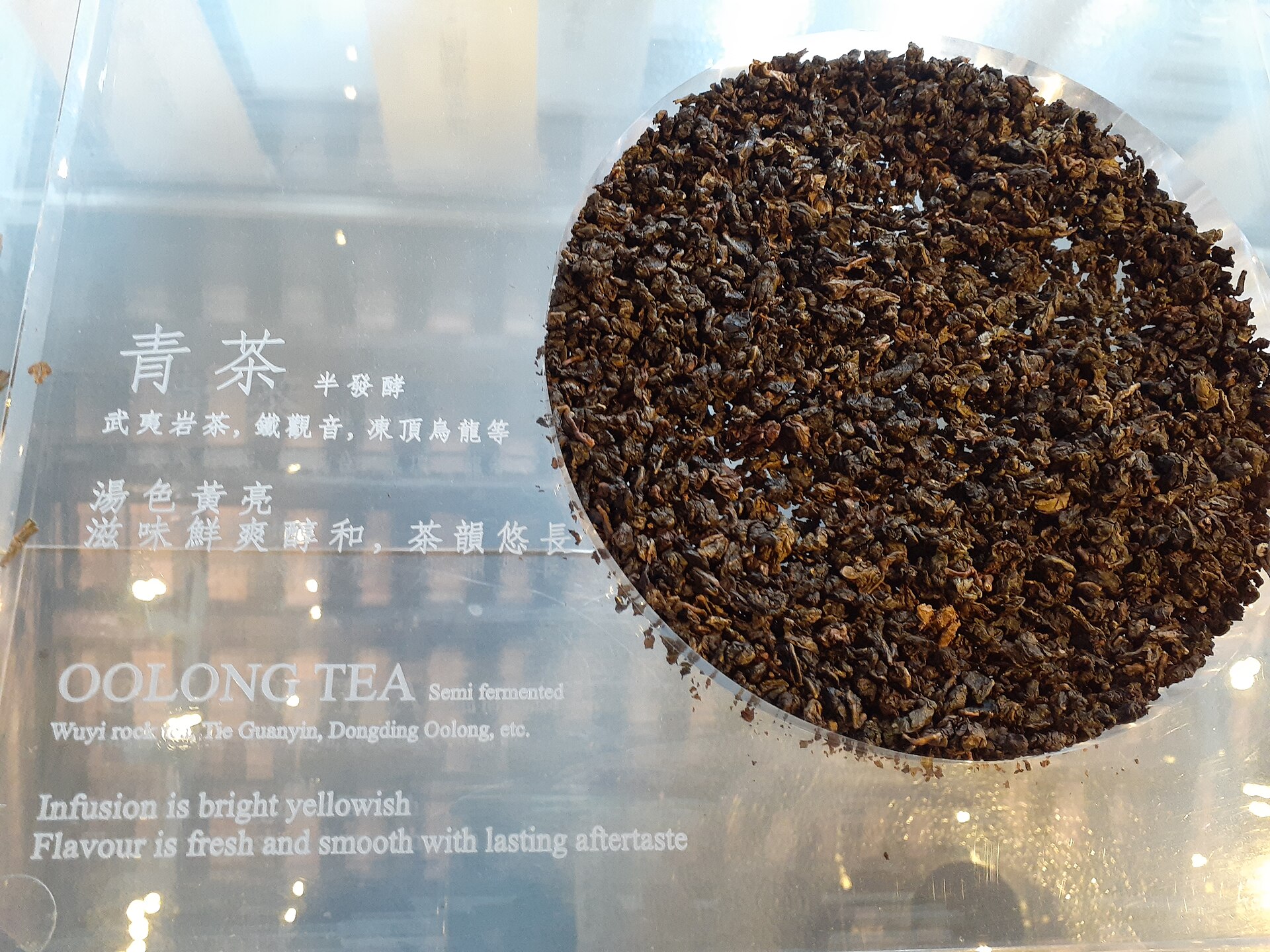
1. Why now? Because a single tea name is no longer enough to explain product difference
Over the last few years, one of the most important changes in tea-drink menu language was the shift toward telling people more clearly whether a drink actually contained tea and what kind of tea it was. That is why we started seeing terms like seven-scent jasmine, Jinguanyin, chenpi pu-erh, glutinous-rice green tea, slow-roasted Jinguanyin, mid-roast oolong, and Lapsang Souchong enter public product pages so often. That step mattered because it moved the market from “this is just milk tea” toward “what tea route is this cup actually taking?” But once more and more brands learned to use that language, a new problem appeared. If everybody can now write a more specific tea name, how do they keep widening the gap?
One answer is to make the blend itself visible. A single tea name may provide recognition, but it often no longer fully explains the structure of a modern drink. That is especially true in products where milk, light dairy, fruit, floral notes, ice, and sweetness are all interacting at once. What brands are often operating is not a single tea material but a more stable result: should the front feel brighter, should the middle feel rounder, should the finish feel steadier, should the returning sweetness last longer, how should floral lift connect to mature warmth, how can tea stay clear without becoming sharp? At that point, a single tea name often stops being enough.
“Blend” gives brands a stronger explanatory tool. It lets them translate what used to be hidden structure decisions into front-end language: this is not a random mixture, but a way to hold aroma higher, tea structure steadier, layering fuller, and the finish clearer. Consumers do not need to understand every detail. They only need to register the intuitive difference: this cup is not merely “more fragrant” or “lighter.” It has been designed to feel more complete.
So this is not an isolated surprise. It is the logical next step after tea-base naming matured. First the market learned to say “there is real tea.” Then it learned to say “this is what tea it is.” The next step is to say “here is why these tea elements were put together.” Once brands begin answering that third question, menu language moves from tea naming into tea-structure explanation.
2. Why are blended tea bases so suited to the 2026 menu environment? Because they translate back-end formulation logic into public-facing result language
Many product-development concepts do not travel well to the front end because consumers either do not understand them or cannot use them while ordering. “Blend” is different. It carries some technical flavor, but remains intuitive enough. Most consumers do not know exactly how two black teas are balanced, what the ratio is, or how the processing differs. But once a brand says that a tea base is blended in order to preserve sweetness, fruit notes, floral lift, thickness, or returning sweetness together, the consumer can immediately read one larger signal: this cup has been deliberately tuned rather than supported by a single attractive noun.
That is what makes blended tea bases especially communicable. They sit in the same useful middle zone as other increasingly visible menu words such as scenting, roasting, aging, or blending. They are not fully ordinary everyday words, but neither are they niche enough to drive people away. They hold enough information to create distinction without becoming too heavy for a fast ordering scene.
More importantly, what blending sells is usually a result rather than a parameter. Most consumers will not order because two teas were blended at a precise ratio. They order because that language helps them predict a certain feeling: steadier, more balanced, more layered, less likely to open beautifully and then collapse into emptiness. Blended tea bases move into the foreground not because the public suddenly wants formulation theory, but because brands have learned to translate formulation logic into feeling logic.
That is also why blended tea bases connect so naturally with identity-card style menu writing. Brands are not trying to turn consumers into tea technologists. They are trying to give them a high-efficiency difference language. Blending is powerful inside that language because it suggests not just source but active structural control.
3. What are brands really selling when they openly write “blend”? Not mystery, but layering, stability, and repeat-purchase strength
When brands foreground blending, they are not primarily trying to create a fake aura of mystery. What they usually sell are three things: layering, stability, and repeat-purchase strength. Layering is the easiest to see. A single tea name gives a main direction, but blending allows a brand to say it wants more than one direction at once: a stronger front and a stronger finish, aroma and tea frame together. Stability matters too. In modern tea drinks, ice, milk, fruit, and sugar all interfere with the tea base. Blending is often presented as a way to build a chassis that can resist that interference more reliably. And repeat purchase follows from the first two. A drink that needs to sell every day cannot rely only on an impressive first sip. It needs to keep standing through the middle and back half of the cup.
That is why public blend descriptions rarely stop at “Tea A + Tea B.” They usually move toward a result statement. One blend is there so sweetness and fruit can coexist. Another allows floral lift while keeping the tea body from thinning out. Another keeps a light-milk structure from going hollow. What is being sold is not the blending action itself, but the more complete result that a single tea name does not explain as well on its own.
Seen this way, blended tea bases connect directly with earlier themes on this site such as “floral + tea base” as signature language and roast-forward oolong moving into menu foreground. All of them answer the same larger question: once “real tea base” becomes baseline, how does a brand prove that its tea is not just built around one abstract direction but around a deliberately designed structure? Blended tea bases are one of the most effective current answers.
They are especially useful for product lines that look light but cannot taste empty. That includes light milk tea, fresh-milk tea, and parts of the fruit-tea and Oriental iced tea lineups. The lighter the burden language, the less a product can rely on sheer heaviness to maintain presence. It has to depend more on structural stability inside the tea base. In that environment, blending stops being a hidden craft move and becomes front-end competitiveness.
4. How does this relate to the foregrounding of single named teas? It does not replace that move; it deepens it
Blended tea bases do not cancel out the earlier move of pushing named teas into the foreground. More accurately, they deepen it. Bringing names like Jinguanyin, jasmine snow buds, chenpi pu-erh, Lapsang Souchong, and glutinous-rice green tea into public view taught consumers that tea is not just background filler. Bringing “blend” into view goes one step further: even after you know the tea name, the real difference in a modern drink may still depend on how multiple tea elements are arranged together.
Those two moves do not conflict. They connect naturally. First consumers learn how to read a tea name. Then they learn how to read structure. First they know what broad tea route the cup belongs to. Then they learn why that cup can hold several flavor directions at once. For brands, this means menu language moves from naming toward composition. For consumers, it means ordering moves from choosing a familiar label toward choosing a more desirable result structure.
That is also why blended tea bases can carry the next round of mature-market competition more effectively than single tea names alone. A named tea provides recognizability. A blended tea base provides explanatory power. Recognizability helps consumers remember a cup. Explanatory power helps them believe why that cup should be more complete, more drinkable, and more worth buying again. The first works like a label. The second works like an argument. A mature market increasingly needs both.
So what we are seeing is not the replacement of named teas by blends. It is the merger of named teas, blending logic, and result-oriented explanation into a new menu structure. Brands are no longer writing only the tea name. They are learning how to turn the internal construction of a cup into a story that consumers are willing to read.
5. Why does this matter for brand competition? Because it turns “structural design ability” into something that can finally be sold at the front end
Brands have always done structural design, but most of the time that work stayed behind the curtain. Consumers only saw the finished effect: cleaner, more fragrant, thicker, smoother. What is different now is that brands are beginning to move the explanation of why a drink can feel that way into the foreground. Blended tea bases are one of the clearest expressions of that shift. They turn structural design ability from a hidden product-development advantage into something that can be named and sold in public-facing copy.
Once that shift holds, brand competition becomes finer-grained. Chains will not compete only over who is lower sugar, lighter, or better at telling floral stories. They will also compete over who can explain tea-base structure more convincingly, who can make “balance, layering, and stability” sound precise without becoming intimidating, and who can persuade consumers that a cup was not merely assembled but deliberately designed.
This is also a format especially well suited to the Chinese internet. It comes with built-in debate: is blending actually more advanced, or just more marketable? Can people really taste the difference? Which blends are there to raise aroma, which are there to build structure, and which are mostly there to make the copy sound smarter? Those questions can easily become reviews, comparisons, blind tastings, ranking lists, and factional preference content. They spread more naturally than a simple “this cup tastes good” claim.
So as a market signal, the front-end visibility of blended tea bases is not a tiny menu adjustment. It is a sign that a mature market is starting to compete over smaller, more structural distinctions. Brands are shifting from selling isolated selling points to selling judgment itself.
6. The key thing to watch next is not who writes “blend” first, but who makes consumers actually remember this structural difference
Any trend that reaches the menu foreground eventually faces the same real-world test: do consumers build a stable preference around it? Blended tea bases are no exception. Writing the word “blend” is only the first step. What will determine whether this becomes a durable line is whether more consumers begin saying things like: I now prefer light milk teas with a slightly more complex structure; I do not look only at the tea name anymore, I also look at whether the base is built through blending; I think certain black-tea blends work better with fresh milk; I prefer an oolong blend that opens floral and finishes with clearer returning sweetness, rather than a tea base that moves in only one direction.
If those preferences really take hold, blended tea bases will stop being only a copywriting hot phrase and become a long-term flavor asset for chains. At that point, one of the key achievements of the 2026 menu-upgrade cycle will not simply be that tea bases became more transparent and more specific. It will be that the mass market learned a more natural way to understand that the pleasure of a modern tea drink may come not only from a single tea name, but from a deliberately designed tea-base structure.
If that does not happen, the outcome is also clear: all brands will write more professional-sounding text, while consumers still conclude that the drinks feel broadly similar. So the most important thing to track is not which chain writes the word “blend” first, but which one turns this structural difference into something ordinary consumers can repeat, compare, and order again.
To keep following this line, read “Tea Bases Now Come With an Identity Card”, “Why Identity-Card Style Product Copy Became a Tea-Drink Menu Format”, “Why Roast-Forward Oolong Is Showing Up on Menus”, and “Why Tea Chains Are Writing Beany, Grainy, and Roast Notes into Light Milk Tea Menus”. They describe different sides of the same menu-upgrade cycle, and the foregrounding of blended tea bases is one of the next steps most worth tracking.