History feature
Why Song whisked tea preferred dark Jian bowls: not a cult of objects, but the result of white foam, heat retention, and doucha judgment working together
Today, when many people mention Song Jian bowls, their first reaction is often that hare’s-fur streaks are beautiful, black glaze looks noble, or Song taste simply favored dark vessels. None of that is entirely wrong, but the historical order is usually reversed. The Song did not first worship a dark bowl and then go looking for a tea method to match it. The historical sequence is closer to this: first there emerged a world of whisked tea and doucha centered on white foam, warm bowl surfaces, visible water traces, and enduring froth; then dark-glazed, relatively thick Jian bowls were pushed by that evaluative system into the most suitable position. Cai Xiang’s Record of Tea says it plainly: “Tea is white, so dark bowls are suitable.” This was not merely decorative advice. It was the conclusion forced out by a whole set of technical and visual judgments.
In other words, the importance of dark Jian bowls should not be written only as the prehistory of a famous collectible object or as a chapter in today’s market for Song-style wares. It deserves to be written as a clearly functional, clearly evaluative, and clearly aesthetic position inside the world of Song whisked tea. Dark bowls made white foam easier to see, kept the bowl surface warm for longer, and made it easier to observe whether foam broke early, whether water traces appeared first, and whether the foam “bit” the bowl. Without this layer, Jian bowls get miswritten as isolated art objects detached from tea technique. Once we return to the whisking scene, however, it becomes obvious that they were products of tea method, bowl color, bowl form, glaze behavior, and contest standards growing together.
That is also why this article complements but does not repeat pieces already on the site, such as why Jian tea became central in Song tea culture, why Cai Xiang’s Record of Tea matters, and why The Daguan Tea Treatise matters. Those essays handle the larger framework of Jian tea, tea-book standards, and Song whisked-tea order. This one asks a more precise question: why that order finally pushed dark Jian bowls into the core position among tea vessels.
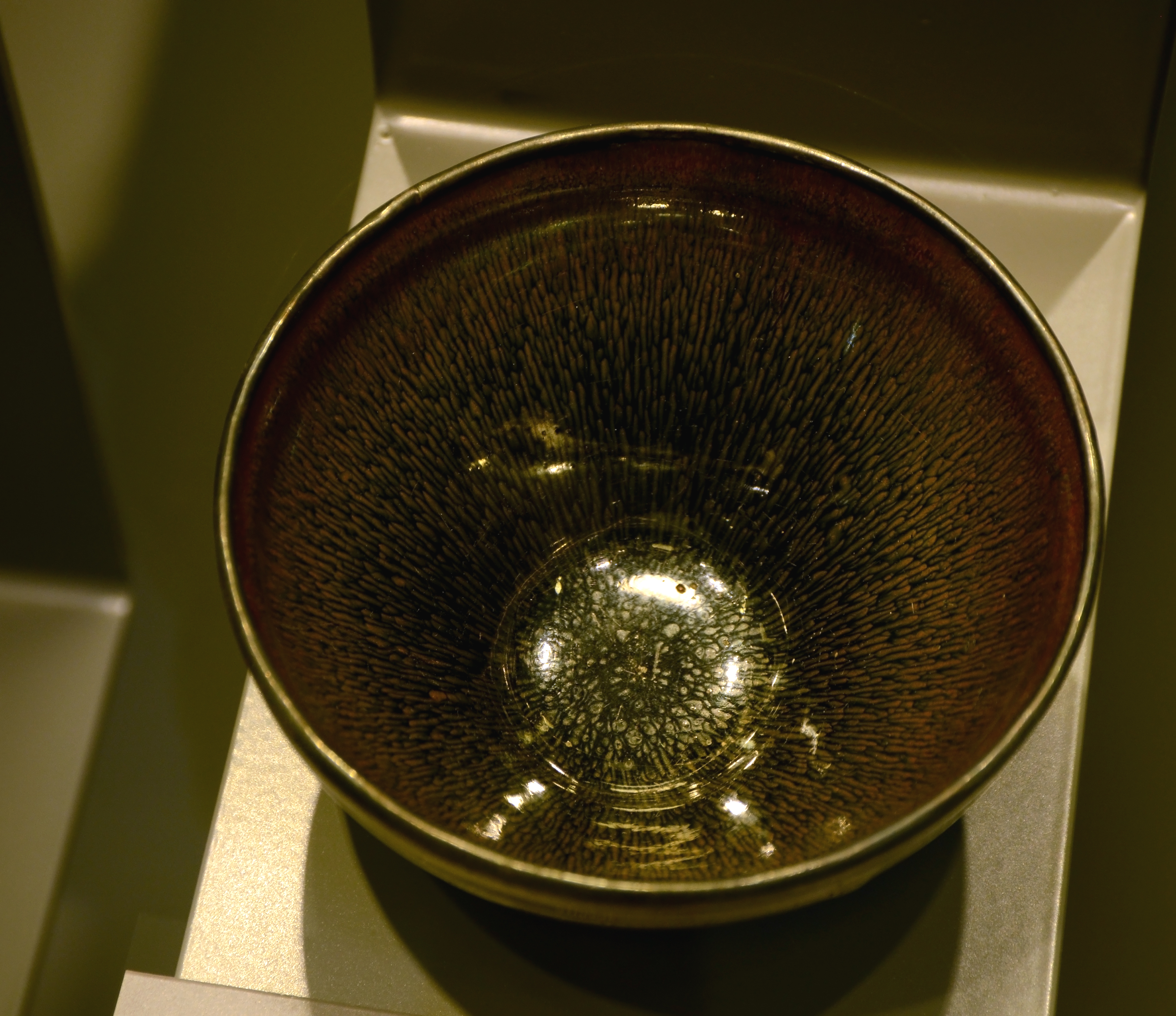
1. Why this subject deserves its own article: because “tea is white, so dark bowls are suitable” is not a line of taste, but a technical judgment
When modern readers see the phrase, it is easy to interpret it as a graceful color recommendation: white foam looks prettier in a dark bowl. That certainly makes sense, but it is still too shallow. Back in the Song whisked-tea scene, the phrase mattered because it described a judging condition, not a display preference. The age of whisked tea prized the white milky foam produced through whisking tea paste with hot water. In doucha, people cared about whether the foam was even, whether it stood firmly, whether it lasted, and whether water traces appeared early or late. Once those become the core standards, bowl color is no longer an optional background. It becomes part of the act of judgment itself.
That means a dark bowl was not a secondary aesthetic feature. It was part of the judging interface. If white foam were set against a pale bowl, visual contrast would weaken. Against a deep black surface, subtle differences between pure white, bluish white, gray white, or yellowish white become easier to see. The gathering and dispersal of foam, the early or late emergence of water traces, and the degree to which the foam clung to the bowl all become easier to judge. In that context, “dark bowls are suitable” means not simply beautiful, but more effective for comparing quality.
That is exactly why the topic deserves separate treatment. It reconnects vessel history with tea-method history. Jian bowls mattered not because later generations elevated them in isolation, but because Song whisked tea itself demanded such a vessel. First the tea world created the requirements; then the dark bowl became the best response. That is the historical order, and it matters.
2. Why Song whisked tea especially needed a dark bowl surface: because it was not judging the liquor alone, but the white foam produced by whisking
To understand dark Jian bowls, we first have to understand what Song whisked tea was actually looking at. The Song was not, in the later loose-leaf sense, mainly observing a clear infused liquor, rising aroma, or opened leaves. To a significant extent, it was observing the milky mist, foam, and bowl-surface behavior produced by whisking. In the “Color” section of The Daguan Tea Treatise, Zhao Ji distinguishes among pure white, bluish white, gray white, and yellowish white, which shows that the central object of comparison was not simply the tea liquor’s hue but how pure, bright, and stable the white foam appeared.
That immediately means the bowl has to function like a stage background. If the background is too pale, whiteness does not stand out clearly. If the background is deep and dark, fine differences become easier to perceive. So the real Song question was not “what vessel color is more elegant?” but “what vessel color lets white foam speak most clearly for itself?”
That is one major reason dark Jian bowls became so tightly bound to Song whisked tea. It was not simply that Jian tea came from Fujian and people conveniently used a local dark bowl. The point is that the desired white-foam effect already required a dark surface for support. As long as white foam remained the key evaluative target, dark bowls held a natural advantage over light ones.
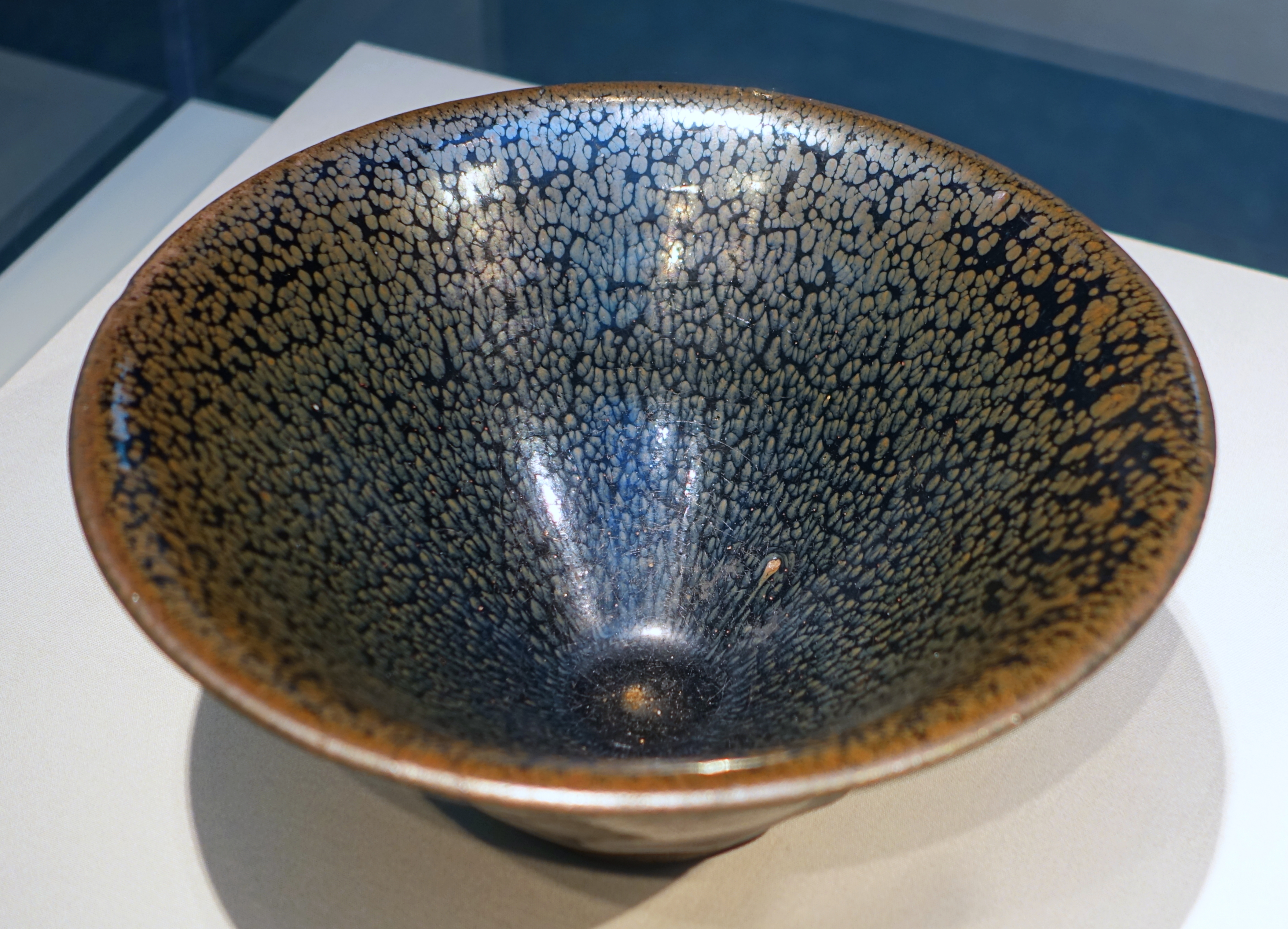
3. Why Record of Tea especially stresses dark bowls: because Cai Xiang is talking about tea operation, not object display
The most frequently quoted sentence in Cai Xiang’s Record of Tea says: “Tea is white, so dark bowls are suitable. Those made in Jian’an are a deep black, with markings like hare’s fur; their body is slightly thick, and once warmed they stay hot and are slow to cool, making them the most useful.” This passage is already remarkably complete. First, it explains why bowl color should be dark. Second, it explains why this specific type of dark bowl from Jian’an was especially suitable. Third, it shows that suitability lies not only in color, but also in a slightly thick body and strong heat retention.
The most revealing phrase there is “most useful.” Cai Xiang does not say “most beautiful,” nor “most prestigious.” He says “most useful.” Useful in what sense? The first half explains the visual condition; the second half explains the thermal condition. So Jian bowls rose to the center of Song whisked-tea use for at least two linked reasons: dark glaze made whiteness easier to see, and a thicker body with slower cooling created better working conditions for whisked tea. Jian bowls did not win only because of their glaze patterns. They won because darkness and retained heat worked together.
That means Record of Tea is not simply handing the modern collecting world a sentence to copy. It is recording how Song tea people folded vessels into a technical system. Once we read it that way, dark bowls stop looking like decorative props and start looking like operational tools.
4. Why “stays hot and is slow to cool” was so important: because bowl temperature directly affected whether foam could rise and how long it could stand
If we notice only the dark glaze, we still underestimate Jian bowls. Cai Xiang immediately stresses their slightly thick body and long heat retention, which tells us that Song people were not talking about flat color alone. They were talking about a thermal vessel that actively participated in the whisking process. Whisked tea was not finished the moment tea powder and hot water met. It was a dynamic process in which the whisking had to raise and sustain a milky foam across the bowl surface. If a bowl was too thin and lost heat too quickly, the surface condition could destabilize more easily.
That is also why Record of Tea says, “Whenever one wishes to prepare whisked tea, the bowl must first be heated; if cold, the tea will not float.” In other words, Song tea people clearly understood that if the bowl was cold, the surface state would be worse and the foam would not rise well. By extension, a bowl that stayed hot longer would naturally make it easier to maintain a favorable surface environment for whisking. The thicker, heat-retaining body of the Jian bowl became a practical advantage exactly here.
So dark bowls mattered for more than visual contrast. They were also tools for making tea “stand” properly. White foam needed dark glaze for visibility; it also needed thermal stability for duration. Jian bowls combined both of these in one object. That is the real depth of their suitability.
5. Why doucha raised the status of dark Jian bowls even further: because doucha required a bowl surface that was comparable, visible, and judgeable
As long as Song whisked tea remained a matter of individual tea preparation, dark bowls already had advantages. But once the same technical world moved into doucha, the status of Jian bowls rose even faster. The reason is simple: contest culture needs a clear, shared, and visible judging surface more than ordinary daily use does. Doucha depended on winning and losing, and those outcomes depended on foam quality, water traces, “biting the bowl,” and durability. That meant the bowl surface could not be ambiguous.
Cai Xiang’s “Whisking Tea” section makes this explicit: in Jian’an tea contests, the side whose water traces appeared first lost, and the side whose foam lasted longer won. That means the contest was not abstract talk. It required observers to see who broke first, who held longer, who revealed water marks sooner, and who maintained structure. Once that is the rule, the bowl surface has to make those changes legible. Dark-glazed Jian bowls did exactly that.
Put differently, doucha did not merely happen to like dark bowls. This visible judging system actively pushed vessels toward darkness, stability, and sustained heat. Jian bowls were not elevated by a detached discourse of object admiration. They were elevated by repeated practical situations in which people needed to distinguish winners from losers.
6. Why specifically Jian bowls, and not just “any dark bowl”? Because Jian bowls brought together region, glaze color, body thickness, and practical reputation
At this point we can ask a further question: if Song tea needed dark bowls, why did Jian bowls become the most famous answer rather than just any dark-colored tea bowl from somewhere else? The answer is that historically successful vessels usually satisfy not one condition but a whole cluster of conditions. Jian bowls were not only dark, but deeply dark. They not only had dark glaze, but often hare’s-fur-like streaking and a surface character that could visually carry activity across the bowl. They were not only visually effective, but relatively thick-bodied and slow to cool. And because they stood geographically and culturally close to the Jian tea and Jian’an whisked-tea world, they entered the language of standards more easily than many rivals.
That means Jian bowls did not win by chance on a single metric. They won because they were simultaneously suitable on several metrics at once. Other dark bowls might also have set off white foam well, but not necessarily with the same heat retention. Other bowls might also have retained heat, but not accumulated the same prestige within whisked-tea circles. Still others may have had certain local strengths, but failed to bind themselves to Jian tea, contest scenes, and tea-text discourse with equal intensity.
So the success of Jian bowls resembles the logic by which Jian tea itself became central: not because they were uniquely good in one isolated sense, but because they were good in the most systematic way. Once dark glaze, thick body, retained heat, visual contrast, regional centrality, and textual reputation all converged, Jian bowls were very hard not to become the core vessel of Song whisked tea.
7. Why The Daguan Tea Treatise continued to reinforce this tendency: because by Zhao Ji’s time, dark bowls were no longer just practical experience, but part of a mature standard
By the time of Zhao Ji’s The Daguan Tea Treatise, this evaluative structure had become even more complete. The section on bowls says clearly that bowl color should value dark blue-black tones, especially those with well-developed markings, and that only when the bowl is warm does the tea stand and endure. These lines effectively restate the same logic seen in Cai Xiang: the first part concerns bowl color and glaze character, while the second concerns thermal condition and the durability of the whisked surface. In other words, by the late Northern Song, the core advantages of the dark bowl had not changed. They had become more fully standardized.
What matters here is not merely that Zhao Ji agreed with Cai Xiang. The agreement itself shows that dark bowls were not a private taste of one writer, but a broadly shared operational truth within the whisked-tea world. If this had been only an individual preference, it would not necessarily have been confirmed across different moments by the central tea texts of the age. Once it is repeatedly confirmed, however, it has moved from practical preference into a mature norm.
So The Daguan Tea Treatise does more than repeat Record of Tea. It tells us that by Emperor Huizong’s time, the relation among vessel, foam, bowl warmth, and tea judgment had become stable enough to enter the standard textual order of the age. Jian bowls at this point were no longer simply a good local vessel from Jian’an. They had become the proper vessel inside a systematized whisked-tea aesthetic.
8. Why it is easy for modern readers to reverse the order: because we first encounter Jian bowls as collectible objects, then work backward to tea history
Today many people encounter Jian bowls not through whisked tea but through museums, auction catalogues, glaze typologies, reproductions, or a broader imagination of “Song-style life.” There is nothing wrong with that entry point, but it creates a tendency: we first see the independent beauty of an object, and only afterward try to add tea back in. Once that happens, Jian bowls easily get written as aesthetic idols of Song taste, with tea reduced to background.
The historical order was the reverse. The Song did not first create a world of vessel collecting and then recruit whisked tea to decorate it. Instead, there first existed the concrete needs of whisking tea, contesting tea, producing white foam, maintaining warm bowl surfaces, and observing water traces. Out of many possible vessels, the most suitable ones were gradually selected. Jian bowls rose because they served that tea world especially well, not because Song people venerated them as pure autonomous artworks detached from use.
This matters a great deal. Once we reverse the sequence, we underestimate the power of tea method to shape vessel history. In reality, the bowl did not single-handedly dominate tea. The tea method and its evaluative mechanisms posed the problem first, and the vessel supplied the best answer. The status of Jian bowls grew out of that problem-and-response relation.
9. Conclusion: the importance of Song dark Jian bowls lies not in being “elevated black objects,” but in best carrying the core standards of the whisked-tea world
If I had to compress this article into one sentence, I would say this: the Song formed the consensus that “tea is white, so dark bowls are suitable” not because black glaze was first mystified, but because the age of whisked tea pursued white foam, warm bowl surfaces, visible water traces, and bowl-biting stability, and these standards together pushed dark, relatively thick Jian bowls into the most suitable role.
So the historical significance of Jian bowls is not only that of a famous kiln product in the history of ceramic taste. It is also that of the best judging tool in the history of tea method. Such bowls made white foam easier to see, maintained a bowl surface more favorable to whisking, and made victory and defeat in doucha easier to perceive. The “value” of the dark bowl was not abstract value. It was value produced by the overlap of function, technique, and aesthetics.
What deserves to be remembered today is not simply that “Song people liked black vessels,” but that the Song whisked-tea world gradually selected one vessel form into a standard. Once we return to the scene described by Record of Tea and The Daguan Tea Treatise, it becomes clear that Jian bowls were never lonely objects sitting beside tea history. They were one part of the whisked-tea order itself.
Continue reading: Why Cai Xiang’s Record of Tea matters, Why The Daguan Tea Treatise matters, Why Song doucha was not merely a contest, and Why Jian tea became the national center of Song tea culture.
Source references: the core basis of this article lies mainly in Record of Tea on “tea is white, so dark bowls are suitable,” “their body is slightly thick, and once warmed they stay hot and are slow to cool, making them the most useful,” “if cold, the tea will not float,” and “in Jian’an contests, the side whose water traces appear first loses, while the side that endures longer wins,” together with The Daguan Tea Treatise on dark blue-black bowls and the principle that warm bowls help the tea rise and endure. The aim here is to explain why dark Jian bowls became the core vessel of Song whisked tea rather than to provide a line-by-line philological edition of the texts.