History feature
Why Song fencha deserves its own place in Chinese tea history: not a light synonym for tea baixi, but a high-skill art that compressed foam, viewing, technique, and ephemeral images into a single bowl
Today, when Chinese-language internet culture mentions tea baixi, it often casually drops the term fencha alongside it without really treating fencha as a historical object worth separating. It is commonly written up as a pretty, light, short-video-friendly factoid: Song people could make landscapes, characters, flowers, or birds appear on the tea surface, so they were refined and playful. The problem is exactly there. If fencha is reduced to “ancient people could draw on tea,” then its place in tea history becomes far too small. What is really worth asking is not whether premodern drinkers could make patterns on the surface of tea, but why, in the whisked-tea world of the Song, the tea surface itself became a place that could be compared, watched, displayed, and briefly written upon. Fencha deserves separate treatment not because it is exotic, but because it compresses some of the most central components of the diancha age—white foam, dark bowls, whisking control, judgment, and live spectatorship—into a single bowl.
That means the real concern of this article is not why “tea baixi” is popular again today, but what fencha meant inside the Song world itself. The site already has an article on why tea baixi is trending again, focused on contemporary revival, visual circulation, and non-heritage experience culture. This piece goes one step deeper into historical structure and handles fencha as such: why it could only grow in the age of whisked tea rather than in the age of steeped loose leaves; why it depended so strongly on white foam and dark bowls; why it sits close to the edge of doucha while also belonging to the center of literati viewing culture; and why it disappeared with the whisked-tea world instead of surviving as a fully independent art form.

1. Why fencha deserves separate treatment instead of being treated as a synonym for tea baixi: because it is not about patterning alone, but about the historical elevation of the tea surface itself
Many historical terms get written too lightly not because they are unimportant, but because they are easy to romanticize. Fencha is one of them. The moment it is mentioned, modern readers immediately think of characters, landscapes, or birds appearing on a tea surface, and naturally interpret it as an ancient version of latte art. That association is not wholly wrong, but if the discussion stops there, the historical emphasis shifts in the wrong direction. The true importance of fencha does not lie in the “pattern” alone. It lies in why the surface of tea, in the Song, was elevated for the first time into a place that could carry technique, judgment, spectatorship, and admiration.
The word “surface” matters here. Before the Song, tea of course already had color, aroma, vessels, and handling. But the peculiarity of the Song lies in the extent to which the surface itself became important. In doucha, one had to observe whether the foam held, when water traces emerged, and whether the foam clung to the bowl. Literati viewing culture then turned this habit of “looking at the tea surface” into an aesthetic act. Once the bowl surface is already treated institutionally, aesthetically, and competitively as important, fencha is no longer an accidental embellishment. It becomes a high-level mobilization of the whole whisked-tea system. It asks tea production, whisking, water control, bowl choice, and spectatorship to act together in the same instant.
Put differently, the importance of fencha does not lie in proving that ancient people were imaginative. It lies in showing that the tea surface had already been trained into a place dense with cultural meaning. If an age does not care about the bowl surface, fencha cannot exist. If an age cares only about drinking and not about watching, fencha cannot exist. If an age lacks stable whisked-tea technique, fencha cannot exist. It is precisely because the Song held all of these conditions together that fencha deserves a distinct place in Chinese tea history rather than being reduced to a decorative footnote under tea baixi.
2. Why it could only grow in the age of whisked tea rather than the age of steeped loose leaves: because fencha requires not just liquid, but a controllable field of white foam
To understand fencha, we have to return to whisked tea itself. Elite Song tea culture was not built around the later method of tossing loose leaves into a pot and letting aroma, leaf shape, and layered infusions carry the experience. Instead, it involved processing compressed tea into fine powder, making a paste, adding water in stages, and whisking until a dense pale foam rose across the bowl surface. That means Song tea drinkers were often looking at something different from what later tea cultures primarily looked at. Later ages more often attended to the brightness of liquor, fragrance, aftertaste, or open leaves; the Song whisked-tea world attended intensely to foam, bowl-surface behavior, and the emergence of water traces.
Once that premise is clear, it becomes obvious why fencha belongs to the age of diancha. Fencha is not drawing on any arbitrary bowl of tea. It is making variation upon a surface of already-formed white foam. Its images are not pasted onto the surface from outside; they arise through water marks, foam disturbance, concentration differences, and fine adjustments in thickness and flow. In other words, the tea surface has to be at once delicate, high in contrast, and stable enough to hold form for a short time. Without the powdered-tea world that made pale foam the central object of attention, fencha could not even begin.
This also explains why, after the Yuan and Ming, as whisked tea withdrew from the center of elite tea culture, fencha could no longer remain stably inside the mainstream. It was not that later people lost their poetic sense or ceased to like images. The underlying tea-surface conditions changed. In the age of steeped loose leaves, the center of tea moved away from making a bowl surface into a judged field of pale foam and toward leaf behavior, fragrance, texture, and infusion control. Once the center of attention moved from the surface to liquor and leaves, a technique defined by brief images on the surface naturally lost its institutional ground.
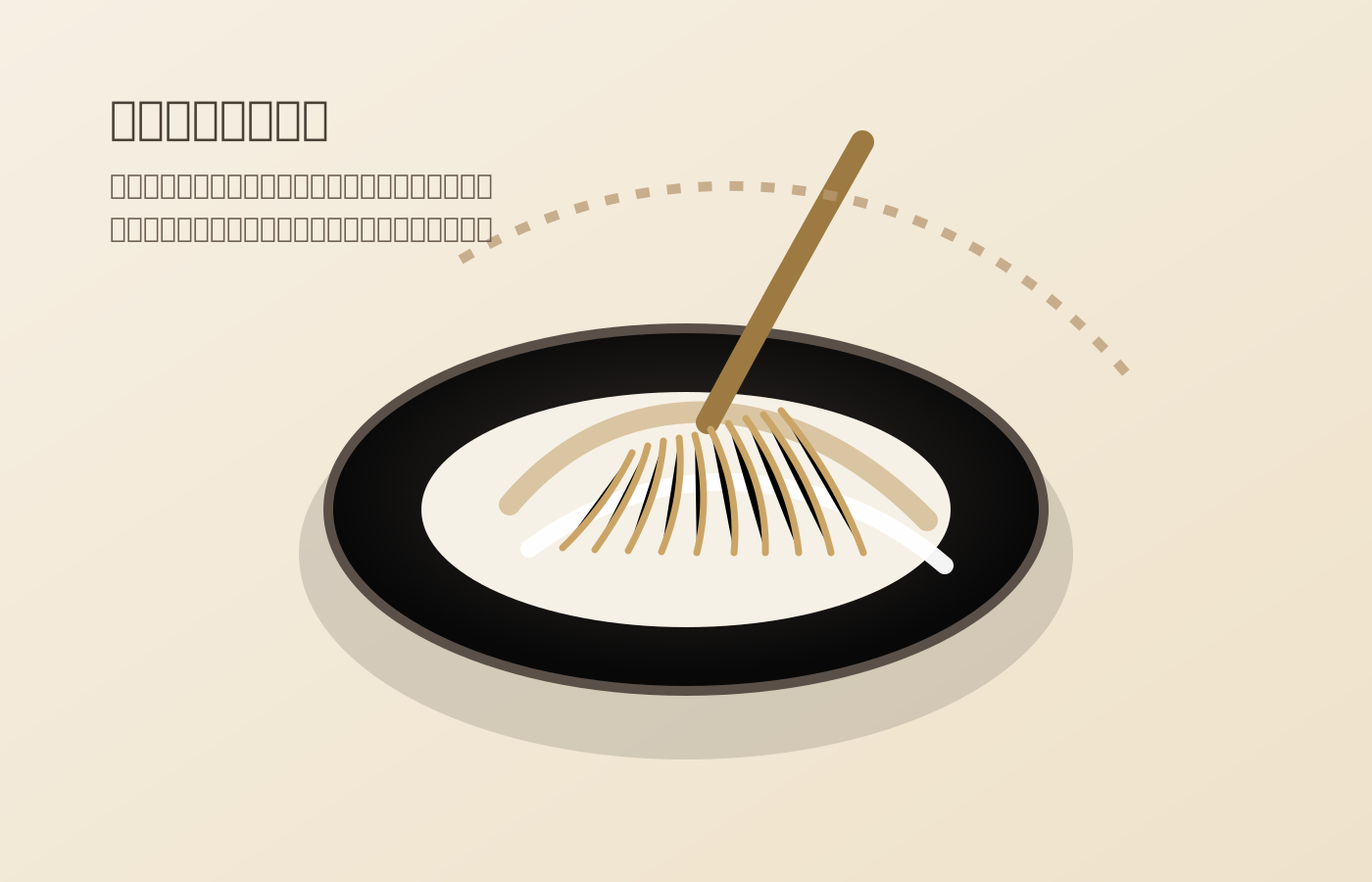
3. Why it almost always appears alongside white foam and dark-glazed bowls: because it is, in essence, a surface image that exists only through contrast
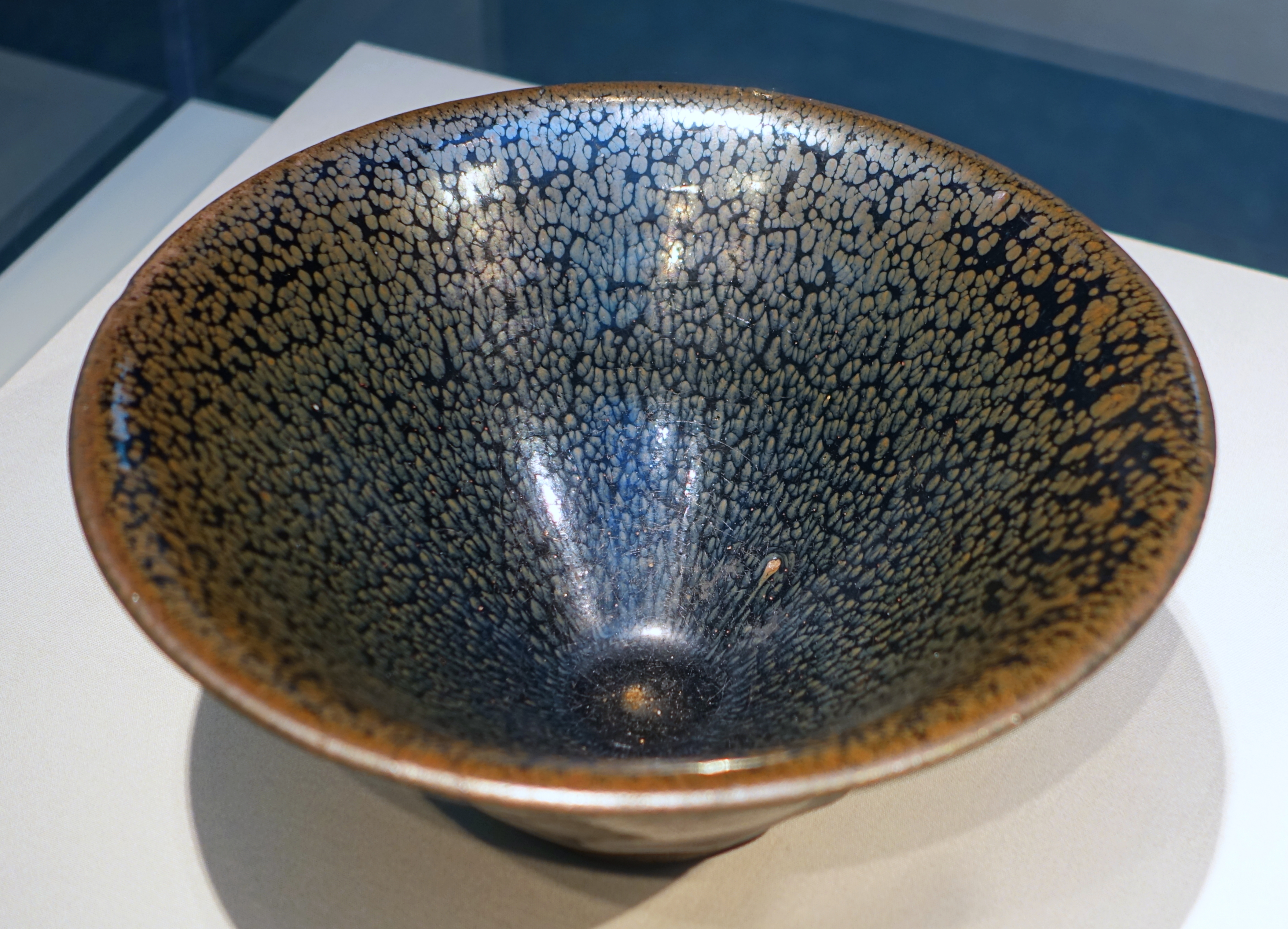
Today, whenever people encounter images of fencha, they usually see dark bowls, white foam, a whisk, and a striking bowl-surface effect all at once. This is not merely a later “ancient-style” visual package assembled for photography. It comes from the image logic of fencha itself. For a pattern to be visible on the surface of tea, it first needs a strong contrast field. White foam set against a light-colored background will not show fine water traces or contour changes easily. Set against a deep, nearly black bowl, white and black create immediate contrast. Song tea culture valued black-glazed bowls not only because it “liked black,” but because the whisked-tea world needed darkness in order to let whiteness reveal itself.
This fits closely with the site’s recent article on why Song whisked tea preferred dark Jian bowls. That essay explains why dark bowls became central to whisked tea in general. From the angle of fencha, we can see something more specific: dark bowls mattered not only because they made it easier to judge foam quality, but because they made visible image-making possible on the tea surface. The deep bowl surface functions like a stage backdrop; the white foam becomes the illuminated foreground; fine water lines and tonal shifts complete their brief inscription on that tiny stage. Without this contrast, fencha would be much less able to move from “the maker knows what they are doing” to “the onlooker can immediately see what has happened.”
That reveals another often-missed point in the historical significance of fencha: it is not technique alone, but technique in alliance with spectatorship. A gesture only becomes culturally stable when others can see it, recognize it, and admire it. Fencha becomes a “performance” not because it is unserious, but because it is inherently legible in live viewing. Dark bowls and white foam are exactly the conditions that heighten that legibility.
4. Why it stands close to doucha without being reducible to doucha: because it moves from the edge of contest judgment into the center of aesthetic display
Doucha was crucial to the Song whisked-tea world. It judged whose foam was whiter, more even, and more durable; whose bowl showed water traces earlier; whose surface held longer. This surface-centered comparison already trained the tea surface into something worth looking at with great seriousness. In that sense, without doucha and its intense sensitivity to foam, duration, and water traces, fencha would not have existed in the way it did. It depends on the same class of capacities: first making a stable tea surface, then controlling difference within that stability, and finally directing difference toward image rather than toward victory alone.
But fencha is still not the same thing as doucha. Doucha asks who is better. Fencha asks what else can be made. One is organized around ranking; the other around expansion of possibility. One compares performance; the other turns performance into visible display. They share the same technical soil, but they use it for different cultural ends.
This is exactly why fencha deserves to be written separately. It shows that the Song whisked-tea world was not governed only by competition and vessel hierarchy. It also converted highly technical control of the tea surface into an aesthetic event open to viewing, discussion, and admiration. Technique did not stop at utility. It was further aestheticized. For tea history, that matters enormously: tea was no longer only drunk, compared, and discussed; it could also be watched as a brief event of image formation.
5. Why it especially appealed to literati: because fencha gave tea something like the viewing time of painting and calligraphy, while remaining instantly perishable
If we understand fencha only as technical display, we still miss the core. What made it especially attractive to literati was its unusual relation to time. Ordinary painting and calligraphy exist on silk or paper and can be viewed repeatedly. Fencha is different. Its images appear briefly on the tea surface. You can see them, but you cannot keep them. You can admire them, but they are already dissolving. In other words, the deepest pleasure of fencha lies not in leaving behind a finished object, but in watching an image emerge and disappear within a very short span of time.
That temporal structure aligns closely with Song literati taste. Song culture valued writing, implements, painting, and also the fine-grained pleasures of cultivated daily life. Fencha compresses all of these into a very short moment: it has technique, image, improvisation, and control; it resembles calligraphy without being literal calligraphy; it resembles painting without becoming a durable picture. For literati, that fleeting yet legible image held a special subtlety. It turned viewing from contemplation of a static object into attention to an event.
That is why fencha is not simply “painting on tea,” but composing briefly on a dissolving material surface. Its ephemerality is not a defect. It is part of its charm. It stands in productive contrast with paper-and-silk arts: calligraphy and painting aim at endurance, while fencha aims at emergence; those can be revisited, while this can only be truly seen in the moment. That time-bound mode of viewing makes fencha feel like a higher-order pleasure inside the Song world rather than merely a decorative trick.
6. Why it did not continue as an independent long-term art like painting or calligraphy: because it remained bound to the infrastructure of whisked tea from beginning to end
At this point a natural question appears: if fencha was so subtle and impressive, why did it not survive as a stable independent tradition in the way calligraphy, painting, or ceramics did? The answer lies in its very strengths. Fencha is so compelling precisely because it depends on the entire infrastructure of the whisked-tea age: powdered tea, paste preparation, whisking, white foam, dark bowl surfaces, habits of viewing, literati taste, and live technical control. Remove part of that system and fencha weakens. Remove the whole whisked-tea world and it loses its ground of growth altogether.
Unlike calligraphy, it cannot detach itself from a specific food-and-drink scene and survive on its own material support. Unlike a vessel, it cannot remain as a durable object after use. Its material is too fleeting and its conditions too concentrated. It must exist in a bowl, within a brief time, inside a very particular technical state. Precisely because it was so tightly integrated with one historical system, it was also very difficult to carry across time once that system withdrew.
That is why, when we discuss fencha today, we should treat it as a window into the Song whisked-tea world rather than imagining it as a completely uninterrupted independent art line extending unchanged into the present. It is better understood as a recovered historical capacity than as a seamless surviving everyday tradition. That reading gives it a more accurate, not a lesser, historical dignity.
7. Why re-understanding fencha still matters today: because it corrects our habit of writing tea history only as a history of drinking or of objects
Many current ways of writing tea history tend to split in two directions. One writes about institutions, taxes, regions, trade, and tribute. The other writes about famous vessels, bowls, kilns, and connoisseurship. Both matter. But something often falls out between them: how tea acquired cultural density in the instant when it was made, served, watched, and compared. Fencha restores that missing layer. It reminds us that tea history is not only the history of production or the history of things. It is also a history of how surfaces were trained to be seen.
Once fencha is written seriously into the story, the shape of Song tea culture becomes more complete. We begin to see that the real power of the whisked-tea age did not lie only in how carefully tea books were written or how beautifully Jian bowls were fired. It also lay in the fact that one tiny bowl surface could simultaneously bear technique, competition, spectatorship, imagery, and conversation. Tea here is not only a drink and not only the content of a vessel. It is a highly compressed visual-cultural scene.
This matters especially for how we understand tea baixi today. If we first understand fencha clearly, we are less likely to write contemporary reconstructions and performances off as nothing more than “ancient-style check-ins” or generic non-heritage shows. Of course present-day forms involve packaging, performance, and traffic logic. But the real historical core being reactivated is that the Song truly trained the tea surface into an interface capable of carrying images and viewing relations. That historical fact matters more than any packaging vocabulary around it.
8. Conclusion: what fencha really reveals is not simply that Song people were playful, but that the age of whisked tea turned the tea surface into a high-density cultural interface
If I had to compress this article into one conclusion, I would put it this way: the true importance of fencha in Chinese tea history does not lie in proving that Song people could draw on tea. It lies in showing that the Song whisked-tea world elevated the tea surface, for the first time in a stable way, into a high-density cultural interface. That interface could be judged, watched, displayed, admired, and briefly inscribed. Once that level is recognized, fencha is no longer a minor curiosity. It becomes the result of the internal logic of the diancha age pushed to an extreme.
It depends on white foam, so it belongs to the whisked-tea age. It depends on dark bowls, so it is tied closely to the visual logic of bowl-surface observation. It stands near doucha, but not merely for winning and losing; it turns the control cultivated at the edge of contest into an aesthetic event at the center of spectatorship. It attracted literati not only because its patterns resembled calligraphy and painting, but because it made emergence and disappearance themselves into the object of refined attention. And it later struggled to survive independently precisely because it was bound so deeply to the whisked-tea system from beginning to end.
So to understand fencha is not simply to understand a technique of “drawing on tea.” It is to understand a crucial moment in Chinese tea history when tea ceased to be only something for the mouth, or only something inside a vessel, and became a temporary surface for viewing, judging, and inscription. For the history section, that is exactly why it deserves to stand on its own.
Further reading: Why tea baixi is trending again, Why Song whisked tea preferred dark Jian bowls, Why Song doucha was not merely a contest, and Why The Daguan Tea Treatise matters.
Source references: this article is based on established tea-historical knowledge about Song diancha, doucha, fencha, and tea baixi. Its core arguments are that fencha depended on the stable white foam produced by whisked tea; that dark bowls such as Jian ware were crucial to making foam and image effects visible; that fencha shared the bowl-surface control cultivated in doucha while redirecting it toward aesthetic viewing; and that fencha declined together with the whisked-tea system rather than surviving as an independent long-term art category detached from it. The focus here is to explain fencha’s structural position in Song tea culture, rather than to produce a line-by-line philological edition of classical texts.