Teaware feature
Why a tea tray is not just the English version of chapan: service trays, dry-brewing tabletops, and its real boundary from the tea tray, tea boat, and pot stand
Many people first meet the phrase tea tray through English product language, and from there make a very understandable but very misleading leap: if it is called a tray for tea, then it must simply be the same thing as the traditional Chinese tea tray / chapan, perhaps just in a lighter or more modern form. That idea catches part of the picture, but not enough of it. In actual contemporary tea life, a service tray or tea tray often does not carry the full burden of a traditional chapan. It is usually not the main device for catching runoff, defining the wet zone, and organizing the whole table. More often, it works as a movable service plane: a place to gather a set of vessels, bring them from cabinet to table, stage a compact dry-brewing setup, or carry a complete tea moment from one part of the house to another. It has order, but not the same order as a traditional tea tray.
That is exactly why this object deserves a separate explanation. It stands at an increasingly common but increasingly blurred intersection: on one side are the clearer traditional Chinese categories such as chapan, tea boat, pot stand, and jianshui; on the other side are modern home habits, English product naming, lighter dry-brewing layouts, and the logic of mobile service. The modern tea tray is not important because it is simply “a tray that holds tea things.” It is important because it gives a set of vessels a shared, movable, temporarily coherent base before or around actual tea service.
Even more importantly, it forces a useful distinction back into view: which objects organize the whole tea table, and which ones mainly carry, stage, and serve. If that distinction disappears, then everything flat becomes “just another tray.” But once it becomes clear again, the modern tea tray stops looking like a cheap substitute for the traditional chapan, and starts to appear as a different and very contemporary object category: one that allows tea to leave a fixed tea table without immediately losing all of its order.
1. Why the modern tea tray should not be reduced to “the English version of chapan”
Once terms travel across languages, shape often overwhelms function. Tray looks like 盘, so tea tray becomes tea tray / chapan by reflex. That is easy to understand, but it misses the real issue. Traditional chapan holds its ground in Chinese tea practice because it usually bears a heavier set of responsibilities: catching water, channeling runoff, defining the wet zone, compressing movement paths, organizing the center of the table, and in many cases acting as real infrastructure for brewing. The modern tea tray is different. It often does not exist to receive large amounts of water, and it does not automatically demand that the whole tea session unfold inside its boundaries. Much more often, it handles a lighter task: giving a set of teaware a shared surface that can be carried, placed, and served, and giving a table a local service zone when a full tea tray is absent.
That difference matters immediately. If you mistake the service tray for a traditional tea tray, you begin asking the wrong questions at once: why does it not drain, why does it not catch more water, why does it feel more like a serving tray, why can it be lifted so easily? None of those are necessarily failures. They are often signs that you have assigned it the wrong job. The modern tea tray was not designed primarily to replace the drainage tray. It was designed to make moving, staging, and serving teaware more coherent. Its strength is not that it locks the whole tea table into place. Its strength is that it lets a small system of objects travel together.
Put differently, the traditional tea tray behaves more like a working platform, while the modern tea tray behaves more like a service surface. The first says, “this is where tea work happens.” The second says, “these things can be brought there together, and can settle there without instantly falling apart.” Of course the two can overlap. Some contemporary tea trays can be lifted; some service trays can host light brewing. But if understanding collapses them completely, one of the most interesting layers of contemporary tea-life organization disappears.
2. Its first real job is to let a group of vessels travel and settle together
People tend to underestimate trays because they often look at teaware in static images. Real life is different. Tea is not always made at one permanently arranged tea table. It may move from cabinet to desk, from kitchen to living room, from sideboard to balcony, from studio shelf to meeting table, or even from indoors to a terrace or garden. The moment objects need to move, a shared plane becomes important. Without one, every object must be carried, placed, and oriented individually. Once several pieces are involved, order begins to fight itself: where do the cups land first, where does the fairness pitcher go, where does the main brewer rest while everything else is still in motion?
The first concrete value of the modern tea tray is that it gathers what would otherwise be scattered objects into one temporary unit. A pot, gaiwan, fairness pitcher, cups, a tea towel, a small caddy, perhaps a sweets dish or aroma vessel, sometimes even a small jianshui, can be related to one another on this surface before they enter the actual scene of use. That sequence matters. It means the order of the tea table does not need to be invented only after each object has separately arrived. Part of the order is prepared in the movement itself.
That is one reason the tea tray suits contemporary life so well. Modern homes and workspaces often do not want a full tea setup permanently occupying a table. Tea tends to appear in temporary, repeatable, and reversible ways. The tray serves exactly that rhythm. It allows tea service to be mobile without forcing every session to begin from total disassembly and improvisation. It allows tea to move without making movement itself look disorderly.
3. Why it works especially well with modern dry-brewing tables and local service zones
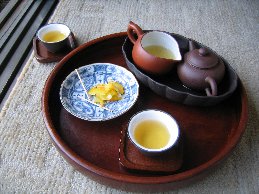
Dry brewing does not always mean that no supporting plane is needed. It means that the whole table should not become an open drainage field. That is exactly why contemporary dry-brewing tables often generate a new need: people do not want a large full tea tray, but they still want the main brewer, fairness pitcher, cups, and a few auxiliary objects to share a local boundary. This is where the modern tea tray becomes especially convincing. It does not need to swallow large amounts of runoff. It only needs to provide a preliminary zone of concentration. Which cups belong together, how far the pitcher sits from the brewer, where the towel and tea tools wait, how a sweets dish or aroma vessel stays in relation to the brewing area—these can all be gathered first on the tray.
This logic of a “local service zone” is different from the traditional tea tray. The traditional tea tray acts more like the central platform of a full brewing system. The modern tea tray acts more like a lighter foreground plane. It keeps objects from scattering directly across the table, while also keeping the table itself from having to absorb all responsibility for order. For side tables, desks, low tea tables, office meeting tables, and other everyday surfaces, this lighter organization can be extremely useful. Such surfaces were not born as tea tables. They have other daily lives. The tray allows part of them to become tea-ready temporarily without demanding that the entire surface be permanently converted.
This also helps explain why trays appear so often in contemporary home and English-language tea imagery. They answer a very modern tea-life condition: tea no longer lives only in a dedicated tea room. It appears flexibly within ordinary space. The tray prevents that flexibility from immediately becoming messiness. It does not solve everything, but it gathers the most easily scattered part of the system before anything else begins to drift.
4. How to distinguish the modern tea tray from the traditional tea tray
At first glance, both have surfaces, edges, and carrying functions, so many people instinctively start with shape: the thicker one is the traditional tea tray, the thinner one is a service tray; the draining one is a tea tray, the non-draining one is not. That kind of distinction is not useless, but it is still too shallow. The more reliable distinction is whether the object bears the responsibility of a whole working platform. In other words: is the entire tea session expected to unfold around it? Are the main wet gestures allowed to happen on it? Does it define the center, movement paths, and water logic of the table? If yes, it is moving closer to the traditional tea tray / chapan. If instead it mainly provides carrying, staging, local grouping, and a service surface, then it belongs more clearly to the modern tea tray or service-tray logic.
That is why some objects may look like trays in English but still function as real tea trays in practice. And conversely, some objects may look refined and almost tea-tray-like, yet still belong to service-tray logic if their primary work remains carrying and local service. Identity in teaware is not written only in shape. It is written in repeated use. Are you doing substantial water work on it? Are you compressing the whole session inside it? Do you treat it as the center of the tea table, or as a movable local platform? Those questions tell you more than the frame height ever will.
Once that distinction becomes clear, much of the confusion around modern tea setups quiets down. You stop asking a tray to do the whole job of a brewing platform, and you stop using a real tea tray as though it were merely a transport tool. Each object returns to the scale of work it is best suited to handle.
5. Why it should not simply be equated with the tea boat or the pot stand either
If we scale downward from the tea tray, we meet another easy confusion. Since the modern tea tray is also a supporting surface, is it simply a larger version of the tea boat or the pot stand? Again, no. The tea boat and pot stand deal with a far more concentrated area: the small local zone beneath the main brewing vessel. They are concerned with heat, moisture, balance, and the place to which the main pot returns after pouring. The modern tea tray is much less concentrated than that. It usually faces a group of vessels rather than one primary vessel. It cares about carrying, staging, and shared service more than about the consequences under a single pot.
That is why the tea boat and pot stand do not translate easily into carrying surfaces for a whole tea set. They may seat the main brewer beautifully, but once you need to bring out the fairness pitcher, several cups, a towel, and perhaps a sweets dish together, the pot stand is no longer in the right role. The tea tray becomes meaningful at exactly that point. Its job is not to refine the tiny area beneath one vessel, but to provide a common base for a group of service objects. Its logic is closer to service than to support under one pot.
Put simply, the tea boat and pot stand establish the position of the main vessel. The modern tea tray establishes a way for several vessels to arrive together. The first goes deeper into the brewing action itself. The second goes deeper into carrying, staging, and serving. Both matter, but one cannot be turned into the other just by making it larger or smaller.
6. Why the tea tray also changes the feeling of service and hospitality
Many discussions of teaware stay locked inside the brewing zone, as though once tea is brewed well, everything else is merely secondary. But the moment tea enters hosting, sharing, conversation, work meetings, or everyday family life, the question of how it is brought out stops being small. This is one of the places where the modern tea tray becomes especially strong. It allows tea not to appear as scattered objects awkwardly transferred one by one to the guest’s side, but as a prepared service unit. The main brewer and cups do not need separate entrances. A towel and a sweets dish do not need to follow afterward as corrections. Everything can first be organized on one shared plane, then carried to the low table, side table, or meeting table as a coherent offering.
This feeling differs sharply from the more work-oriented presence of the traditional tea tray. The traditional tray says, “tea starts here.” The service tray says, “this set of tea things is ready to arrive before you.” That is why it naturally creates a stronger sense of service. Not a theatrical restaurant service, but a quieter and more mature kind of hospitality: tea is not a handful of separate objects. It is a small system that can be presented whole.
That also helps explain why English-language tea and home-living content relies so heavily on the tray image. The tray makes readiness visible. It moves tea from storage mode into service mode. It lets hospitality feel less improvised and more continuous. If we translate every one of those objects back into the traditional tea tray too quickly, we lose this distinctly modern and domestic layer of meaning.

7. What makes a modern tea tray actually good to use
The easiest mistake is to choose it first as something that “looks tea-like,” and only later remember that it is a tool that must be lifted, carried, and set down. The real first standard is carrying stability. Does it wobble when lifted? Are the edges high enough to limit sliding? Is the grip point obvious? When set down, does it jolt cups, make the main brewer shift, or produce a nervous clatter? If those questions fail, then beautiful wood grain, woven bamboo, or stony textures belong only to still-life photography, not daily use.
Size comes second. Too small, and the core vessels immediately crowd one another, defeating the purpose of the tray. Too large, and movement becomes heavy, as if you are carrying a whole tabletop. Mature sizing is not about maximum capacity. It is about matching the most common service unit in your real life: what one-person drinking needs, what two- or three-person sharing needs, what office tea service needs, what living-room hosting needs. A tray is best when it allows exactly the right set of objects to move together, not when it tries to hold everything at once.
Third comes boundary and retreat. A good tray gives a clear but not overly clumsy edge so that vessels feel safe in motion. After use, it should also retreat easily: easy to clean, easy to return to a cabinet or shelf, easy not to become another permanent table-occupying object. Because the whole point of the service tray is mobility and flexibility. If the tray itself becomes too heavy, too awkward, too difficult to clean, it stops being a tool of convenience and becomes a new burden.
8. Common misunderstandings
Mistake one: the modern tea tray is just a lighter version of the traditional tea tray. Not exactly. They both support objects, but the traditional tray tends toward whole-table working logic, while the modern tray tends toward mobility, service, and local staging.
Mistake two: every English “tea tray” should be translated as chapan. This is the central confusion. Many English tea trays function more like service trays or carrying trays than like traditional Chinese tea trays.
Mistake three: any attractive tray can replace a real tea tray indefinitely. Temporary substitution is easy. Long-term use quickly reveals problems of grip, stability, boundary, vibration, material tolerance, and cleanup.
Mistake four: tea trays are mainly for styling and have little to do with actual tea drinking. In real life, they are very practical for moving teaware, building local service zones, staging temporary tea setups, and making hospitality less fragmented.
Mistake five: once you have a modern tea tray, you no longer need a traditional tea tray, tea boat, or pot stand. Quite the opposite. They answer different scales of questions. The tea tray carries a set of objects into the scene, the traditional tea tray organizes the whole table, and the tea boat or pot stand manages the local boundary under the main brewer.
Why the modern tea tray is worth understanding seriously today
Because it makes one contemporary reality especially clear: many people no longer drink tea at a permanently unfolded, specialized tea table. They bring tea into daily life through more flexible, lighter, reversible arrangements across changing spaces. As long as that reality exists, tray logic will not disappear. It may not carry the grand infrastructural role of the traditional tea tray, but it carries something else that matters just as much in modern life: it keeps a set of tea vessels from scattering during movement, lets service retain coherence in temporary settings, and gives teaware a stable shared plane before actual brewing or sharing fully begins.
To understand the modern tea tray is also to understand how Chinese tea-object systems reconnect with contemporary domestic life. Not every new situation should be forced into an old category, and not every English product word should be copied back unexamined. The more mature approach is to return to the problem the object is actually solving: what does it organize, what does it carry, what does it move, what does it serve? The modern tea tray deserves a separate explanation not because it is ancient, but because it is modern and honest. It reminds us that tea does not happen only at the fixed center of a dedicated tea table. It also happens in every transition where vessels are carried out, settled, and presented together.
Related reading: Why a tea tray is not just a tray, Why a tea boat is more than a stand under the teapot, Why the pot stand matters again today, and Why jianshui became central again in the age of dry brewing.
Source references: public Chinese-language discussions around trays, service trays, dry-brewing setups, mobile tea service, living-room tea tables, and the English product language of tea trays / service trays, cross-checked against the functional boundaries already established on this site between the traditional tea tray, tea boat, pot stand, and jianshui. The focus here is on the logic of the modern tea tray in contemporary life, not on mechanically equating every English tea tray with the traditional Chinese chapan.