Teaware feature
What is the difference between a tea tray and a tea boat? One organizes the movement and service of a grouped setup, the other manages the local landing zone beneath the main brewing vessel
Many people first treat the tea tray and the tea boat as the same class of object. After all, both seem to be things that support tea vessels. One looks a little larger, the other a little smaller; one may feel more modern, the other more traditional. That reading is understandable, but it is still too shallow. Once one returns to actual movement, it becomes obvious that the two do not answer the same problem. The tea tray is concerned with how a whole group of objects can be carried out, moved, set down, served, and temporarily organized together. The tea boat is concerned with how the small and sensitive zone directly beneath the main brewing vessel can absorb heat, a little moisture, repeated return movements, and the local center of gravity. One faces the problem of a grouped setup. The other faces the problem of the main brewer’s local working boundary.
That is why these two objects still deserve a dedicated comparison, even though each already makes sense on its own. When looked at alone, the tea tray is easy to reduce to a modern service tray. When looked at alone, the tea boat is easy to flatten into an old-fashioned name or a near-synonym of the pot stand. But once they are placed side by side, they reveal two entirely different scales of teaware logic. The tea tray governs how a whole setup enters a scene, how it is presented as a unit, and how tea can remain orderly even outside a fixed tea table. The tea boat governs how the main brewing vessel lands, returns, and keeps heat and moisture from spreading outward. One behaves more like a small mobile service system. The other behaves more like a local boundary system beneath the main brewer.
And because they belong to different scales, neither should be treated as a simple substitute for the other. If one tries to use the tea tray to replace the tea boat, the local heat-and-moisture boundary under the main brewer often becomes vague. If one tries to use the tea boat to perform the work of the tea tray, one quickly finds that it does not really organize a full group of service objects in motion. The moment a tea table compresses different scales into one problem, movement starts to feel loose. The moment the scales are separated again, placement and workflow become much clearer.

1. The shortest distinction: the tea tray organizes a group of objects, the tea boat organizes one main brewer
If one had to explain the difference in a single sentence, the clearest version would be this: the tea tray handles the shared movement, presentation, and service of a grouped set of teaware, while the tea boat handles the local support, local moisture control, and local landing point beneath the main brewing vessel. The tea tray typically appears when the main brewer, fairness pitcher, cups, tea cloth, snacks, or other auxiliary objects need to be brought together into a usable scene. The tea boat appears when one wants the main vessel to have a clear resting point that can absorb a little heat, a little moisture, and repeated return movements.
That difference may sound like a matter of size, but it goes deeper than size. The tea tray faces a problem of relationship: how several objects remain a group while being moved and placed. The tea boat faces a problem of boundary: how the local effects of the main brewer do not spread across the whole tabletop. One is an object for organizing relation. The other is an object for containing consequence. Both matter, but they work on different levels.
In other words, the tea tray is concerned with the whole transition by which tea moves from storage into service, while the tea boat is concerned with the recurring local node where the main brewer lands, works, and returns. The first serves entry into a scene. The second serves stability within the scene. Once these two questions are collapsed into one, teaware judgment becomes rough very quickly.
2. Why are they so often spoken of as one category? Because both “support,” but not the same kind of problem
The confusion is natural enough. Both appear as supporting surfaces. Both slightly lift tea objects away from the tabletop. Both contribute to order. And in English especially, tray-language easily gathers many different scales under one broad visual category. It is therefore easy to assume that anything which supports tea objects belongs to the same family. The problem is that this kind of sorting depends too much on outline and too little on action.
Once one returns to movement, the two objects reveal very different failure risks. The tea tray worries about a grouped setup losing its internal relation in motion: where the cups go first, where the fairness pitcher lands, whether the cloth and small accessories suddenly need separate rescue placement, whether the whole arrangement starts from fragmentation. The tea boat worries about the local consequences beneath the main brewer: where heat goes, where the small hanging drip goes, whether the brewer has a trustworthy return point, and whether local wet traces quietly expand into a table-management problem. The first is a problem of service organization. The second is a problem of local boundary.
So although both “support,” they do not support the same layer of order. The tea tray supports grouped relation. The tea boat supports local brewing consequence. One gathers several objects into a unit. The other keeps a small but sensitive zone from spreading outward. Once that distinction is seen clearly, it becomes much harder to flatten them into “a larger tray” and “a smaller tray.”
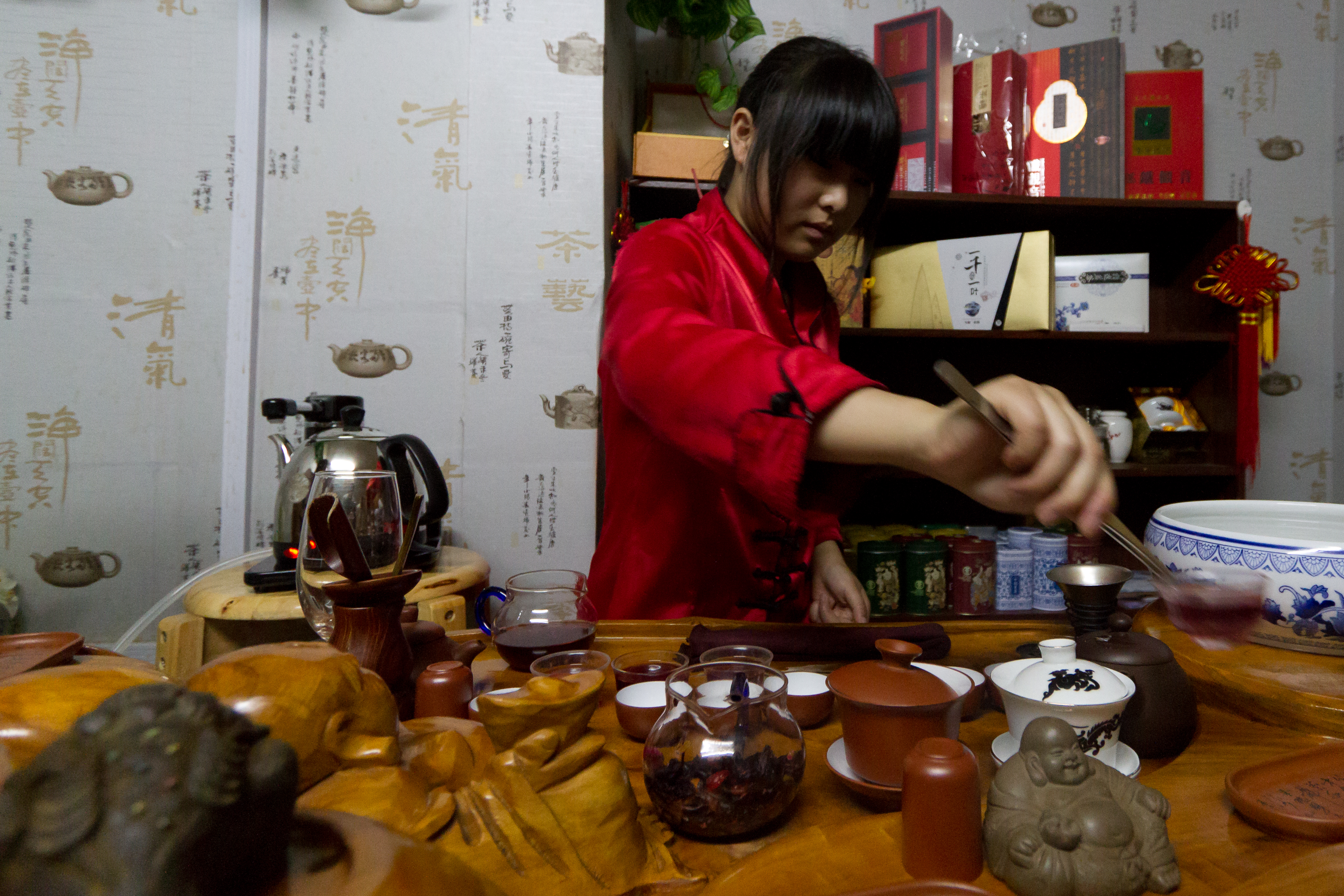
3. What the tea tray really does best is bring tea from storage state into service state
One of the most practical truths about modern tea life is that tea does not always happen at a fixed tea table. It moves from a tea cabinet to a writing desk, from a sideboard to a living room table, from a kitchen to a small reception table, from indoors to a balcony. The moment objects must move together, the question of how a whole setup enters a scene becomes real. Without a tray, each object must be carried separately, placed separately, and reorganized separately. As soon as the number of objects increases, the sequence starts to break apart.
The tea tray’s real value is that it gives this group a common plane first. The main brewer, fairness pitcher, cups, tea cloth, snack dish, aroma tools, and even a few small auxiliary pieces can establish an initial relationship on that shared surface before entering the scene together. Tea therefore does not begin from scattered transport. It begins from a service unit that has already been partly organized. The maturity of the tea tray lies not in how much it resembles a tea table, but in whether movement ceases to mean disassembly.
That is why the tea tray belongs more naturally to service and transfer logic than to local moisture-control logic. It can establish a temporary service zone on a dry-brewing table. It can let tea function in ordinary living spaces without requiring a permanently opened large tea table. It addresses the problem of flexibility: how tea enters another space without losing basic order.
4. What the tea boat really does best is localize the consequences beneath the main brewing vessel
The tea boat is entirely different. It does not need to carry a whole set of objects together. It does not exist to present tea as a full service unit. It serves the repeated return of the main brewing vessel. Wherever the main brewer exists, heat, moisture, steam, center of gravity, contact with the tabletop, a small hanging drip from the spout, or a little moisture from the lid edge will exist as well. The tea boat’s value lies in not letting those consequences spread immediately across the entire tabletop. Instead, it creates a local receiving zone right beneath the brewer.
This is also why the tea boat has become visible again in the age of dry brewing. Dry brewing does not mean the absence of water. It means refusing to let water spread without boundaries. The less one wants to place a large full tea tray on the table, the more one needs a mature small support beneath the main brewer. It does not need to absorb every wet movement of the whole tea session. It only needs to contain the most frequent, most local, and most repeated effects that gather around the main vessel. That act of “containing first” is the tea boat’s core reason for existing.
So the tea boat is not merely an old poetic term, nor only a decorative variant of the pot stand. It represents a precise object judgment: the whole table does not have to become a drainage system, but the space beneath the main brewer should not be left completely exposed to consequence. The tea boat is that local boundary made visible.
5. Why can the tea tray not replace the tea boat? Because a shared plane is not the same thing as a local return point
Many contemporary tea tables look simplified, so a common assumption appears: if I already have a tray and the main brewer sits on it, do I still need a tea boat? The answer depends on what one expects the tray to do. If the tray’s job is to bring a set of objects into the scene, then it has already done exactly what it should do. But that does not automatically mean it has also solved the local heat-and-moisture boundary beneath the main brewer.
The deeper issue is that a shared plane and a local return point are not the same thing. A tray may bring a grouped setup into the scene, yet still fail to give the main brewer a particularly clear, particularly stable, and particularly repeatable place to land. In a workflow where the brewer returns again and again, it can easily feel as if the vessel is simply “somewhere on the tray.” The tea boat, by contrast, makes the point explicit: the brewer comes back here, and the local consequences are primarily received here.
So when the tea tray is used as a substitute for the tea boat, the problem is usually not immediate collapse. It is that local order slowly becomes vague. The hand loses a crisp sense of where the brewer belongs, and the effects under the vessel begin to spread across a broader surface. The tray still has real value, but it is solving a different level of problem. It is not incapable. It is simply in a different role.
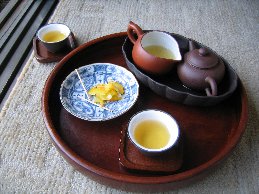
6. Why can the tea boat not replace the tea tray? Because a local receiving zone is not a mobile service system
The reverse mistake is just as common. Some people assume that if the tea boat can hold the main vessel and catch a bit of moisture, then a separate tray is unnecessary. But the tea boat handles the local zone beneath the main brewer, not the shared movement of a whole service group. It rarely wants to organize cups, a fairness pitcher, a tea cloth, snacks, aroma tools, and other service objects as one mobile unit. Nor is it especially suited to carrying them through larger scene changes.
The moment one forces the tea boat into the role of a tray, its limits become obvious. The setup lacks a proper shared plane, carrying becomes awkward, and scene changes still require secondary rearrangement. What was meant to make one local problem precise is pushed into doing grouped transport, so it naturally begins to feel cramped. Just as a cup stand should not be asked to become a tea tray, the tea boat should not be asked to become a service tray.
This also reveals an important principle: the maturity of an object usually does not lie in how many jobs it can half-do. It lies in how accurately it solves the problem at its own level. The tea boat matures through local boundary under the main brewer. The tea tray matures through the movement and service of a grouped setup. Once they are made to substitute for one another, both problems are often handled less well.
7. When should one think first of a tea tray, and when should one think first of a tea boat?
These are the situations that usually call first for a tea tray: you need to bring a grouped setup from a tea cabinet, sideboard, or kitchen into another space; you do not have a fixed large tea table but want a desk, coffee table, balcony table, office table, or small reception table to become temporarily tea-ready; you care about the feeling of serving a whole setup at once rather than carrying objects one by one; or you want tea to enter a scene as an already organized unit. All of these point toward one question: how to create a shared plane for several objects.
These are the situations that usually call first for a tea boat: you already have a clear main brewer that will repeatedly return to one point; you do not want to use a full large tea tray, but you also do not want the zone under the brewer to remain exposed; you care about the heat, moisture, visual center, and return logic directly under the main vessel; or you notice that the workflow is not chaotic but the brewer still feels as if it is only temporarily resting on the table. All of these point toward another question: how to establish a local boundary beneath the main brewing vessel.
The worst outcome is simply diagnosing the grouped-entry problem and the local-boundary problem as if they were the same thing. The first is not a larger version of the second, and the second is not a smaller version of the first. Both concern order, but they concern order at different scales. Once the scale is understood correctly, object choice becomes much clearer.
8. Common misunderstandings
Mistake one: the tea tray is just a larger tea boat. It is not. The tea tray organizes a grouped setup through movement and service, while the tea boat organizes the local support and return point beneath the main brewer.
Mistake two: the tea boat is just a smaller tea tray. Also not true. The tea boat does not exist to carry and present a whole grouped setup. It exists to localize the consequences under the main brewing vessel.
Mistake three: if both can support tea vessels, they belong to the same kind of object. That is precisely the roughest kind of classification. What matters is the level of the problem being supported: grouped relation or local boundary.
Mistake four: in modern life only the tea tray matters, while older names like tea boat can be discarded. As long as the local heat-and-moisture boundary under the main brewer still exists, the problem represented by the tea boat still exists as well. Names may shift, but the object logic remains.
Mistake five: once one has a large tea tray, neither object really matters. A large tea tray can certainly absorb many problems, but modern tea life does not always revolve around a fixed large tea table. The moment tea enters mobile, temporary, and dry-brewing logic, both objects become visible again.
Why is it still worth distinguishing clearly between the tea tray and the tea boat today?
Because this is not pedantry. It is a way of recovering scale on the tea table. Many objects are only said to overlap because people compress different scales of problem into one vague word. The tea tray faces the question of how tea enters a scene as a grouped setup. The tea boat faces the question of how the local consequences beneath the main brewer are kept from spreading outward. One belongs more to service logic. The other belongs more to local working boundary. Both support order, but not the same layer of order.
To separate them clearly is also to understand something fundamental about contemporary tea life: tea no longer happens only at the center of a fixed large tea table. It also happens in transition—while objects are carried out, set down, gathered, localized, and returned. The tea tray keeps a group of objects from scattering in motion. The tea boat keeps the main brewer from drifting in work. One brings tea into the scene. The other lets the main brewer sit firmly inside it. Once that line becomes clear, many teaware decisions return from appearance to action.
Further reading: Why the tea tray is more than a direct English rendering of tea tray, Why the tea boat is more than a support under the pot, Why the pot stand matters again today, and Why the tea tray is more than a tray.
Source references: written through comparison with the site’s existing articles on the tea tray, tea boat, pot stand, and tea tray systems, together with synthesized public Chinese-language discussion around mobile tea setups, dry-brewing surfaces, local moisture control, and the placement logic of the main brewing vessel. The focus here is object scale and workflow division rather than textual philology.