Teaware feature
Why the tea bowl is more than an ancient tea “bowl”: from bowl to zhan, from whisked tea to brewed tea, from Jian ware to modern drinking, and how to rethink one of the most easily overlooked vessels in Chinese tea
Today, when people hear “tea bowl,” two images usually appear at once. One is the black-glazed bowl of Song-dynasty whisked tea, especially Jian ware. The other is the museum-label version of the idea: an “ancient tea-drinking utensil.” Neither image is exactly wrong, but both push the tea bowl too far away, as though it belonged only to history, only to connoisseurship, or only to people who already speak in references. But once one returns to Chinese teaware language more carefully, it becomes clear that zhan was never just a nostalgic word. It points not merely to one famous object, but to an entire class of vessels between bowl and cup, deeply involved with hot tea, handling, visual reading, mouthfeel, and drinking rhythm. The tea bowl is worth rewriting today not because it is somehow more elevated than the tea cup, and not because it automatically carries more cultural atmosphere than the gaiwan, but because it sits on one of the key lines in the evolution of Chinese tea vessels: it was once highly central, was later partly displaced, and yet never truly stopped working.
That is also why the tea bowl is so easy to miswrite. If one writes lazily, it shrinks into “the bowl ancient people drank tea from.” If one writes too romantically, it collapses into a story about Jian ware or Song elegance. The first approach erases the tea bowl. The second narrows it too much. The real challenge is to admit that the tea bowl is both a historical term and a vessel type; that it is deeply tied to Song whisked tea and tea contests, but also to a broader Chinese history of tea drinking; and that it points not only to highly recognizable objects such as Jian bowls, but also to a larger question: why Chinese tea long needed a drinking vessel that was more open than a cup, more specialized than an ordinary bowl, and more capable of holding looking and drinking together in one form.
If we treat the tea bowl only as “something from the past,” we cannot understand why it keeps returning in discussion. If we treat it only as a collector’s object, we miss what is still alive in it. What it really handles is how hot tea is received, seen, held, and drunk inside a vessel form that remains relatively open, relatively visible, and relatively close to both hand and mouth. In other words, the tea bowl is not just a small noun from tea history. It is one of the clearest clues to how Chinese tea once organized looking at tea and drinking tea inside the same object.
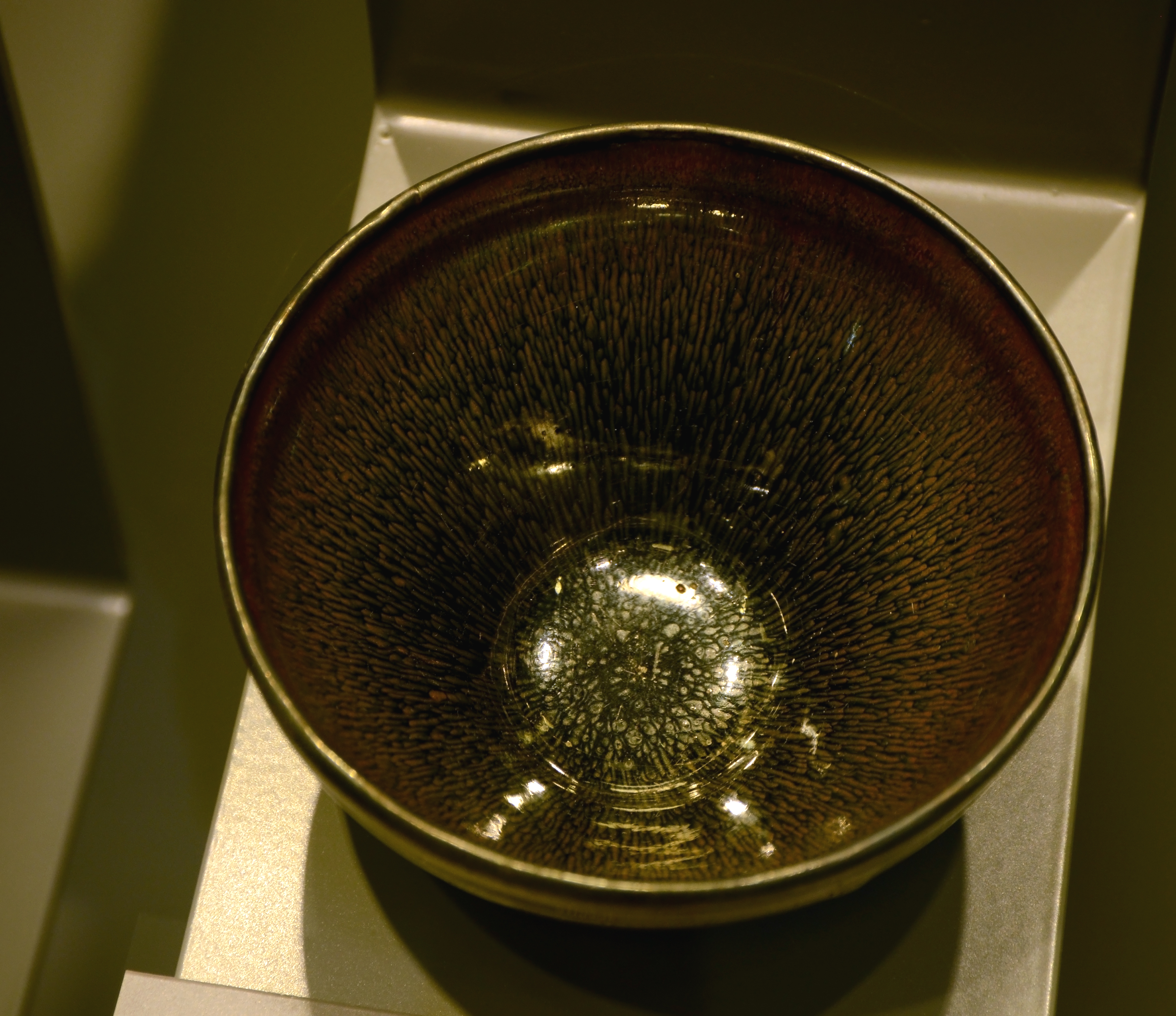
1. What exactly is a tea bowl, and why is it not just a minor word between “bowl” and “cup”?
Public Chinese references often explain zhan as a small, shallow cup, and a tea bowl as a drinking vessel for tea. That is a useful beginning, but not enough. At the level of actual objects, zhan is not just a refined substitute word. It usually points to a vessel logic that is more gathered than a rice bowl, more open than a small cup, and more focused on single-unit tea drinking, visual reading, and direct handling. That is why earlier tea vessels were often discussed more broadly as bowls, while in the Song period, as whisked tea, tea contests, and finer vessel specialization matured, zhan became a more stable and more specific term. The word changed because the role changed. The object was no longer merely a container for liquid. It had become a more specialized tea vessel.
That matters because once we admit that zhan is not a casual literary replacement, we can understand why it is constantly tied to questions of visual judgement, heat retention, handling, support, and tea assessment. A bowl can certainly hold tea. A cup can certainly hold tea. But the tea bowl handles a more specific situation: the tea is not only being consumed, but seen, compared, carried, offered, and judged. It is usually lighter and more specialized than an eating bowl, yet not as narrowly mouth-centered as a modern tiny cup. It gives hot tea a visible surface, and it gives the drinker an observational surface as well. That is why it deserves recognition as a real vessel type rather than a decorative old term.
Put differently, the core of the tea bowl is not that it “looks like a small bowl,” but that it organizes tea as both visible and drinkable. If the vessel is too enclosed, observation weakens. If it is too open, heat, rhythm, and handling become harder to manage. The tea bowl was one of the mature Chinese answers to that problem for a long stretch of tea history. It let one vessel hold viewing, handling, heat, and entry together, rather than handing all of those tasks off to separate objects.
2. Why does the tea bowl keep appearing together with Song-dynasty whisked tea and tea contests?
The tea bowl became especially prominent in the Song not because it accidentally entered a culturally glamorous age, but because the technical logic of whisked tea and tea contests pushed it to the center. Whisked tea depended heavily on reading the whiteness of the foam, the stability of the surface, and fine differences in appearance. That meant that the vessel’s color, opening, depth, heat retention, and contrast power were all magnified. Dark-glazed bowls mattered not merely because black looked striking, but because white foam stood out better against a dark interior, while relatively thick bodies and more stable heat behavior better supported the style of tea judgement at the time. That is exactly why objects such as Jian black-glazed bowls became so important in Song tea culture.
But the easiest mistake here is to reduce the entire Song tea bowl world to Jian ware alone. Jian bowls are certainly crucial, and they are one of the brightest lines in the history of tea bowls, but the tea bowl is not identical to Jian ware. Song tea bowls were fired at more than one kiln system, and bowls varied in lip shape, depth, glaze, and body. Jian ware looks so large today partly because it is visually overwhelming, and partly because it fits modern image culture extremely well: hare’s-fur, oil-spot, and iridescent transformations are naturally memorable. But if we allow that visual dominance to swallow the larger category, we hide the real point. Tea bowls mattered in the Song not because one kiln was especially legendary, but because the tea method required a drinking vessel capable of holding observation and drinking together.
So the value of the Song period is not merely that it gave us an elegant historical label to repeat. It showed the working logic of the tea bowl clearly. The bowl was not a passive endpoint. It participated in tea judgement itself. In that period, Chinese tea made one thing unmistakable: a drinking vessel was not merely what came after the tea. It was part of how the tea was assessed.
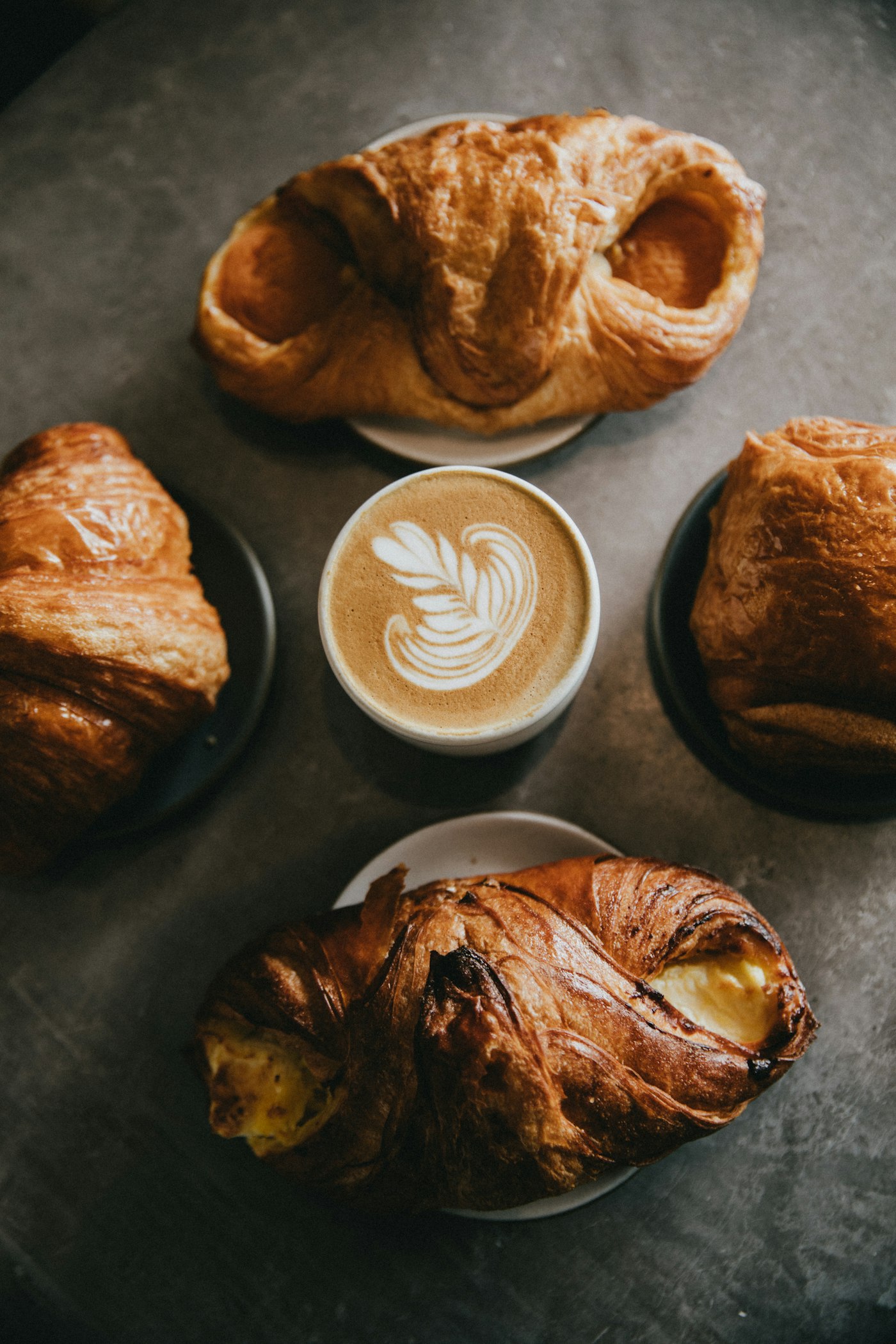
3. Why is the tea bowl not just a historical vessel name, but a form in which looking and drinking happen together?
Modern discussion often separates “looking” from “drinking.” If one wants to inspect color, one reaches for glass. If one wants to drink efficiently, one reaches for a small cup. If one wants heat retention, one looks for a thicker body. But the tea bowl represents another logic entirely. Instead of splitting functions apart, it allows them to happen together inside one vessel. Its opening leaves the tea surface visible. Its depth and body keep heat from disappearing too quickly. Its handling is more bodily than a stemmed vessel, but more specialized than a plain eating bowl. One sees the tea while already preparing to drink it; one lifts the bowl while continuing to judge it. This unity of looking and drinking is one of the most important things the tea bowl preserves.
That is also why the tea bowl is not exactly the same thing as the modern small tea cup. The small cup emphasizes single-sip entry, rapid division, lip path, and drinking rhythm. The tea bowl emphasizes the presence of the tea surface inside the vessel and the sense that tea remains fully there before it is reduced to one sip. Even when the final swallowed amount is not dramatically larger, the bowl still creates more preparation, more visual field, and a stronger presence of heat and liquid surface. Put simply, the cup tends to pull tea tightly toward the mouth, while the tea bowl first opens the tea out before bringing it in.
This is also why translating zhan simply as bowl or cup never quite solves the problem. It certainly shares something with bowl in historical body-feel, and something with cup in drinking function, but more accurately it is a specialized Chinese tea vessel: not a rice bowl, not an ordinary modern mug, but a vessel form refined around tea itself. Once one sees that, the tea bowl stops being a museum tag and becomes a meaningful teaware concept again.
4. Why was the tea bowl later partly displaced by the gaiwan and the small cup? Does that mean it stopped working?
No. The tea bowl became less central in many later contexts mainly because tea method changed, not because the vessel suddenly became wrong. As brewed tea rose after the Ming, the division between brewing vessel and drinking vessel became much clearer. Leaves completed their main extraction in the teapot or gaiwan, the liquor was evened out through the fairness pitcher, and it then entered smaller cups better suited to multi-round sharing. In that system, many tasks once compressed inside the tea bowl—some observation, some heat management, some direct drinking—were split apart. The main brewing vessel took the front end, the fairness pitcher took even distribution, the small cup took the mouth. Naturally, the tea bowl no longer stood at the center by default.
But that does not mean it lost value. It only means the vessel system reorganized itself. In fact, wherever tea still requires a more visible surface, a more direct sense of heat, and a more complete handling-and-drinking experience, the tea bowl does not truly fail. It simply shifts from “default central drinking vessel” to “still very strong under certain conditions.” In reconstructed whisked-tea settings, matcha-style drinking, or situations that emphasize a single vessel experience, it remains nearly irreplaceable. Even in modern brewed-tea contexts, some people return to bowls in personal sessions, experimental settings, and object-focused tea tables precisely because a cup cannot provide the same field of openness and pause.
So the better statement is not “the tea bowl became obsolete,” but “the tea bowl stopped monopolizing the drinking end.” What it lost was its dominant position, not its working power. A mature understanding of vessel history does not judge value solely by whether a form still occupies the center of mainstream practice.
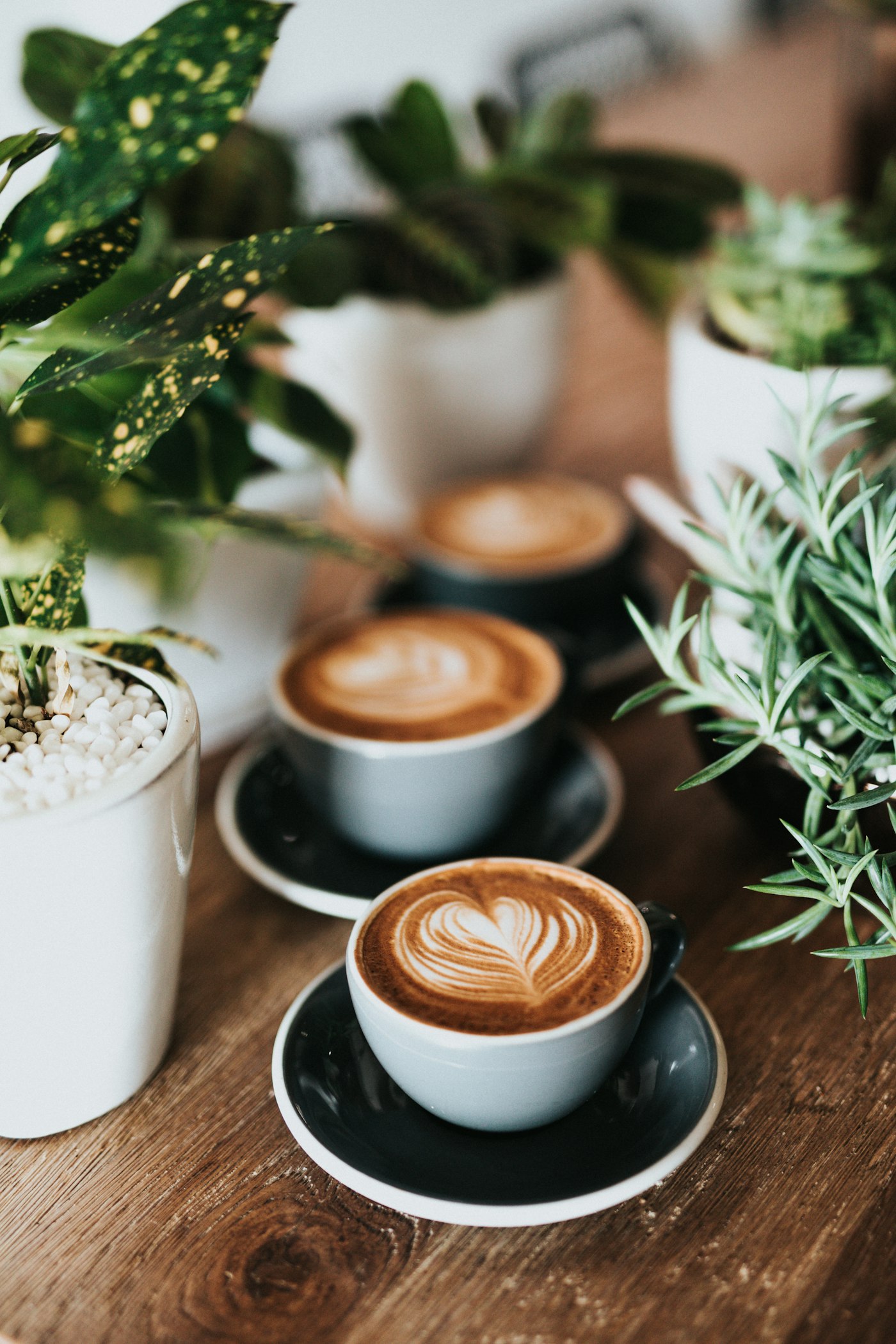
5. What is the relationship between the tea bowl and Jian ware, and why should they not be treated as exact equivalents?
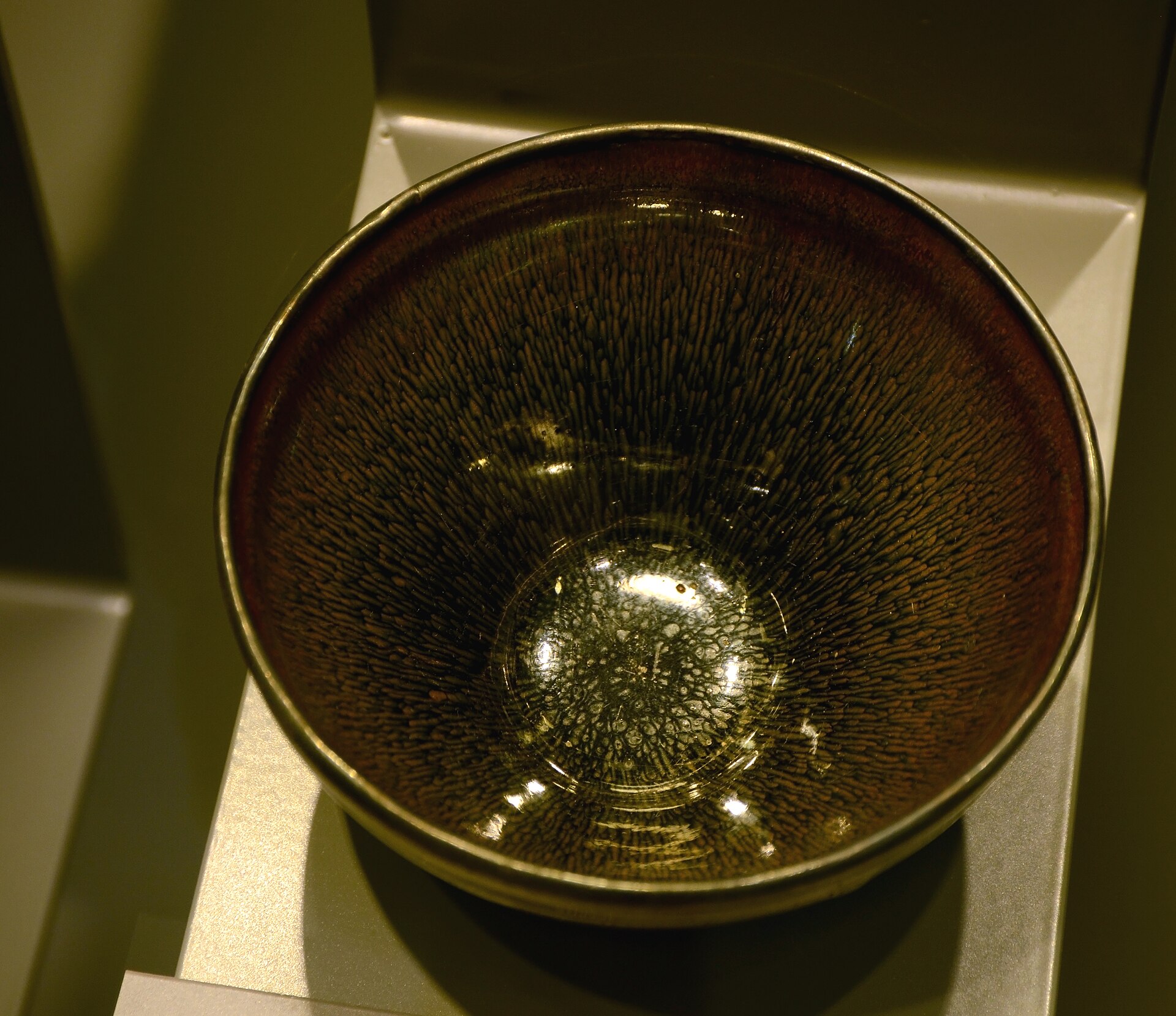
Today many people first encounter the tea bowl seriously through Jian ware. That is entirely understandable, because Jian bowls are visually overwhelming: black glaze, hare’s-fur streaks, oil spots, iridescent transformations. They are almost made to become the representative image of the tea bowl. Add to that the way Song whisked-tea narratives and modern Jian revival narratives reinforce each other, and it becomes easy for Jian ware to stand in for the whole category. But conceptually, Jian ware is a highly typical branch of the tea bowl, not the entire meaning of it. It is important, but the term “tea bowl” covers a broader vessel logic than the Jian black-glaze system alone.
Flattening the two together creates two problems. First, it makes the tea bowl seem dependent on dark-glaze aesthetics, as though anything outside that visual world were secondary. Second, it pushes the tea bowl too far toward collecting and prestige, as though it were primarily an art object and only secondarily a drinking vessel. But if one starts from tea practice rather than collecting culture, Jian ware matters not only because it is rare or prized. It matters because it magnifies several tea-bowl qualities with unusual force: strong visual contrast, thicker body, better heat retention, concentrated visual center, and a very strong sense of objecthood in the hand. It is one of the most extreme realizations of tea-bowl logic, not the only acceptable answer.
That is why the best way to understand Jian ware is not to let it swallow the entire tea-bowl idea, but to use it to understand the larger category more clearly: why Chinese tea wanted a drinking vessel so attentive to liquid surface, glaze, heat, and single-vessel judgement; why one vessel could be both a use-object and an assessment-object; and why a drinking vessel could become a visual center in one era. Once the order is corrected, both Jian ware and the tea bowl become easier to understand.
6. Why does the tea bowl still have real meaning today rather than existing only as a prop for historical style?
Because although today’s tea environment is completely different from the Song, the desire for a more complete tea experience has not disappeared. The modern small-cup system is efficient. It is excellent for many rounds, clear distribution, and side-by-side comparison. But it also breaks some experience into smaller pieces: the presence of the liquid surface weakens, heat leaves faster, and the relation between hand and vessel becomes lighter. The tea bowl often returns today precisely because it reconnects some of those broken parts. It lets tea arrive in the hand as a fuller hot-drink object before it reduces itself to a sip. One does not receive only “a mouthful.” One receives something with surface, temperature, weight, and visual center.
That is why tea bowls remain persuasive in certain matcha contexts, reconstructed Song-style tea settings, object-study tea tables, and even some kinds of solitary drinking. What they offer is not a vague aura of professionalism, but a stronger sense of completeness. One feels more clearly how heat sits in the vessel, how the liquid surface quietly remains there, and how smell and sight begin working before the first swallow. Many modern tea vessels chase lightness, speed, thinness, and quick clarity. The tea bowl reminds people that tea drinking can also allow more slowness, more gravity, and more participation from the vessel itself.
Of course this does not mean the tea bowl suits every scene. In multi-person gongfu tea settings with continuous infusions and tightly synchronized rounds of judgement, small cups often remain more efficient. But the moment the scene shifts toward single-vessel experience, visual reading, whisked-tea reconstruction, or fuller bodily presence, the tea bowl becomes realistic again. It is not a universal vessel, but it is certainly not dead.

7. The most common misconceptions around the tea bowl
Misconception one: the tea bowl is just the small bowl ancient people drank tea from. This is the easiest way to erase the problem. Bowls and tea bowls are related, but the tea bowl deserves separate attention precisely because it is already more specialized than an ordinary eating bowl.
Misconception two: the tea bowl is the same thing as Jian ware. Jian ware is the most dazzling and representative branch of tea-bowl history, but it is not the entire category. To write the tea bowl purely as Jian ware is to shrink a larger vessel problem into kiln history and collector aesthetics.
Misconception three: once brewed tea became dominant, the tea bowl became obsolete. What changed was vessel division of labor. The tea bowl lost its default central role, not its functional power. Whenever a setting still values visible surface, heat, and single-vessel drinking presence, it remains effective.
Misconception four: the tea bowl belongs only to Song whisked tea and has no modern relevance. Its bond with the Song is indeed deep, but its continued return in contemporary practice shows that its working logic still answers modern needs, especially in solitary drinking, matcha, and object-study tea settings.
Misconception five: the tea bowl is only an aesthetic object, not a vessel of judgement. In fact the opposite is closer to the truth. Historically, the tea bowl mattered precisely because it bound visual reading and drinking judgement tightly together. It was never just there to be looked at.
Why is it still worth giving the tea bowl its own serious article today?
Because it helps reveal something central in the history of Chinese teaware: many truly important objects matter not because they remain dominant forever, but because they make a core question especially clear. The tea bowl makes one question clear above all—namely that a drinking vessel is not merely the endpoint that receives finished tea. It also organizes seeing, heat, handling, rhythm, and judgement. The Song period pushed that logic to an especially visible extreme; later brewed-tea systems redistributed it across several objects. But the question itself never disappeared. We have simply grown used to handing it separately to the gaiwan, fairness pitcher, and cup, and in doing so we have forgotten that one vessel once held these experiences more tightly together.
To understand the tea bowl again is also to understand why zhan was never a light little word in Chinese tea. Behind it is not decorative antiquarianism, but an entire vessel method: how tea is seen, how it is held in heat, how it is lifted, how it enters the mouth, and how judgement begins before the object has even left the hand. That line is easy to lose behind today’s cup system and gaiwan system. That is exactly why the tea bowl deserves to be pulled back out and written carefully on its own.
Further reading: Jian Zhan: black glaze, hare’s-fur pattern, and the afterimage of Song whisked-tea aesthetics, Why the tea cup is more than the final little container, Why the bowl stand is more than the tray beneath an old tea bowl, and Why the gaiwan can handle almost every Chinese tea.
Source references: Baidu Baike: Tea Bowl, Wikipedia: Jian Zhan, Wikipedia: Tea Ware. The purpose here is not to exhaust archaeological typologies of every tea bowl form, but to explain the tea bowl as a vessel type and its working logic inside Chinese tea.