Teaware feature
Why chachuan is not just an old name for the pot stand: old vessel terms, local water catchment, and its real boundary against hucheng, chaxi, and jianshui
When many people first see the term chachuan, their immediate reaction is often: isn’t this just a more old-fashioned, more literary way of saying pot stand? That reaction is not entirely wrong, because in real tea-table use many objects called chachuan do indeed perform the work of a pot stand: they support the main brewing vessel, catch a little residual water, buffer heat, and give the brewer a stable landing point. But if chachuan is flattened entirely into hucheng, something finer disappears. The reason this older term never fully vanished is not only that it sounds more antique. It is that it more easily makes us notice that the small area beneath the main brewer is not just a functional “support.” It is also a little working field with its own boundary, containment, receiving logic, and visual closure.
That is exactly why chachuan deserves a dedicated article today. The question it handles sits at one of the most easily blurred points on the modern tea table: how should the small zone beneath the main brewer really be understood? How is it different from jianshui as a terminal recovery vessel? Where does it overlap with chaxi as a localized wet-zone vessel, and where does it diverge? Is it simply identical to hucheng, or are there still slight differences of vessel form and semantic emphasis? These may look like naming questions, but they are really questions about how tabletop action is locally organized.
More importantly, the old name chachuan reminds us that naming often preserves movement logic. Hucheng emphasizes “supporting the pot,” so it behaves like a job title. Chachuan, by contrast, feels more like a vessel-form term. It suggests a shallow, slightly enclosed support object that gathers heat, water, weight, and the resting point of the main brewer into one small receiving field. The difference is subtle, but it helps us see more clearly what is actually happening beneath the brewer instead of treating it as just “some small thing under the pot.”
1. What exactly is chachuan, and why is it not just an old synonym for hucheng?
In contemporary speech, chachuan and hucheng do overlap heavily. Many objects sold today could be labeled either way. So from the point of view of buying and everyday conversation, using them loosely is not strange. But from the point of view of understanding vessels, chachuan is not merely a classical substitute for hucheng. Hucheng is more like a functional job term: it supports the main brewing vessel. Chachuan, by contrast, more easily carries vessel form and spatial feeling. It suggests not a flat generic pad, but a small receiving object with some sense of enclosure, support, and independent presence.
That is why the term still deserves to be retained. It helps us notice that the small area beneath the main brewer is not a mere accessory. It has its own boundary, its own ability to contain minor consequences, its own visual center of gravity, and its own movement logic. Where does the brewer return after pouring? What happens to the little drip hanging at the spout? Where does residual water pause after the vessel has been rinsed or warmed? How is heat buffered before it reaches the whole table? None of that is fully explained by saying only that the pot is “supported.” Chachuan names the small local field in which those things are organized.
So the more accurate statement is not that chachuan and hucheng are completely different, but that chachuan can be understood as a branch within the wider pot-stand family that more strongly emphasizes vessel-form feeling, local enclosure, and the idea of a small receiving field. To split them too sharply is misleading. To flatten them completely is also misleading. The important point is that hucheng behaves more like a job title, while chachuan behaves more like a vessel-form term. Hucheng emphasizes the work of “supporting the pot”; chachuan emphasizes the little contained zone beneath the brewer.
2. Why is chachuan so often confused with chaxi and jianshui?
The reason is very practical: all of them have something to do with receiving water. As soon as an object can catch a little runoff or receive wet actions, people naturally begin to group them together. This becomes even more common on small and lightweight tea tables, where one object is often asked to do more than one job. On the surface, chachuan, chaxi, and jianshui all seem to answer the same question: where does the water go? In fact, they answer that question at different scales.
Jianshui leans toward terminal recovery. It faces more explicit, more concentrated, and often larger amounts of waste water and residual liquor, so capacity, depth, stability, and final emptying matter more. Chaxi leans toward the mid-process gathering of local wet actions. It often serves cup-rinsing, temporary lid retreat, localized receiving, and short pauses. Chachuan stays much closer to the main brewing vessel itself. It solves the problem of how the small zone directly beneath the brewer is organized. In other words, jianshui is more like the endpoint, chaxi is more like the transition zone, and chachuan is more like the local field under the main brewer.
Because all three may “catch some water,” their functions naturally overlap in actual use. Especially when space is limited, one shallow vessel may serve as both chachuan and temporary chaxi; one convenient deeper vessel may also function as a small jianshui. But understanding should not flatten them into a single vague category. Otherwise the judgment collapses into something crude: as long as it can catch water, it is fine. Mature tea-table judgment asks something more specific. Is this a local consequence beneath the main vessel, or the final recovery of discarded liquid from the whole table? Is this a short-distance receiving move while the action is happening, or is it the concentrated handling of what remains after the action is over? Once those questions are separated, the specific meaning of chachuan comes back into view.
3. Chachuan handles more than water: it also handles heat, weight, and the way the main brewer actually sits down
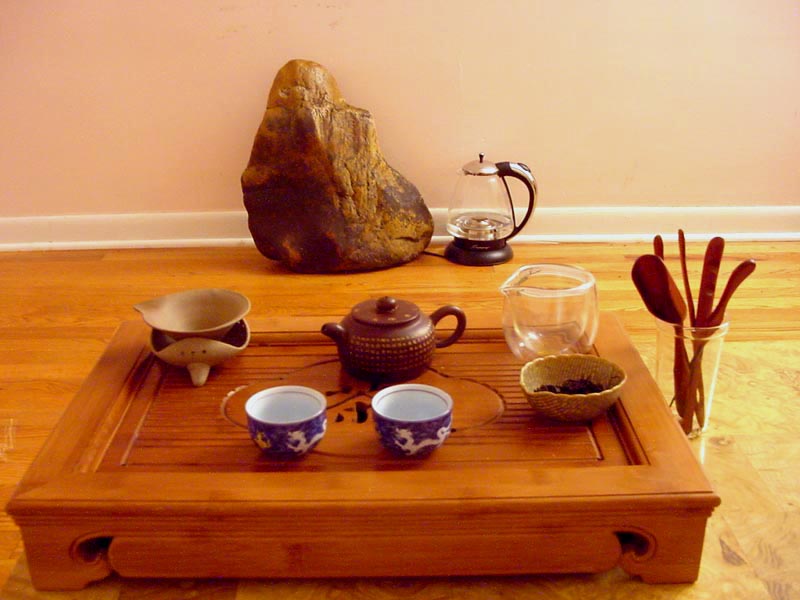
If an object merely “provides a place for the pot,” then almost any flat surface can technically do that. But an actual tea table never deals only with that low-level question. The main brewing vessel is the point on the table where problems concentrate most easily. It is the hottest point, the point most likely to carry hanging drips, and the point where repeated pouring and returning focus moisture and weight into one area. The real importance of chachuan is that it localizes those consequences. What it receives is not abstract “water” but the combined pressure of heat and moisture beneath the brewer.
At the same time, it solves a problem of center of gravity. If the main vessel lands directly on a bare table or broad flat surface, it often looks as if it has merely been parked there for the moment. With a chachuan, the brewer seems to sit into a place that belongs to it. This is not a matter of theatrical presentation. It is a practical statement made on the table: this is the main brewing zone; this is where heat, water, attention, and return motions are gathered. Chachuan provides not a decorative border, but a functional border.
That is also why chachuan often feels more vessel-like than an ordinary flat pad. That sense of vessel-ness is not for display. It arises because the object really is doing the work of a small receiving vessel: carving the area beneath the brewer out of the general background of the table. If the chachuan is too weak, the brewer feels suspended. If it is too strong, the brewer feels awkwardly lifted or overframed. A good one usually makes the viewer feel first that the brewer sits properly, and only afterward that the composition also looks right.
4. Why does chachuan become easier to justify again in dry brewing and lightweight tea tables?
At first glance, dry brewing uses less water and less pouring over the pot, so one might think it should need chachuan less. In reality the opposite often happens. Dry brewing does not mean no water. It means refusing to let water lose its boundary. In the past, a large tea tray could absorb many small problems. Once the tabletop becomes lighter, the objects fewer, and the negative space larger, even a little moisture beneath the main vessel becomes conspicuous. The less one wants the whole table to enter a wet state, the more one needs a mature local receiving object.
Here the meaning of chachuan is not to restore old large-scale wet brewing. It is to pull unavoidable local consequences back into a confined area. Even if one does not pour over the pot, the small drip at the spout, the little dampness caused by heat, or a small amount of water running from the lid edge still need somewhere to pause first. Chachuan is ideal for that. It does not announce that the whole table has entered drainage mode, yet it preserves order at the most critical point.
This also explains why many contemporary lightweight tea tables, although visually simpler than older ones, still pair the main brewer with a distinct support object. Sometimes that object is called hucheng; sometimes it is called chachuan. The name may change, but the logic does not: once the table no longer depends on a large apparatus to absorb everything, the boundary power of small local objects becomes important again. Chachuan is not there to make the table look old. It is there to let a modern light table still stabilize its hottest and wettest core zone.
5. What kind of form feels more like chachuan? What do shallowness, width, and enclosure really mean?
If one distinguishes by use, chachuan tends to fall into a few recognizable tendencies. Shallow and broad forms feel like a lightly drawn main-vessel zone on the tabletop, suitable for restrained movement, very little pouring over the pot, and a layout that emphasizes negative space. Forms with a slight rim, a shallow belly, or a stronger vessel wall feel more like true receiving vessels. They are more tolerant of local water and heat, and they bring out the sense of enclosure implied by the word “chuan,” or boat.
These differences are not merely visual preferences. They directly determine how the object behaves. Too shallow, and tolerance drops. Too deep, and the main vessel begins to look visually buried. Too open, and residual water may have nowhere to gather. Too enclosed, and cleaning becomes heavy while the appearance may become dull. A mature chachuan does not push to one extreme. It balances several things at once: the brewer should sit securely, minor runoff should have somewhere to pause, the table should not feel overly weighed down, and cleaning should not become tedious.
That is why chachuan is not a vessel one can judge well from photographs alone. Its success depends heavily on how tea is actually made: whether the setup is pot-centered or gaiwan-centered, whether pouring over the vessel is almost absent or still occasionally retained, whether the tea table is for one person or shared among several people. Form is not an isolated aesthetic tag. It is the outer shell of movement logic. When people say a chachuan has “good feeling,” what they often really mean is that the small area beneath the main brewer has been arranged clearly.
6. Common misunderstandings about chachuan
Misunderstanding one: chachuan is merely a literary way of saying hucheng, so there is no reason to understand it separately. In practice the overlap is real, but the older name is worth keeping precisely because it helps us see vessel form and the idea of a localized receiving field, not only the function of “supporting the pot.”
Misunderstanding two: chachuan is basically just a small chaxi. Chachuan does indeed catch local moisture, but its center of service remains the zone directly beneath the main brewing vessel. Chaxi more often serves the intermediate gathering of local wet gestures. The two overlap, but their centers of gravity differ.
Misunderstanding three: as long as something can hold a pot and catch a little water, any object can replace chachuan in long-term use. Temporary substitution is of course possible, but over time center of gravity, boundary, form, cleanability, and visual weight all begin to matter. Chachuan is really about organizing the main-vessel zone, not merely about providing enough surface area.
Misunderstanding four: dry brewing has already made this old-style support object unnecessary. In fact, the less one depends on a large tea tray, the more a mature local receiving system is needed. Otherwise so-called dry brewing often remains visually dry while constant small corrections continue behind the scenes.
Misunderstanding five: chachuan is only a classical aesthetic prop. It certainly participates in aesthetics, but not by stealing the scene. It helps the brewer sit securely, keeps the local wet zone gathered, and lets the relations of the whole table read as ordered. Much of its beauty comes from the stability that appears once function has been arranged clearly.
Why is chachuan still worth understanding seriously today?
Because it stands exactly where many contemporary tea-table questions intersect: how vessel names are simplified in modern speech, how traditional localized receiving objects find a place again in the age of dry brewing, and why the small area beneath the main brewer simultaneously concerns heat, water, weight, boundary, and aesthetics. Chachuan is not a word that must be spoken every day, but the problem it represents remains fully real.
To understand chachuan is also to understand a core logic of Chinese tea objects: a good object does not only solve the low-level question of whether something can be placed somewhere. It arranges the consequences of movement, the order of the table, and the visual center of gravity all at once. Chachuan is not just an old name for hucheng because it reminds us that even the smallest zone beneath the main brewing vessel deserves to be understood as a distinct and intelligible little field. Once that small field becomes clear, the larger tea table usually becomes clearer too.
Related reading: Why the pot stand matters again today, Why chaxi is not just an old name for jianshui, Why jianshui returned to the center of the tea table in the age of dry brewing, and Why the tea boat is more than a tray beneath the pot.