Green Tea Feature
Duyun Maojian is more than a famous Guizhou tea: a full guide to curled downy buds, the 'three greens with yellow showing' aesthetic, and misty mountain terroir
If one were to list the Chinese green teas most often reduced to a single sentence, Duyun Maojian would almost certainly appear. Many readers first meet it through phrases like “a famous tea from Guizhou,” “a misty high-mountain green tea,” or “one of China’s famous teas.” None of those phrases is entirely wrong, but they flatten the tea into a reputation and a place name. What actually deserves attention is how Duyun Maojian binds together tight curled strands, visibly downy tender buds, a fresh-yet-substantial palate, and the humid mountain environment of Guizhou into one coherent standard.
It belongs in the same broad “famous Chinese green tea” conversation as Longjing, Huangshan Maofeng, and Xinyang Maojian, yet it speaks a different internal language. Longjing is about flattening and pan-shaped order. Huangshan Maofeng emphasizes elegant bud-and-leaf beauty and a classic baked-green profile. Xinyang Maojian leans toward needle-like strands, early-spring mountain sharpness, and visible white down. Duyun Maojian stands out for its curled, tight, downy shape, its specific processing rhythm, and the sensory phrase most associated with it in Chinese: “three greens with yellow showing.”
What kind of tea is Duyun Maojian? Why is it not just a “Guizhou Longjing” or “another Maofeng”?
Duyun Maojian is a Chinese green tea, and a classic example of the famous fine-green-tea tradition, but it is neither a flat pan-shaped tea nor simply a baked-green tea that depends on graceful bud-and-leaf appearance alone. Common descriptions stress that it is fine, rounded, tight, straight, and rich in white down, while also carrying a curled and compact feel. Once brewed, it is expected to show high fragrance, a clear bright liquor, and a taste that is fresh, full, and returning sweet. Even from those terms alone, one can see that it differs from Longjing’s pressed flatness and from Huangshan Maofeng’s more elongated, delicate bud-leaf elegance.
That is exactly why Duyun Maojian matters in a fuller map of Chinese green tea. It helps readers see that Chinese green tea is not a single broad category of “light fragrant spring tea.” Some styles value flattened shape, some value refined budding beauty, some prize firework and roast structure, and some, like Duyun Maojian, make tight curled strands and a fresh-thick palate central to the tea’s identity.
What does the name “Maojian” really emphasize here?
The term “Maojian” appears in several Chinese green tea contexts, but in Duyun Maojian it means more than a vague reference to downy tender buds. “Mao” points to the fine white down on young shoots, while “jian” points to the delicate, pointed quality of the buds and leaves. Yet Duyun Maojian is distinctive because it does not stop at raw-material tenderness. It uses processing to turn that bud aesthetic into a stable finished-tea character.
In other words, Duyun Maojian does not stand on “tender leaves” alone. It also requires tightly made strands, even shape, a clean aroma that rises without floating away, and a liquor that feels fresh and substantial rather than watery. Many teas can claim to use early tender spring buds. Far fewer can turn tenderness, visible down, strand structure, and flavor depth into one convincing whole. That is where Duyun Maojian earns its place.
Why does origin matter here? Guizhou mountain ecology is not decoration but part of flavor
Classic descriptions of Duyun Maojian usually place it in the mountain environment around Duyun in Guizhou’s Qiannan region. Public references often mention areas such as Tuanshan, Shaojiao, and Dacao, along with relatively high altitude, persistent mist, dense vegetation, humid air, and cool mountain conditions. Readers do not need to memorize every local place name, but they should understand the basic point: Duyun Maojian is not an infinitely expandable label for “green tea from Guizhou.” It is tied to a fairly specific mountain ecology.
Those conditions are not merely useful for branding. Moderate annual temperatures, generous rainfall, mist-filled valleys, loose humid soils, and mildly acidic growing conditions all influence how slowly the buds develop, how tender they remain, how compounds accumulate, and how the tea eventually tastes. If “misty high mountain” is treated only as a seller’s cliché, the real point is missed: for Duyun Maojian, mountain terroir is part of how its freshness, lift, and satisfying thickness take shape.
This is also what makes it so useful in comparison with greener-tea traditions from eastern China. Longjing carries the calm order of Hangzhou and pan-shaped discipline. Huangshan Maofeng carries Huizhou mountain refinement and baked-green elegance. Duyun Maojian carries a distinctly southwestern mountain freshness: humid, lifted, supple, yet not weak. It is not a substitute for those other teas but an independent regionally grounded answer.
Why do older historical references often mention names like “fishhook tea” and “sparrow tongue tea”?
The Duyun region has a long tea history. Local records and public reference material often connect today’s Duyun Maojian with earlier local tea traditions associated with names such as “fishhook tea” and “sparrow tongue tea,” and some sources note that related teas from the region were already presented as tribute products in earlier dynastic periods. The important point here is not simply to give the modern tea more romance. It is to show that the local preference for fine tender bud teas has deeper roots than a modern branding campaign.
At the same time, the fully stabilized, modern form of Duyun Maojian is not something that existed unchanged for centuries. Public materials often note that the historical craft line was partly lost and then restored and re-standardized in the twentieth century. That matters because it reminds us that many famous Chinese teas contain both a long local heritage and a modern process of reconstruction. Taken together, those two lines tell a truer story than a simple claim that the tea has always existed in exactly its current form.
So the most reasonable historical reading avoids two extremes. One is to present Duyun Maojian as an unbroken myth unchanged from antiquity. The other is to treat it as a purely modern invention. In reality, it stands on a long local base of tea picking, processing, and regional memory, while also passing through modern recovery, naming, and standardization. That combination is part of what gives it both legitimacy and clarity.
What is the key processing step? Why do so many references emphasize “tuan-rou and lifting the down”?
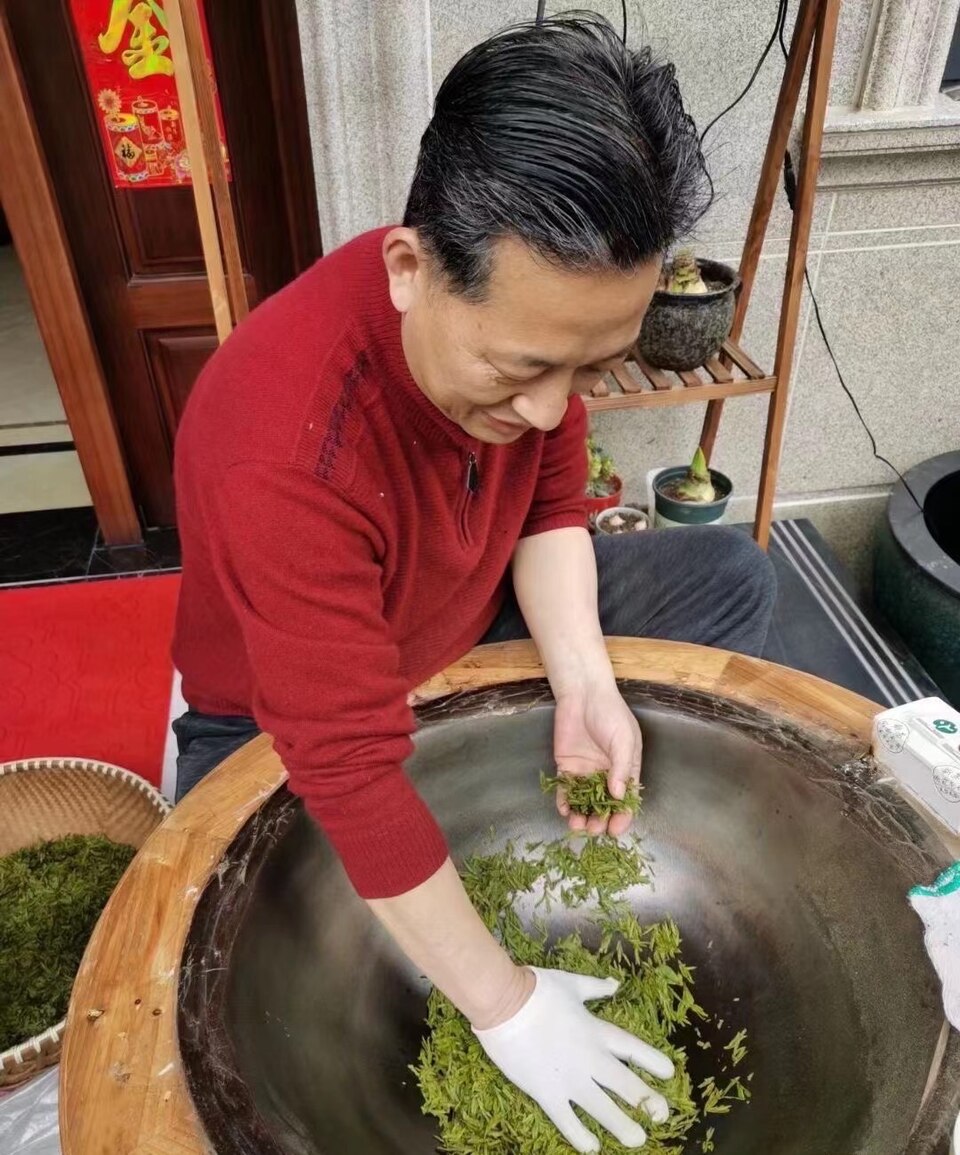
Typical process descriptions for Duyun Maojian include picking, resting, kill-green heating, rolling, shaping, a stage often described as forming and rubbing the leaf mass to raise the down, and final drying or fragrance finishing. As with many fine Chinese green teas, the real issue is not the list of steps itself, but what each step is trying to solve. Fresh shoots are first sorted and briefly rested so their condition becomes more even. Kill-green work suppresses raw grassy notes while preserving life. Rolling begins to form the tea’s strand structure and flavor base. Then comes the especially distinctive stage: shaping the tea into its tight curled form while allowing the down to show.
Why is that step so important? Because Duyun Maojian does not simply “become curled” on its own. It depends on repeated controlled rubbing, gathering, loosening, and reforming so that the strands tighten, curl, and reveal white down without becoming broken, stale, or muddy. If the hand or heat is too heavy, the tea turns dull or cloudy. If it is too light, the strands fail to stand up and the tea tastes incomplete. Good Duyun Maojian looks easy and natural only because a great deal of precision sits behind that result.
What does “three greens with yellow showing” mean, and why is it one of the most important phrases to remember?
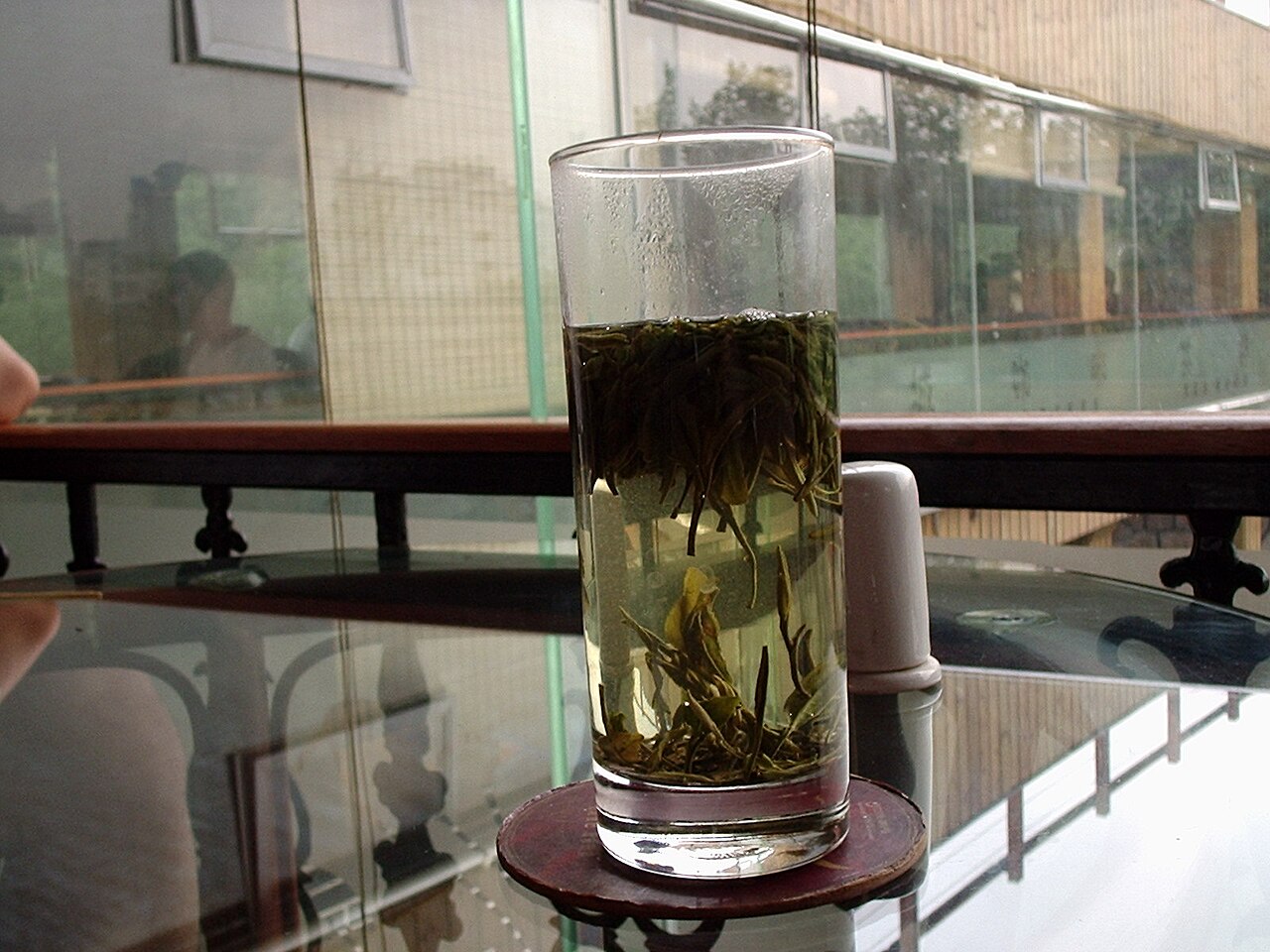
Many descriptions of Duyun Maojian use the phrase “three greens with yellow showing”: the dry tea is green with yellow showing through, the liquor is green with yellow showing through, and the leaf base is green with yellow showing through. This is an unusually useful phrase because, unlike many tea descriptions that simply imply “the greener the better,” it points to a more mature and nuanced sensory standard. The goal is neither raw grassy greenness nor dead yellow dullness, but a balanced yellow-green that suggests freshness, processing completion, and clarity.
This helps readers avoid a common mistake: assuming that all green tea should look as vividly green as possible. In Duyun Maojian, an ideal color is not unreal neon green, but a living yellow-green with translucence and maturity. That usually corresponds better to proper processing and a liquor that feels bright, clear, fresh, and substantial rather than aggressively raw. In that sense, “three greens with yellow showing” is not a poetic slogan. It is a compact sensory judgment about heat handling, maturity, and overall completion.

What does it actually taste like? Why is it so often described as “fresh and full”?
Duyun Maojian differs from many tender green teas that rely mainly on light floral freshness. Good Duyun Maojian certainly has a lifted clean aroma, but the more memorable quality is its fresh fullness. “Fresh” here means lively, bright, clear, and quick on the palate. “Full” does not mean heavy or harsh. It means the liquor has content and support rather than collapsing into thinness. Public descriptions often mention returning sweetness and saliva flow, and in good examples that is not empty wording. The tea often does carry a trailing sweetness more clearly than lighter, thinner green teas do.
Ideally, the fragrance should rise clearly without turning floaty or perfumed, carrying a mountain-green-tea combination of fresh plant clarity and a gentle cooked-bean or chestnut warmth. The liquor should be bright, brisk, and energetic, but the finish should still cleanly close rather than leaving a muddy or overfired impression. If a tea smells nice but drinks hollow, scattered, watery, or rough, or if the liquor is green yet raw and stuffy, then the raw material and processing have not really justified the name Maojian.
How does Duyun Maojian differ from Longjing, Huangshan Maofeng, and Xinyang Maojian?
This comparison matters a great deal. Compared with Longjing, Duyun Maojian does not pursue flattened pan-shaped elegance. Its center lies in tight curled strands, visible down, fresh fullness, and returning sweetness rather than chestnut-like pan-fired flatness. Compared with Huangshan Maofeng, it relies less on the image of elegant opening bud leaves and less on a refined “orchid-like” narrative, while putting more weight on tightly built shape and a stronger fresh palate. Compared with Xinyang Maojian, the relationship is even more instructive: both belong to a Maojian vocabulary, but Xinyang tends toward needle-like strands and an early-spring northern mountain sharpness, while Duyun Maojian leans toward tighter curling, a more rounded fresh-thick balance, and a humid southwestern mountain softness with strength.
That is why Duyun Maojian is not a disposable add-on article. It helps the site’s green-tea section become structurally legible. Readers can begin to see that different famous Chinese green teas define “good” in different ways: some through flat shape, some through refined bud-leaf beauty, some through firework, and some, like Duyun Maojian, through curled strands, fresh fullness, and the “three greens with yellow showing” standard.
How should it be brewed to show its fresh-full structure properly?
Duyun Maojian works well in both a glass and a gaiwan. A glass is excellent for first encounters because one can watch the strands loosen, the down become visible, and the liquor evolve. A gaiwan is better for precise control. For most fine-grade Duyun Maojian, a practical starting temperature is around 80°C to 85°C. It tolerates heat somewhat better than the most fragile bud teas, but it still should not be blasted with boiling water at the start.
In a gaiwan, around 3 grams for 100 to 120 ml of water is a comfortable baseline. The first couple of infusions should be short, often around a dozen seconds or so, then gradually extended. What makes Duyun Maojian compelling is the balance in the opening rounds: freshness, substance, lifted aroma, and returning sweetness standing together. If the water is too hot, the leaf too heavy, or the steep too long, that balanced structure quickly turns into bitterness, astringency, and dullness.
It is also a very good comparison tea. Brew Duyun Maojian next to Longjing, Huangshan Maofeng, or Xinyang Maojian and readers can immediately see that Chinese green tea is not a single family of similarly colored beverages, but a system of distinct shapes, methods, and taste logics.

What are the easiest buying mistakes?
The first mistake is being completely carried away by the phrase “high mountain mist,” as if any green tea from Guizhou with a little down can count as fine Duyun Maojian. The second is looking only at visible fuzz and apparent tenderness, while ignoring whether the finished strands are tight and clean, whether the aroma is clear, and whether the liquor is fresh and full without murkiness. The third is treating “very green color” as a simple synonym for quality. Duyun Maojian’s classic aesthetic is actually “three greens with yellow showing”; something aggressively raw-green and flashy is not necessarily more mature or better made.
Another common mistake is imagining Duyun Maojian as a tea of “lightness” only, with no backbone. Truly good Duyun Maojian is not flimsy. It should have the liveliness of tender spring material, but also real liquor content and a meaningful finish. In other words, it is not a single-feature tea. It stands through overall completion. The more one judges it through the whole chain—raw material, shape, liquor color, aroma, taste, and finish—the harder it becomes to be misled by sales language.
Where does Duyun Maojian belong in a broader Chinese tea knowledge system?
If a tea site wants to turn Chinese green tea into a genuinely layered map, Duyun Maojian is difficult to omit. It allows Guizhou to appear not as a footnote saying “the southwest also grows tea,” but as the home of a fully formed, highly recognizable fine green tea. It also prevents the word “Maojian” from remaining a vague generic label. Instead, the term becomes tied to a specific mountain environment, a specific processing logic, a specific color aesthetic, and a specific palate structure.
More importantly, Duyun Maojian is an excellent lesson in what regional style really means. What readers meet here is not a floating famous-tea name, but a local expression shaped by Guizhou mountain ecology, tender bud standards, strand-forming craft, the “three greens with yellow showing” sensory criterion, and a fresh-full-returning-sweet taste profile. Once readers understand that, they are much less likely to imagine all Chinese green teas as basically the same tea wearing different place names.