History feature
Why Tea Fu deserves serious discussion today: from Du Yu and Six Dynasties rhapsody to the moment tea was first written as an object of display, aesthetic attention, and literary expansion
When people talk about Chinese tea history today, the texts and themes that keep returning are usually The Classic of Tea, Tang boiled tea, Song whisked tea, Ming loose-leaf tea, gongfu tea, or the Tea Horse Road. Compared with them, something like Tea Fu can look less solid and less immediately useful. It is not a systematic knowledge treatise like The Classic of Tea. It is not as technically direct as Record of Tea or The Daguan Tea Treatise. It does not come with the same built-in historical scene as the Tea Horse Road or the Famen Temple tea set. Precisely for that reason, it is easy to overlook. Yet if we take Chinese tea history as a long formation made jointly by food practice, utensils, literary form, institutions, and aesthetics, Tea Fu stands at a very important point. It shows tea entering writing for the first time as something worthy of expansion, embellishment, admiration, and sustained literary attention.
That matters because tea could not become the cultural object it later became in China merely by being drunk. It also had to be spoken, written, compared, praised, and made visible in language. In other words, tea had to enter not only stomachs and daily life, but also imagination and textual form. Without that linguistic elevation, tea would have had a much harder time moving from a functional or regional drink into something that could travel across regions, be absorbed by elite culture, and be revisited again and again by later ages. The importance of Tea Fu lies in the fact that it preserves an early piece of evidence for that elevation.
That is also why this history topic finally returned to a literary text rather than yet another utensil or brewing practice. The site already has articles on The Classic of Tea, the Guzhu tribute tea yard, Record of Tea, The Daguan Tea Treatise, why Tang boiled tea faded from the mainstream, Song whisked tea and the tea whisk, and the Ming shift toward loose leaf. Those articles explain systems of knowledge, technical order, institutions, and later transformations. Tea Fu fills another gap: before those mature tea texts and technical systems, how did tea first become literary, sensory, and objectified? Without that earlier step, it is actually harder to explain why tea could later be written so deeply and so completely as a world of its own.
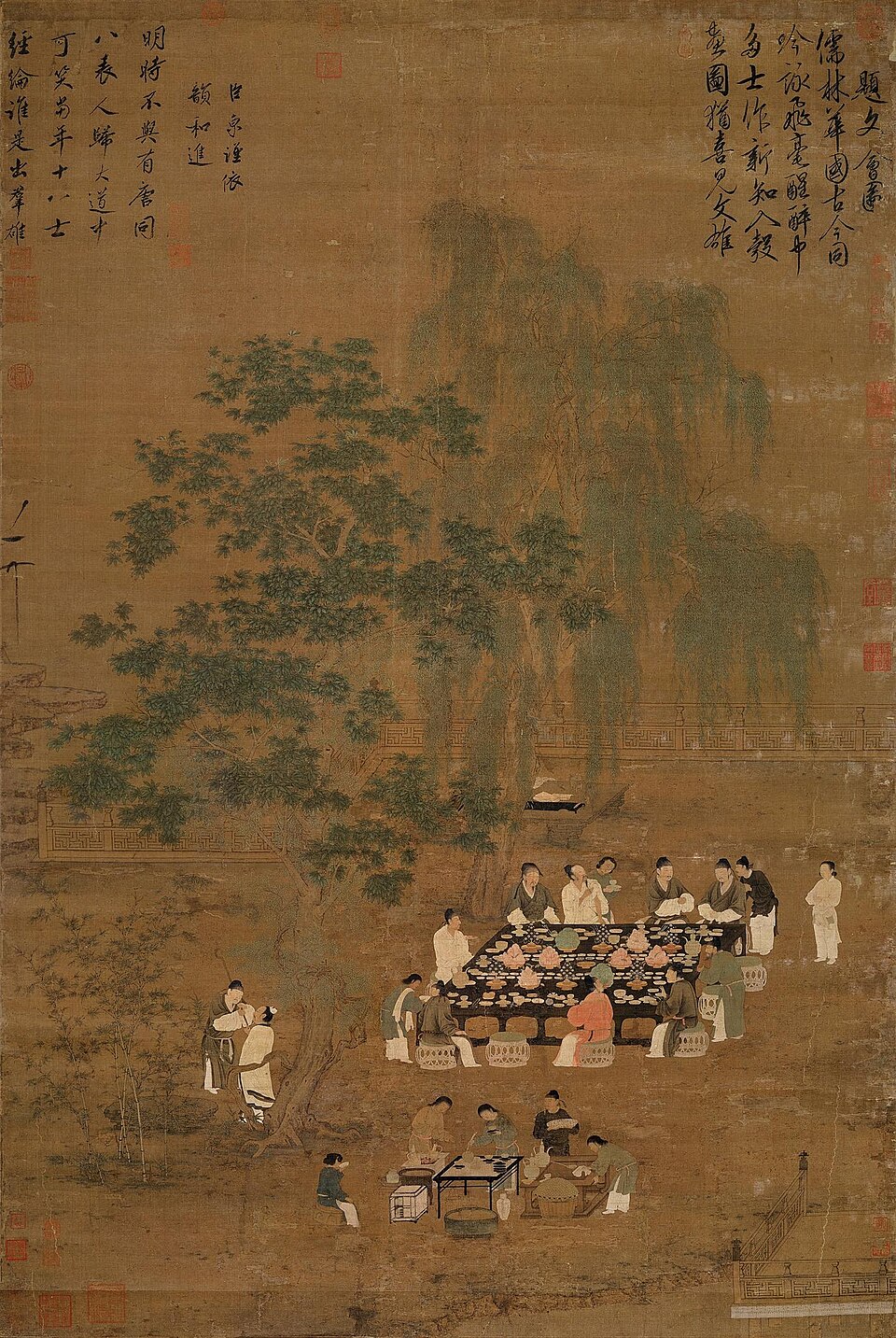
1. Why this topic deserves an article of its own
One of the laziest shortcuts in Chinese tea history is to assume that once tea was being consumed, it had already acquired a mature cultural position. The two things are related, but they are not the same. Many things can be eaten or drunk for a long time without automatically becoming civilizational objects worthy of sustained writing. For that to happen, material use is not enough. Language, genre, and aesthetic mediation also have to intervene. In other words, for something to move from being an ordinary thing to a cultural thing, it first has to become stable in writing.
Tea is no exception. It entered Chinese life early, but when did it stop being merely a local product, a medicinal substance, or a simple dietary habit, and begin to appear as an object worthy of elaborate writing? That question cannot be answered entirely through The Classic of Tea, because by the time Lu Yu wrote, tea already belonged to a comparatively mature and highly organized knowledge world. Tea Fu matters because it lets us see an earlier action. Tea was first written as something with sensory richness, rhetorical presence, and room for embellishment. That literary objectification helps explain why later tea knowledge could become so stable and expansive.
That is why Tea Fu, although not a tea manual in the later sense, should not be treated as a dispensable literary ornament. Many civilizational objects do not first become important in handbooks. They first become important in literary experiments. And the fu form is especially important here. Fu is not simple record. It expands, enumerates, compares, embellishes, and heightens. Once tea enters fu, it means tea is no longer merely being used. It is being placed on display.
2. What Tea Fu actually is
When people speak of Tea Fu, the most important line in tea history usually points to Du Yu of the Western Jin. Strictly speaking, “Tea Fu” is not the name of only one possible text in all literary history, but in Chinese tea-history discussion, the real focus is Du Yu’s piece and the literary position it represents. Its greatest importance is not that it provides later generations with executable technical instructions. Its importance is that it shows tea had already become an object fit for rhapsodic literary treatment.
And that matters because fu is not simply a casual form for praise. It is a genre that depends on the ability to unfold an object. One can write its appearance, color, aroma, vessels, setting, movement, bodily effects, and social meaning. If an object is still too rough, too thin, or too functionally narrow, it is actually hard to sustain as fu. The object has to have accumulated enough sensory and cultural complexity for the genre to work. Once tea can support such treatment, its status has already changed.
So the historical value of Tea Fu is not just that someone in the Western Jin wrote about tea. It is that tea had already gained enough complexity to sustain the fu form. That means tea was no longer merely present in life. It had begun to enter the literary stage. It had gained the right to be described, and with that, the right to be admired.

3. Why the Du Yu line matters
Another mistake in tea history is to place almost the entire burden of tea culture’s true formation on the Tang and on The Classic of Tea. That is convenient, but it flattens what came before. Du Yu’s Tea Fu reminds us that the earlier preparatory stage was not empty. By the Western Jin, tea was already more than a nameless marginal thing. It had begun to enter the world of literati expression as something that could be mobilized, displayed, and turned into literary material.
That is crucial because elite literary systems do not automatically admit every ordinary object. To be written in fu usually means an object has crossed several thresholds. It must be recognizable beyond a tiny local setting. It must have enough internal differentiation not to remain flat. It must be capable of generating sensory and aesthetic imagination. And it must have begun to connect with cultivation, taste, gathering, setting, and status. Once tea can be written in this way, its cultural position is clearly rising.
So Du Yu matters not merely because he is early, but because he is early in a way that proves something. If tea can enter fu in the Western Jin, then later Tang maturity cannot be described as if it simply appeared from nowhere. A better way to put it is that Tang systematization was built on an earlier stage in which tea had already begun to be literary, objectified, and aestheticized. Tea Fu is one of the clearest surviving signs of that stage.
4. Why literary formation matters so much in tea history
It is tempting to think of literature as the “soft” part of history, while production, technique, institutions, and trade are the “real” drivers. But tea became more than a drink in China precisely because literature magnified it. Knowledge can tell us what tea is. Institutions can regulate how tea circulates. Literature can persuade people that tea deserves to be regarded in a particular way.
That is the contribution of Tea Fu. It gives tea an early form of cultural visibility. It does not build an encyclopedic system the way The Classic of Tea later would. Instead, it gives tea presence in language. Tea ceases to be only something consumed and becomes something capable of carrying beauty, detail, rhythm, and rhetorical force. That is enormously important for later tea history. Once an object is stable in literature, later generations can more easily attach knowledge, institutions, morality, and aesthetics to it.
That is why Tea Fu should not be reduced to an attractive literary miniature about tea. It is better understood as an early rehearsal in the making of tea as a high cultural object. Without such rehearsal, tea might still have developed, but it would have had a harder time becoming the fully articulated civilizational object it later became in Chinese self-imagination.

5. Why the fu form could elevate tea so effectively
If tea appears only in plain record or miscellaneous notation, it may be mentioned without having its status fundamentally transformed. Fu is different. Fu does not merely note an object. It unfolds, arrays, compares, exaggerates, and organizes sensation and space around it. It naturally places an object under a brighter light. Tea’s entry into fu therefore means that tea had gained the right to stand at the center of description.
This is especially worth recovering now, because modern readers are so used to treating tea as an obvious “Chinese cultural element” that they forget it had to be raised into view. Fu supplied one of the mechanisms of that raising. It asked not whether tea was useful, healthy, or marketable, but whether tea as an object was rich enough to justify literary elaboration. Once tea passed that test, its cultural position changed.
So Tea Fu is not only a fu about tea. It is also testimony that tea had already been acknowledged by literature. From that point on, tea could stand not only on the table but also in rhetorical display; not only in appetite but also in evaluation; not only in life but also in expression. For the many later poems, notes, treatises, records, prefaces, and inscriptions about tea, this was an early and very important beginning.
6. How it relates to The Classic of Tea
Once one starts thinking seriously about early tea history, a common question appears: if The Classic of Tea is already so important, why write separately about Tea Fu? The better answer is not to choose one over the other, but to recognize their different functions. Tea Fu matters not because it replaces The Classic of Tea, but because it helps explain why The Classic of Tea could later emerge so naturally. Tea Fu helps make tea writable as an object. The Classic of Tea systematizes an object that had already become important enough to justify full organization.
In that sense, Tea Fu is closer to a signal that tea had entered a high expressive system, while The Classic of Tea is a sign that tea had entered a mature order of knowledge. The former leans toward literaryization, objectification, sensory expansion, and rhetoric. The latter leans toward system, classification, technique, and theory. They are not the same step, but they belong to the same rising sequence. Without the earlier step, the later one can look too sudden. With it, tea’s ascent appears much more gradual and intelligible.
That is one of the strongest reasons to reread Tea Fu today. It helps restore depth to the period before The Classic of Tea. Tea culture did not move from nothing to a finished encyclopedic order in one jump. It moved from becoming worth writing, to becoming worth organizing. Tea Fu stands in the earlier part of that movement.
7. Why it still has explanatory power today
Tea Fu is not only an early historical document. It also helps explain the present, because contemporary Chinese tea culture is doing something similar: it keeps rewriting, refilming, rearranging, and restaging tea as an object fit for display. Short-form videos of pouring and brewing, tea-table layouts, vessel combinations, mountain-terroir narratives, tea-event copywriting, brand language, and lifestyle content are not merely selling tea. They are reorganizing how tea deserves to be seen.
From that angle, a great deal of contemporary tea content is also performing a modern kind of “fu work.” The media are different, of course. We now have video, photography, brand narrative, and platform circulation rather than Six Dynasties literary prose. But the underlying motion is similar. Tea is being lifted from simple consumption into something visible, admirable, imitable, and shareable. Understanding Tea Fu helps explain why such content works, and also why it has limits. Every mode of display can magnify an object’s attraction. It can also conceal complexity behind the attraction.
That is why Tea Fu is not only antiquarian curiosity. It also reflects something back at us. Chinese tea has never been merely something to drink. It has always also been something to write, arrange, embellish, and display. Tea culture has always had a rhetorical and performative side. Seeing that side makes tea history more mature, not less.

8. Why it belongs in the history section
For a tea-history site, it is already useful to write about institutions, routes, utensils, and drinking methods. But if one wants a fuller tea history, one must also ask a more prior question: how was tea itself generated as an object? How did it move from local product, dietary material, and everyday habit into something capable of carrying civilizational imagination? That more prior question is exactly what Tea Fu helps address.
It reminds us that history is not only about mature systems. It is also about how objects become visible before systems are fully formed. Tea could later enter The Classic of Tea, tribute institutions, whisked-tea treatises, literati spaces, and countless later discussions of vessels, terroir, fire, and judgment because it had already been lifted in language. Tea Fu preserves one key layer of that earlier process: tea is elevated in writing before it is stabilized in larger structures of knowledge and institutions.
So the point of this article is not to raise Tea Fu above The Classic of Tea. It is to restore Tea Fu to the place it actually deserves. It is not the most complete, mature, or systematic tea text in Chinese history. But it captures one of the earliest moments when tea clearly became something that literature could fully illuminate. For a history section, that kind of hinge is extremely valuable. It makes tea history feel less like a parade of already finished worlds and more like a layered process of formation.
Continue reading: Why The Classic of Tea keeps being rediscovered, Why Cai Xiang’s Record of Tea deserves a close rereading, Why The Daguan Tea Treatise became the standard text of the Song whisked-tea world, and Why Fengshi Wenjianji is a key source for Tang tea’s spread.
Source references: written on the basis of common tea-historical discussions surrounding Du Yu’s Tea Fu, the Wikisource disambiguation trail for “Tea Fu,” and broad historical understanding of the relation between Six Dynasties literary form and early tea culture. The focus here is not a line-by-line philological annotation of Tea Fu, but its structural importance within Chinese tea history.