Teaware feature
Why a Tea Spoon Is More Than a Tiny Scoop: The Overlooked Step Between Dry Tea Transfer, Pre-Dosing Control, and the Space Between the Tea Rule and Tea Lotus
Many people only begin to notice the tea spoon because it seems so unimportant. It is small, quiet, and constantly confused with the tea scoop, tea rule, tea lotus, or even an ordinary spoon. In many tool sets it looks like the easiest item to omit, the easiest to substitute, and the easiest to misuse without much thought. As a result, the tea spoon often falls into an awkward place on the modern tea table: everyone vaguely knows it has something to do with dry tea, yet very few ask what exact movement it serves, or why that movement should not always be handled by fingers, by simply tipping a tea rule, or by whatever tiny spoon happens to be nearby.
Once it is returned to the real movement logic of the tea table, the tea spoon is clearly doing more than merely scooping tea. It works more like a pre-dosing adjustment tool. After dry tea has already left the caddy or storage jar and entered a tea lotus, tea rule, tasting dish, or temporary transfer area, but before it finally drops into the gaiwan, pot, or tasting vessel, there is often one small yet crucial stage of control left: evening out the leaf, adding a little, removing a little, gathering it, avoiding excess dust, or helping long leaves enter the vessel more cleanly. That stage is not the same as storage. It is not the same as display. It is not even fully the same as dosing itself. The tea spoon belongs exactly there.
That is why the tea spoon deserves separate attention not because it is high-frequency, but because it represents a typical class of low-frequency, high-value tools. It does not need to sit at the center of the table every day. But when its moment arrives, it reduces direct finger contact, cuts down leaf scatter, reduces hesitation before dosing, and makes the shift from observation to brewing cleaner and more controlled. It is small, but not trivially small. It is light, but not casually replaceable. Its real importance lies in serving that very short step most likely to be done too roughly.
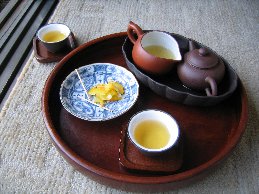
1. What exactly is a tea spoon, and why should it not be reduced to a sugar spoon or a tea-rule accessory?
The phrase “tea spoon” carries several competing meanings today. One is the ordinary teaspoon of daily life, used to stir sugar in tea or coffee. Another is the more traditional tea-tool meaning: a small implement for handling dry leaf, often overlapping in name with tea scoop, tea ladle, or tea pick. A third is the generic small spoon-like object bundled into many modern tea-tool sets. Because these meanings blur together, many people end up treating the tea spoon as a vague minor utensil that is simply “for moving a bit of tea.”
But inside the movement logic of the Chinese tea table, the tea spoon is more specifically a fine dry-tea transfer tool. It serves the final few centimeters, final few grams, and final short adjustment between a dry-tea holding vessel and the main brewing vessel. That stage is brief, which is exactly why it is easy to ignore. It is also easy to think it is simplest to skip. Yet when one is dealing with long-strip oolongs, delicate green teas, curled jasmine forms, uneven fragments of aged white tea, or any situation where dosage and vessel entry need to be a little more stable than “close enough,” the tea spoon becomes legible. It is not a display vessel, not a storage vessel, and not a main brewer. It is a movement buffer just before the dry tea enters the brewer.
Seen this way, the tea spoon is not interchangeable with the tea rule or the tea lotus. The tea lotus is more about holding and presenting dry tea so that it can be seen and smelled after leaving storage. The tea rule is more about creating a clearer dosing channel. The tea spoon is the finer local intervention tool: it adjusts, adds, subtracts, gathers, avoids dust, and corrects the path. One can dose tea without it, but that step then becomes more dependent on fingers, improvisation, and luck.
2. Why does the tea spoon still matter today? Because pre-dosing control has not disappeared
Modern tea tables do indeed emphasize reduction. Many tools are being re-evaluated, and people are increasingly willing to keep only what is truly useful and truly smooth in action. In that process, the tea spoon looks like an obvious candidate for elimination. It is less central than the gaiwan, less visible than the fairness pitcher, less display-oriented than the tea lotus, and less obviously irreplaceable than the tea needle or tongs in special situations.
But precisely because the contemporary tea table values cleaner motion, the tea spoon is worth keeping. One of the major shifts today is that more people care about whether dosing can be done with more cleanliness, steadiness, and repeatability. In the past, rough movements were often absorbed by bigger trays, larger surfaces, and looser daily goals. Now the table is smaller, the tools are fewer, the visual field is quieter, and the brewing rhythm often aims at clearer repetition. A little extra dust falling into the gaiwan, fingers entering to fix a few leaves, or long strips catching awkwardly on the rim all become more visible. The tea spoon matters because it lets this stage be done with more finesse.
It is especially useful for people who do not want fingers repeatedly entering the dry-tea path. Fingers are of course usable, but they also bring contact, scatter, unstable quantity feel, and visible trace. For some rougher teas and lower-demand daily drinking, that is fine. But where people care about leaf integrity, dosing consistency, and rim cleanliness, the tea spoon clearly reduces the roughness of having the hand do everything directly. It does not make the process more complicated. It simply offers a lighter and steadier option at the stage most easily skipped.
3. What the tea spoon really controls is not just quantity, but path
Many discussions of the tea spoon stop at dosage control. That is true, but incomplete. A tea spoon can certainly help add a little, remove a little, and make the measured amount more stable. But its deeper role is in controlling the path by which dry tea enters the brewing vessel. A quantity error can often be corrected. A messy path tends to drag the rest of the movement with it: rim disorder, dust distribution, visual untidiness, and awkward pacing.
Take long-strip yancha, dancong, or other strip-style oolongs. When these move from a tea lotus into a gaiwan, the main danger is often not one or two extra leaves, but leaves entering sideways, catching across the rim, folding badly, half-falling outside, or letting dust lead the way. Or take delicate green teas, flower teas, or curled and rolled forms. The problem is often not gross mismeasurement, but a final rough sweep that sends the lightest pieces first, the most broken pieces downward, and the cleaner leaves in late. The tea spoon helps make that stage feel guided rather than dumped. It supports quantity, but it first serves path.
This is also why the tea spoon and the tea rule are not higher and lower versions of the same thing. The tea rule behaves more like a channel. The tea spoon acts like a hand inside that channel, adjusting the final local passage. The mature tea table does not insist that all tea must simply be tipped in, nor does it overcomplicate every dose. It knows when one small tool is enough to steady the last segment of the route. That is the tea spoon’s real value: light intervention, not domination.
4. How is the tea spoon different from the tea rule, tea lotus, tea scoop, and tea pick?
These tools are easily mixed together because they all operate before the tea has actually begun brewing. But that is exactly why their boundaries matter. The tea lotus is most strongly associated with holding and presenting dry tea. The tea rule is most strongly associated with guided entry, almost like a dosing chute. The tea scoop is a broader category of tea-moving implement. The tea pick is more about nudging and rearranging local clusters of leaf. The tea spoon’s distinctive place is that it can remove or add a small amount, but more typically it performs fine correction.
In other words, the tea spoon is not the tool best suited to large-volume transfer, nor the one best suited to full presentation. It is best when the larger movement is already nearly complete and all that remains is a small adjustment that will look rough if ignored. Perhaps the tea lotus holds slightly too much tea, the tea rule is already in place, but there is a patch of dust that should not follow into the gaiwan. Or the tea is mostly in the vessel, but a little needs to be added. Or one or two long leaves are caught awkwardly at the rim and should be coaxed in rather than pressed by hand. The tea spoon serves exactly that state of near-completion that still needs a light corrective touch.
Clarifying these distinctions is not about vocabulary trivia. It is about preventing one movement from being forced onto the wrong tool. The question is rarely whether a tea table becomes impossible without a certain object. The question is whether some stage, if repeatedly handled by an ill-suited tool, becomes rougher, messier, and less stable over time. The tea spoon exists to release that stage from makeshift improvisation.
5. What makes a tea spoon genuinely good to use?
The tea spoon looks simple, but the difference between a good one and a bad one is real. The first important point is not decoration or material, but the force of intervention it permits. If the spoon bowl is too deep, too thick, or too large, it becomes clumsy in the tea lotus, tea rule, or vessel mouth and tends to bring too much leaf at once. If it is too shallow, too narrow, or too light, it may be suitable only for symbolic tidying and not for actual fine adjustment. A mature tea spoon is rarely “the bigger the easier” or “the smaller the more refined.” It is one whose bowl size and curvature are well matched to small-scale dry-tea handling.
The second important point is its relation to the vessel mouth. A tea spoon never works alone. It must cooperate with the tea lotus, tea rule, gaiwan, or pot mouth. If the leading edge is too blunt, movement near the rim becomes muddy and hesitant. If it is too pointed and thin, it begins to behave more like a needle than a spoon, losing its ability to support and carry a small amount of tea. The best tea spoon typically balances “able to hold a little” and “able to nudge a little.” It is not a tea needle meant for narrow penetration, nor a broad scoop meant for larger general transfer. It is shaped for the final small correction.
Material also matters. Bamboo and wood are common because they are light, quiet, and easy to absorb into the visual language of the tea table. Metal can be clean, durable, and easy to wipe, but if it feels too cold or too sharp at the edge, the motion itself can become tense. In practice, the best tea spoon is often not the most luxurious one, but the one that asks the least attention of the hand: easy to pick up, stable in adjustment, light in leaf guidance, and quiet when it leaves the scene.
6. Why is the tea spoon also a tool for reducing direct hand intervention?
One major tendency on the contemporary tea table is to reduce direct hand entry wherever possible. Tongs handle hot cups. Tea needles handle compressed tea. Strainers handle dust. Lid rests handle hot lids. The tea spoon handles the sort of local pre-dosing correction that people otherwise perform directly with fingers.
This is not about ceremonial excess. It is about the instability of direct hand movement. Fingers can be fast, but speed is not the same as precision. Once dry tea has entered a narrow working area near the mouth of the brewer, a finger entering to add, gather, or press often creates a larger gesture than intended, and its traces are more visible. The tea spoon shrinks that intervention into something smaller, more bounded, and more repeatable.
That is why the tea spoon does not contradict modern reduction. It does not complicate the process. It helps prevent the kind of apparently convenient movements that actually make the table and the vessel mouth messier. A mature tea table is not one that reduces all actions to “the fastest possible.” It knows which actions deserve one small tool so that their boundaries do not collapse.
7. Common misunderstandings about the tea spoon
Mistake one: the tea spoon is just a smaller tea rule, so there is no need to keep it separately. In reality, the tea rule guides entry, while the tea spoon performs fine correction. They overlap, but they are not identical.
Mistake two: any small spoon will do. Temporary substitution is possible, but bowl depth, edge thickness, relation to the vessel mouth, and hand feel all create real long-term differences. The key is not whether it looks like a spoon, but whether it suits the final small stage of Chinese tea dosing.
Mistake three: the tea spoon only affects neatness, not brewing. It may not directly control extraction, but it does affect leaf entry, dust ratio, vessel-rim order, and movement stability, all of which continue into brewing.
Mistake four: low-frequency tools are not worth choosing carefully. Like the tea needle, the tea spoon is a classic low-frequency, high-value object. It stays quiet most of the time, but when it is needed, that is often the last moment one wants to improvise badly.
Mistake five: a minimalist modern tea table no longer needs a tea spoon. On the contrary, the fewer the tools and the clearer the movement boundaries, the more certain small tools matter for preventing local actions from becoming rough. The tea spoon is not a leftover from old ceremonial kits. It remains a valid fine-adjustment tool on the contemporary table.
Why is the tea spoon still worth writing about today?
Because it clearly reveals something often forgotten: the mature tea table is not defined only by how beautiful or prestigious its starring vessels are. It is also defined by whether the quiet transitional tools between one movement and the next have been understood. The tea spoon is one of those tools. It is not conspicuous, not theatrical, and not responsible for the big gesture. It manages the exact small step most likely to become rough if left entirely to improvised hand motion.
If the tea lotus trains the awareness of holding and presenting, the tea rule trains the awareness of guided entry, and the tea scoop trains the awareness of general dry-tea transfer, then the tea spoon trains something finer: the willingness to leave one properly suited tool for the final local correction rather than always trusting fingers and improvisation. It does not need to appear every day. But once one starts caring about boundary, pre-dosing control, and the cleanliness of movement, the tea spoon becomes meaningful again.
Related reading: Why the tea rule is more than a pouring channel, Why the tea lotus is more than a dry-tea tray, Why the tea scoop is more than a tea ladle, and Why the tea needle is more than a prying tool.
Source note: synthesized from public Chinese-language tea-tool references on tea spoons, tea ladles, small dry-tea utensils, and teaspoon terminology, together with contemporary tea-table discussions around dosing paths and dry-tea transfer, and aligned with the working distinctions already established on this site among tea lotus, tea rule, tea scoop, and tea needle.