Teaware feature

Why cha he is more than a tray for looking at dry tea: dry-leaf display, aroma preparation, and the most underestimated order before dosing

Created: · Updated:

Many people first understand cha he as a very light kind of object: a small tray or presentation piece for placing a little dry tea where people can look at the leaf and smell it, something elegant and easily reduced to “tea-table ceremony.” That reading is not wrong, but it misses the main problem cha he actually handles. Its real importance is not simply that it puts tea on display. It takes dry tea out of relatively closed states such as packages, caddies, storage vessels, pouches, and sample boxes, then moves it onto a temporary surface where it can be observed, judged, smelled, arranged, and guided forward. In other words, cha he does not directly extract tea, but it deeply affects whether the short stretch before the main brew begins feels clear, restrained, and well organized.

A mature tea table rarely treats the time before dosing as an empty gap that can be rushed through carelessly. Where the dry tea comes from, where it rests first, whether it should be seen before it is smelled, whether the ratio of intact leaf to fragments should be checked, whether guests can share a first judgement of the dry leaf, and how the tea will then be sent into a gaiwan or potall of those questions are concentrated into just a few moments before brewing starts. Cha he is worth discussing not because it is expensive, but because it carries almost all of the small actions that gather inside those moments.

That is also why cha he has become worth discussing again today. This is not because everyone suddenly became more attached to classical tea-table props. It is because more people are recognizing that tabletop order does not begin only at the instant of pouring water. Many tea tables that look clear, composed, and controlled have already worked out their path before the leaves are even set down. Cha he is one of the most typical tools in that path.

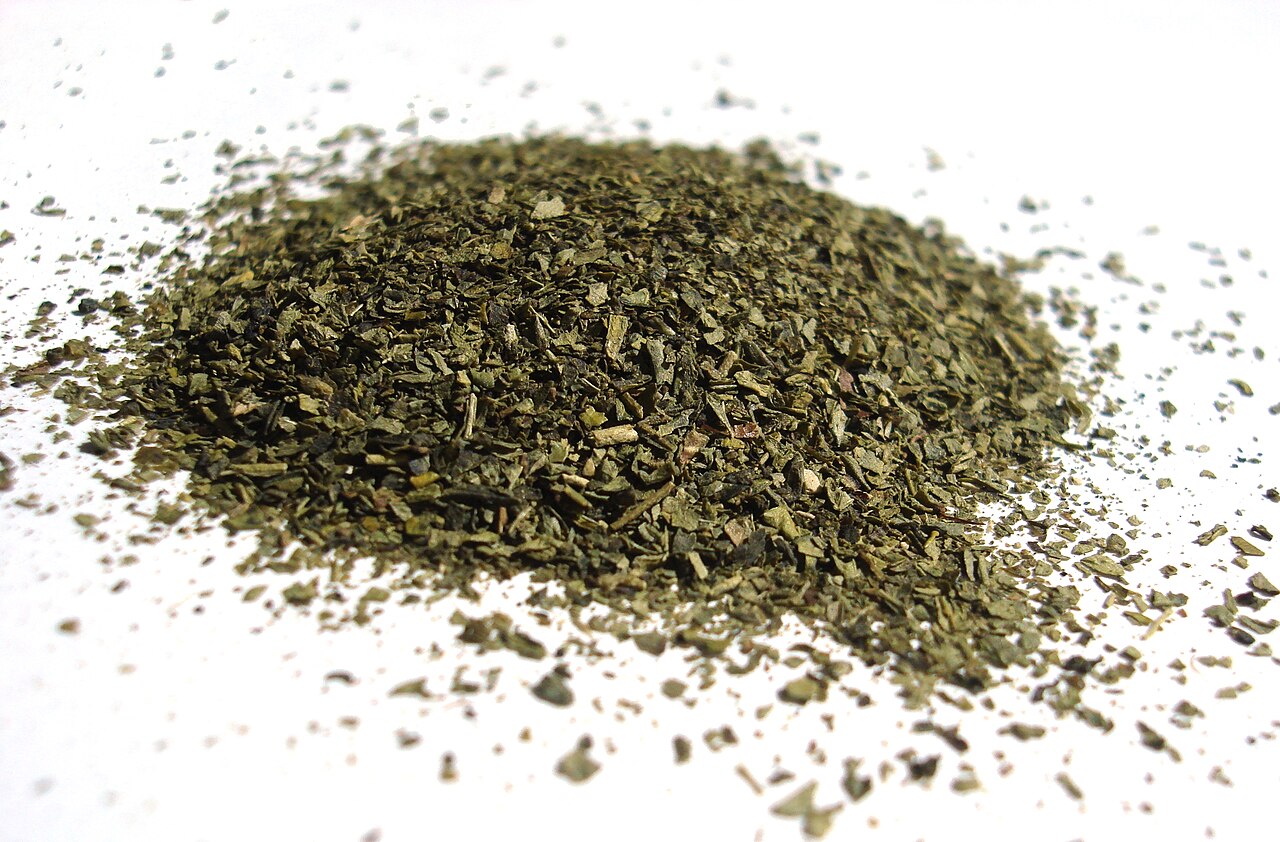
A close view of spread dry tea leaves, useful for explaining how cha he supports tea display, dry-aroma reading, and pre-brewing organization
The importance of cha he is not just that it makes dry tea look good. It creates a readable transitional surface for observation, dry-aroma reading, judgement, and guidance, so that the move from storage to brewing does not happen directly between package mouth and main vessel.

1. What exactly is cha he, and why is it more than a small tray for viewing tea?

In the simplest explanation, cha he is a small object used to hold dry tea before brewing, making it easier to observe the leaf and read its dry aroma. It is usually shallow, open, and light, so the leaves can spread out and later be guided into a gaiwan or pot. That definition is correct, but if cha he is reduced to a little tray for displaying tea, one key fact disappears: cha he is not an endpoint, but an interface of transition. It does not solve where tea finally goes. It solves whether there is a clear, brief, and controllable holding stage before tea enters the main vessel.

This matters a great deal. As long as dry tea remains in original packaging, in a tea caddy, or in a sample pouch, it remains in a condition that is inconvenient for full observation, awkward for shared judgement, and often clumsy for smooth transfer. One can of course pour directly from the bag into a gaiwan, or grab leaves from a caddy with the hand, a tea spoon, or a guiding implement. But when those actions are completed too quickly, many of the judgements that should happen before dosing are skipped: the length and integrity of the leaf, the amount of fragments, the aromatic direction, the visibility of roast, the freshness of the sample, the evenness of the leaf, and the likely amount for this session. Cha he turns those judgements from a blur into a short stage that can actually be seen, shared, and processed.

So cha he is not merely an object that holds tea. It is an object that allows dry tea to become a visible subject before brewing begins. It takes the leaves out of their hidden packaging state and turns them into something that can be looked at, smelled, compared, and re-decided. That transitional surface is what fundamentally separates cha he from an ordinary dish, plate, or temporary container. It is not just for placing tea somewhere. It is for making the act of bringing tea out actually meaningful.

2. Why is the core value of cha he not beauty, but making “looking at tea” actually possible?

When people talk about cha he, the first phrase that comes up is often “looking at the tea.” That is fine, but the real question is what that phrase means. If it means only spreading leaves out so they photograph nicely, then cha he can easily become decorative. But if looking at tea means a real pre-brewing act of assessment, then cha he immediately gains weight. Because looking at dry leaf is not the same thing as admiring an object. It is a way of judging the conditions that shape the whole session to come: the integrity of the leaf, bud-to-leaf ratio, degree of roast, color consistency, amount of broken material, the roughness or evenness of a sample from compressed tea, the cleanliness of scented tea aroma, or the freshness of green tea.

All of those judgements need a suitable surface. The value of cha he is that it provides not a corner inside a container, but a plane made for opening the leaf out. Once tea leaves are taken out of narrow pouches, deep caddies, or reflective inner bags, they can finally appear in a more truthful and legible form. This is especially important with strip-style oolong, bud-shaped green tea, mixed-fragment tasting samples, compressed teas that have been pried apart, and many scented teas. Without that opening-out, judgement is mostly guesswork. With cha he, observation finally has an object.

More importantly, cha he turns looking at tea from a private movement into a shared one. The host does not have to glance quickly at the leaves and rush straight into dosing. The sample can be brought onto a surface that everyone can approach, so that the question “what kind of tea is this, what condition is it in, and what should we expect from this infusion?” gets a shared visual starting point. That is why cha he is especially meaningful in hosting situations: not because it slows everything down, but because it allows a common judgement to happen naturally.

Spread dry Longjing tea, useful for showing how cha he helps reveal shape, color, and dry-leaf condition
Cha he moves tea out of the partial, obscured condition of packaging and onto a surface better suited for judgement. Shape, color, fragment ratio, and freshness cues often become legible here first.

3. Why is cha he so often tied to smelling dry aroma?

Because many teas offer one very important aromatic judgement before they ever meet water. This is especially true of green tea, scented tea, lightly roasted oolong, many black teas, and other teas whose aromatic identity is already pronounced in the dry leaf. Dry aroma is not an optional ornament in these cases. It helps the brewer anticipate style, freshness, roast level, cleanliness, floral character, and storage condition. The problem is that dry aroma is not best read by repeatedly probing into a package mouth or leaning into the depth of a tea caddy. That approach is unstable, awkward, and often means exposing the tea more than necessary.

The function of cha he here is to change aroma reading from “sniff into the package” into “let the dry leaf be read on a prepared transitional surface.” Once the leaves are spread on cha he, aromatic cues become easier to approach, and they can be read together with visual information. One is no longer trying to smell a hidden mass blindly. One is judging aroma while also seeing shape, color, and leaf composition. That simultaneity matters. It turns looking and smelling into two parts of one pre-dosing judgement rather than two disconnected actions.

Cha he also helps keep aroma reading restrained. It does not encourage endless theatrical smelling. It creates a short, clear, sufficient window for smelling, after which the action should continue: assess, guide, dose, brew. Mature use of cha he never turns the pre-brewing stage into a long performance. It makes looking and smelling happen when they should, then lets the action move on smoothly. That is why cha he may be called ceremonial, but in fact it often serves efficiencyjust not the crude efficiency of skipping everything that matters.

4. Why is cha he not only a display object, but also a question of dosing path?

If looking and smelling are the most visible functions of cha he, then the dosing path is its most underestimated function and one of the most important in practice. Many people assume cha he is simply something from which tea is “poured in afterward,” as if any surface could do the same job. In reality, whether the leaves can move from an opened-out state into the gaiwan or pot smoothly, accurately, and with minimal fragment scatter directly affects whether cha he is genuinely useful.

This is one of the biggest differences between cha he and an ordinary plate or saucer. A generic dish may hold tea and may even display it, but it may not guide it well. Cha he often has a narrowing edge, shallow curvature, or an asymmetrical shape because it does not only hold tea. It also sends tea onward. It must allow the leaves to gather again from a spread-out state into a short and readable path. When that path fails, the whole pre-brewing order collapses at the last second: long strips cling to the edge, fragments scatter, and the hand or another tool has to step in for rescue.

So cha he is really a bridge between the logic of display and the logic of dosing. It cannot be as closed as a caddy, but it also cannot behave like a pure display object that cares only about appearance. It has to work for both observation and transfer. Mature use of cha he is not about making it do everything. It is about letting it complete the stage that suits it best: turning tea from a storage state into a judgement state, then from a judgement state into a dosing state. It is not the endpoint, but it is an essential span of the path.

5. Why does cha he also manage fragments, boundaries, and tabletop cleanliness?

Many discussions of cha he stop at whether it feels elegant or necessary. But in long-term use, cha he proves to be a very practical tabletop tool as well. Dry tea is not always tidy. Strip-style oolong, white tea and puer broken from compressed forms, tasting samples, scented teas, and many curled green teas can all create fine fragments, dust, and small loose bits during transfer. If tea is poured directly from a package mouth into a gaiwan, or moved quickly from a caddy, those fragments are most likely to scatter onto the table, the rim of the gaiwan, the shoulder of a pot, or the brewing zone itself.

One of the functions of cha he is to gather that fragile transition onto a more controllable surface. Fragments first fall onto cha he rather than onto the table. Leaves are first arranged on cha he rather than rescued at the rim of the gaiwan. The transfer path is first shaped on cha he rather than improvised by shaking the package mouth at the last second. Cha he cannot make all fragments disappear, but it can convert an unbounded transition into an organized one.

This is where cha he meets tabletop order. Order does not mean absolute cleanliness at all times. It means that the small frictions which inevitably happen are given the right place to happen. Cha he acts like a small buffer zone that absorbs part of the friction of display, smelling, arranging, and guiding, so that those actions do not strike the brewing zone directly. Many tea tables feel composed not because they have more equipment, but because small transitional tools like cha he intercept disorder early.

A tidy tea setup with clear tabletop zoning, useful for showing how cha he helps maintain pre-brewing boundaries
The value of cha he is not only that it lets tea be seen first. It also gathers display, arrangement, and transfer into a small bounded surface, so the table and brewing zone do not have to absorb that disorder directly.

6. How is cha he different from chaze and the tea spoon, and why are they so often confused?

This is one of the most common confusions today. Cha he, chaze, and the tea spoon all belong to the stage before brewing begins. They can all appear slender, shallow, or small in form. Sellers also blur the names on purpose so one object seems to do several jobs. But if one distinguishes them seriously, their central tasks are not the same.

Cha he leans toward holding and showing. It brings tea out first so that the leaf can be observed, smelled, and shared as an object of judgement. Chaze leans more toward guiding and sending. It usually emphasizes the directional path by which prepared tea is led into a gaiwan or pot. The tea spoon leans more toward measuring and taking, especially when leaves begin in a concentrated state inside caddies, pouches, or sample containers. Of course, all three can borrow one anothers place: cha he can also guide tea, chaze can temporarily hold some leaf, and the tea spoon can help with the last part of transfer. Even so, the distinct place of cha he remains the same: it allows the tea to be spread out, read, smelled, and shared before it moves on.

For that reason, cha he should not be reduced to “a larger chaze” or “a more refined little dish.” Its real importance is that it pulls a brief but clear stage of judgement out of what would otherwise become only a few rushed seconds. Without that stage, dosing may be faster but also vaguer. With it, the action is not necessarily slower, but it gains a readable before-and-after structure.

7. What makes a cha he genuinely usable? First the surface, then the narrowing edge, curvature, and return feel

When people choose cha he, they often begin with material and beauty: white porcelain looks clean, bamboo and wood look warm, pottery looks rustic, and elaborately decorated forms seem especially “tea-table appropriate.” That is understandable, but what actually determines whether a cha he stays in use is first of all the surface it offers. If the surface is too narrow, the leaves cannot spread properly and both observation and dry-aroma reading become weaker. If it is too deep, the tea falls back into a gathered mass. If it is too slick, strips and fragments become hard to control. If it is too rough, transfer becomes awkward because the leaf catches.

The second point is the narrowing edge and curvature. A good cha he is not just a flat platform. It is an object that can move naturally from opening-out to gathering-in. The first phase needs enough openness for the leaf to spread. The second phase needs enough control for the tea to be guided into a clear path. If that path is poorly designed, the most awkward moment of the whole process appears at once: the tea looked beautiful while being displayed, but the instant it must be dosed, the action stalls, catches, leaks, or requires rescue. The true professionalism of cha he is often hidden in that one question: does it guide well?

The third point is what might be called return feel: how naturally it can be picked up, turned slightly, offered closer, and set down again. Cha he is not a static display board. It is handled. If it is too heavy, the movement drags. If too light, it feels unstable. If the edge is too thick or too sharp, repeated use becomes awkward. The most useful cha he is rarely the most dramatic one. It is the one that lets looking, smelling, and guiding feel like one connected sequence.

8. The most common misunderstandings about cha he

Misunderstanding one: cha he exists only for ceremony. If it never takes part in real pre-brewing judgement and appears only in styling or photographs, then yes, it becomes decorative. But when it is used seriously for dry-leaf display, aroma preparation, dosing paths, and tabletop boundaries, it is a practical tool.

Misunderstanding two: any small plate or dish can replace cha he completely. Temporary substitution is possible, but not the same as functional equivalence. Something may hold tea without opening it out properly, open it out without supporting aroma reading, or display it without guiding it smoothly onward. Cha he matters because it handles those stages continuously.

Misunderstanding three: cha he is only for hosting, not for personal tea practice. In fact, solo drinkers can benefit from it just as much, especially when they care about dry-leaf judgement, want less fragment scatter, or simply want a clearer path before brewing begins. It does not only serve the eyes of others. It serves ones own reading of the tea.

Misunderstanding four: cha he belongs only to formal traditional tea tables. Modern compact setups, desk brewing, sample comparison, tasting practice, filmed tea scenes, and office dry-brewing can all need a clear dry-leaf transition surface even more than large traditional tray setups do. Cha he is not conservative. In many ways it suits contemporary tables that care about rhythm and boundary.

Misunderstanding five: cha he, chaze, and the tea spoon are basically the same, so the naming does not matter. In real use they do overlap, but their center of action is different. Distinguishing them is not pedantry. It is a way of avoiding the collapse of several different preparatory actions into one vague phrase like “they all help move tea.”

Why does cha he still deserve serious attention today?

Because it reminds us very clearly that the maturity of a tea table does not happen only in the most visible stages such as pouring water, extracting, and distributing liquor. Many of the details that determine whether a table feels composed happen earlier: where the tea is first set down, how it is first seen, how it is first smelled, how it is first arranged, and how it is then sent into the brewing vessel. Cha he is the object that turns that small stretch of action from something blurred into something legible.

It is neither grand nor mysterious, and it is very easy to underestimate. But the more often one drinks tea, the more obvious the honesty of such an object becomes. It does not create drama, but it reduces later rescue. It does not directly alter the liquor, but it changes the path by which one arrives at the brew. It does not occupy the starring role, but it often decides whether the star has a proper beginning. Cha he is more than a tray for viewing tea because what it supports is not only a little dry leaf. It supports the most easily underestimated order before dosingthe order that often reveals whether a tea table is actually mature.

Related reading: Why chaze is more than a tea-moving sliver, Why a tea spoon is more than a small spoon, Why a tea caddy is more than a storage container, and What a gaiwan really is.

Source references: synthesized Chinese-language public discussion around cha he, dry-tea presentation, dry-aroma reading, pre-dosing preparation, and the distinction between cha he and chaze; cross-read with the sites existing articles on tea spoons, chaze, tea caddies, and gaiwan to align the discussion of pre-brewing movement, transfer paths, and tabletop boundaries.