Why oolong best represents the craft spectrum of Chinese tea: from Tieguanyin and Wuyi rock tea to Phoenix Dancong and Taiwan high mountain oolong
Created: · Updated:
If one had to choose a single tea family to explain why Chinese tea is not just a set of labels but a whole system shaped by craft, oolong would be one of the strongest choices. Many introductions define it quickly as a “semi-oxidized” or “partially oxidized” tea. That is not wrong, but it is far from enough. What makes oolong so compelling is not merely that it sits somewhere between green and black tea. It is that the category contains enormous internal variation: some styles are high and floral, some are roast-driven and deep; some are rolled into tight balls, some remain long and twisted; some emphasize orchid-like lift and clarity, while others ask the drinker to pay attention to mineral structure, roast integration, mountain character, and throat feel.
That is also why oolong deserves serious writing. It is not a category one can explain by mentioning origin and season and then stopping. The real story lies in how the leaf is guided through withering, bruising, oxidation control, fixation, rolling, shaping, and roasting. Tieguanyin, Wuyi rock tea, Phoenix Dancong, and Taiwan high mountain oolong all belong to the broad oolong family, yet in the cup they differ in form, aroma, liquor texture, endurance, brewing logic, and even in what counts as “good.” Oolong is not one answer. It is a full craft spectrum.
Oolong is worth returning to because it is not one flavor profile. It is an entire family of teas continuously shaped by craft, cultivar, roast, and place.
What kind of tea is oolong, and why does “semi-oxidized” explain only half of it?
In broad classification, oolong is one of the major Chinese tea families, defined by a relatively complex process that usually includes withering, controlled bruising and partial oxidation, fixation, rolling, shaping, and drying or roasting. It is not trying to preserve fresh leaf character as directly as green tea, and it is not generally pushing oxidation as far as black tea. What makes oolong distinctive is that the maker is constantly making judgments about oxidation level, aromatic development, body, and how later roasting should gather or redirect the tea. “Semi-oxidized” therefore tells you where the tea sits on a rough map, but not why the category opens into so many styles.
A better way to think about oolong is as a tea family defined by craft control. The question is not only how much oxidation happens, but how aroma is lifted, how body is held together, how floral notes are integrated rather than superficial, how roast settles the leaf, and how each producing region lets its own preferences speak. That is why oolong contains so much internal diversity. Readers do not need to memorize one perfect definition. They need to understand from the start that oolong is a family, not a single template.
Oolong is especially suited to gongfu-style tasting because aroma, body, and aftertaste often need several infusions before they fully explain themselves.
Why does shape matter so much in oolong? Rolled and strip styles are not decorative differences
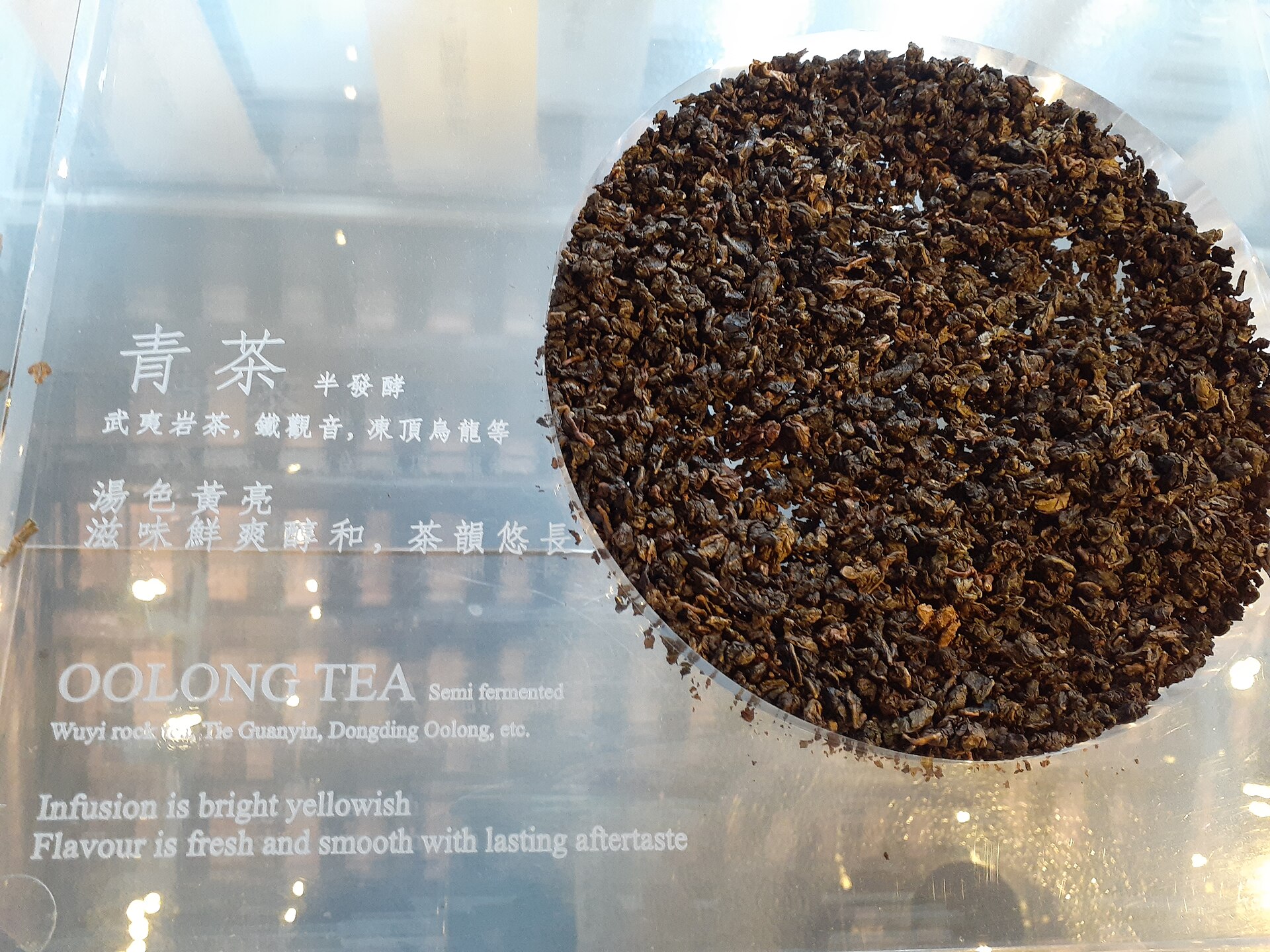
Many tea families can be introduced through color or tenderness. Oolong is unusual in that it is often most useful to begin with visible shape. Form often points directly to processing path. Rolled or semi-ball-shaped oolongs begin tightly closed and then open gradually in water, so the drinker experiences aroma and texture unfolding step by step. Strip-shaped oolongs present the line and structure of the leaf more openly, and their brewing rhythm often reveals aroma and roast in a different way.
This is not merely a matter of appearance. Shape expresses processing logic. Rolled oolongs often lead readers toward Anxi and Taiwan traditions that emphasize floral clarity, smoothness, and the gradual release of aroma. Strip styles more easily evoke Wuyi rock tea and Phoenix Dancong traditions, where mountain site, roast, leaf substance, and aromatic layering are read differently. Shape affects extraction speed, but it also shapes how a reader understands origin, personality, and proper brewing approach. For international readers, this is often one of the easiest ways into the category.
Tieguanyin: why is it so often the first stop in understanding oolong?
Tieguanyin matters not only because it is famous, but because it behaves like a model lesson in oolong. It is closely tied to Anxi in Fujian, yet its wider cultural importance comes from the way it has long functioned at once as cultivar name, origin marker, gift-tea name, and public shorthand for serious Chinese oolong. Many people who do not study tea history or production in depth still remember Tieguanyin as one of the first important tea names they learned. In practice, many readers do not first understand the broad category of oolong and then move toward Tieguanyin. They begin with Tieguanyin, and only later discover how wide the oolong family really is.
Tieguanyin is also useful because it shows that oolong is not static. There is no single eternal Tieguanyin profile. Modern markets have at times favored greener, brighter, more floral styles, while more traditional approaches emphasize fuller roast, greater stability, and deeper body. These debates are not trivial. They are arguments over what Tieguanyin is supposed to represent. That makes the tea especially useful in writing: it demonstrates that oolong style changes with era, market taste, and local processing choice rather than sitting still as a museum object.
Wuyi rock tea: why does it push oolong toward structure rather than just fragrance?
If Tieguanyin often introduces drinkers to floral oolong softness and polish, Wuyi rock tea pushes the category toward another set of values: strip shape, roast integration, rocky structure, body, and site expression. The famous names may be Da Hong Pao, Rougui, and Shuixian, but the deeper point is not to memorize the labels. It is to understand that this branch of oolong is judged differently from cleaner rolled floral styles. It does not ask only whether the tea smells good. It asks whether the aroma settles into the liquor, whether the tea has backbone, whether the so-called rock quality is convincing, and whether the roast has removed roughness without flattening vitality.
This is why rock tea can initially feel difficult to newcomers. It does not always provide a quick bright answer. It asks the drinker to accept that roast is not automatically a flaw, that structure is not secondary, and that minerality and firmness are not the same as harshness. From a writing perspective, Wuyi tea is essential because it proves that oolong does not have to speak only through high floral fragrance. It can also speak through architecture, roast discipline, and aftertaste. In that sense it pairs beautifully with Phoenix Dancong: both are highly complex oolongs, but they make their arguments in different ways.
Phoenix Dancong: why does it turn aroma back into a technical language?
Many people first notice Phoenix Dancong through the unforgettable name Duck Shit Aroma. But what really matters is not the novelty of the name. Dancong develops aromatic differentiation into a dense working language. Mi Lan Xiang, Zhi Lan Xiang, Huang Zhi Xiang, Yu Lan Xiang, Yinhua Xiang: these are not just commercial labels. They describe outcomes shaped by local plant resources, mountain ecology, bruising rhythm, oxidation control, and roast choice. Dancong therefore shows readers that “aroma” in oolong is not necessarily a vague floral impression. It can be a highly trained expression of craft.
Dancong also shows how deeply oolong can be bound to local tea culture. Chaozhou gongfu brewing, with its high leaf ratio, quick pours, and repeated comparison across many rounds, fits the tea almost perfectly. Outside that context, Dancong can be misread as simply a very fragrant oolong. Inside it, one sees why it deserves a full article of its own. This site already expands that path in the separate Phoenix Dancong feature. In the broader oolong overview, it stands as one of the clearest examples of how far the category can push aromatic complexity.
Oolong is often best understood not from the first sip, but from repeated observation across many brews: lid aroma, liquor, aftertaste, and throat feel all shift over time.
Taiwan high mountain oolong and Dong Ding: why do many international readers fall in love here first?
For many international readers, Taiwan oolong provides the first truly vivid oolong experience. The reasons are easy to understand: tightly rolled leaves, dramatic unfolding in water, lifted aroma, clear liquor, and a rounded palate. Whether one is talking about Dong Ding or the wider family of high mountain Taiwan oolongs, these teas quickly teach that tea is not just a beverage that produces one flat flavor. It can be sequential, visual, and alive across many infusions.
Dong Ding is especially useful because it connects two kinds of imagination at once. On one side it belongs to a distinct Taiwan mountain and local identity. On the other it speaks to the broader rolled-oolong route inside the Chinese-speaking tea world. Even looser commercial phrases like “high mountain oolong” often borrow from this image: altitude, coolness, floral lift, elegant structure, and a polished modern oolong style. Whether or not every commercial usage is technically precise, the appeal reveals something important. Oolong is exceptionally good at creating strong style impressions through the meeting of shape, altitude, and aroma.
How is oolong made, and why is bruising and oxidation management so central?
The key processing logic of oolong usually includes withering, bruising or shaking, controlled oxidation, fixation, rolling, shaping, and drying or roasting. Details differ sharply across regions and styles, but one stage remains especially important: the phase in which the leaf is bruised, rested, and observed so that oxidation develops in a controlled way. This is not one simple action. It is a sequence of decisions. Bruise a little more or less, rest the leaf slightly longer or shorter, move onward too early or too late, and the finished tea may head in a very different direction.
This is where oolong shows the hand of the maker most clearly. Green tea often races to preserve freshness; black tea usually pushes oxidation further toward another set of goals. Oolong lives in the zone of adjustment. Too light, and the tea may turn thin and empty. Too heavy, and it may lose lift and vitality. Roast too little, and it may feel scattered; roast too much, and the leaf may lose its life. That is why better oolong is judged not just by whether it has aroma, but by whether aroma, liquor, aftertaste, roast, and endurance actually work together.
What looks like a simple difference in dry-leaf appearance often reflects deeper differences in cultivar, shaping method, roast, and intended drinking style.
Why is roasting so important? It is not simply about making tea taste toasted
Many first-time drinkers treat roast as if it were merely an extra flavor, as though the only question were whether the tea is lighter or darker. In oolong, roast is more like a second act of organization. It changes how aroma presents itself, how tightly the liquor holds together, how stable the tea remains across infusions, and how cleanly rough notes are gathered in. Light-roast teas often seem brighter, more floral, and easier for beginners to love immediately. Mid-roast and fuller-roast teas may appear calmer at first, but they often carry more depth, tighter structure, and a more settled finish.
That means roast should never be discussed only as a matter of personal preference. The better question is whether the roast suits the tea. Has it brought aroma and body into alignment? Has it helped the leaf express its depth? Does the tea still hold together after several infusions? Oolong becomes so rewarding precisely because roast is not meant to hide the tea, but in many cases to complete it.
How should oolong be brewed, and why is gongfu brewing especially revealing?
Oolong generally responds well to relatively high water temperature and repeated short infusions. Whether one uses a gaiwan or a small pot, gongfu brewing reveals the tea in stages. Rolled oolongs need time to open, so the early infusions often move from compression to release. Strip styles may present fragrance and structure earlier, but continue to shift in later steeps. Compared with one long mug infusion, repeated short brews make it easier to understand what oolong is actually doing, because one tastes development rather than a single blended result.
As a practical starting point, many oolongs can be brewed at around 5 to 8 grams of tea for 100 to 120 milliliters of water, using near-boiling water, with a very quick first pour and adjustments afterward based on leaf expansion and roast level. High-fragrance lighter-roast teas are often more sensitive to oversteeping; steadier roasted teas can tolerate fuller extraction. Beginners tend to make two opposite mistakes: too little leaf, which turns oolong into weak scented water, or too much time, which forces bitterness and stuffiness too early. Once the reader grasps three ideas—high temperature, short infusions, repeated comparison—oolong becomes much more approachable.
What are the most common misunderstandings about oolong?
The first is to treat aroma as the only standard. Oolong absolutely values fragrance, but high fragrance does not automatically mean high quality. In stronger teas, aroma must connect to liquor texture, aftertaste, throat feel, and endurance. The second mistake is to treat “semi-oxidized” as a full explanation. That phrase can make the category sound like a simple midpoint rather than a large internal field of craft choices. The third mistake is to treat roast as a flaw. In many great oolongs, roast is not covering the leaf. It is part of what allows the tea to become coherent.
The fourth mistake is to ask, “What does oolong taste like?” as if the category should yield one official answer. The question is too broad. A better one is: what route of oolong is this? Rolled or strip? Floral or roast-centered? Orchid-like, fruity, mineral, or mountain-driven? Once the question improves, the category stops seeming chaotic and starts becoming wonderfully legible.
Why is oolong so important to a serious understanding of Chinese tea?
Because it proves that the complexity of Chinese tea is not mysticism. It is craft. Longjing helps readers understand spring leaf tenderness and pan-firing. Pu-erh helps them understand time, storage, and post-fermentation. Chinese black tea helps explain fuller oxidation and global circulation. Oolong shows how one tea family can be pushed into radically different forms through bruising, oxidation control, shape, roast, and local taste. It can remain deeply tied to mountain place while also being constantly rewritten by modern markets.
Within this site, the purpose of a broad oolong article is to provide a main map. From here the reader can move into more specific branches: to see how Phoenix Dancong pushes aromatic classification to extraordinary density, to compare Tieguanyin with rock tea as two different oolong aesthetics, or to set oolong beside jasmine tea and Longjing and understand why Chinese tea is never just a list of static categories. It is a cultural system shaped jointly by region, plant material, craft knowledge, and shifting ideas of taste.