Yellow tea feature
Why Haimagong Tea Is More Than “a Guizhou Yellow Tea”: From Dafang’s High-Altitude Haimagong Origin and Hairy Local Tea Populations to Controlled Pile-Yellowing and a Bright Yellow-Green Cup
If you reduce Haimagong tea to a single sentence, many summaries will call it “a yellow tea from Dafang in Guizhou.” That is not wrong, but it is much too thin. Once the description stops at “Guizhou yellow tea,” the tea becomes easy to flatten into a minor regional specialty: you know it comes from Guizhou, you know it belongs to yellow tea, and you assume that is enough. What actually makes Haimagong tea worth writing about is that it cannot be explained by region alone. It connects a very specific high-altitude, humid, misty local environment in Dafang; a local small-to-medium tea population known for visible hairs and strong tenderness retention; a yellow-tea process that relies not only on pile-yellowing but also on repeated reorganizing through re-firing and re-rolling; and a cup profile with a very particular rhythm: tightly curled strands, bright yellow-green liquor, a light initial grip, and then a cleaner, sweeter finish as the infusions continue.
That is exactly why Haimagong tea deserves a standalone place in a serious tea section. It naturally extends the logic of yellow tea as a category, and it also gives concrete support to the structure explained in yellow small tea. The most amplified narratives in yellow tea are often famous yellow bud teas such as Junshan Yinzhen. But if a site wants to show that yellow tea is not only about elite bud-tea aesthetics, it needs a regional example like Haimagong tea. This tea shows that yellow tea can also work through slightly more open leaf structure, stronger mid-palate organization, and a cup that becomes smoother and sweeter rather than merely louder in its first sip.
What kind of tea is Haimagong tea, and why should it first be understood inside the yellow tea system?
Haimagong tea belongs to Chinese yellow tea, and that point is consistent across public reference material. It is associated with Haimagong in Dafang, Guizhou, and the place-name remains central to its identity even where administrative boundaries have changed. More importantly, it is not just “a green tea that looks a little yellower.” Its process direction clearly enters yellow tea logic. Public descriptions repeatedly mention a sequence including kill-green, initial rolling, pile-yellowing, re-firing, re-rolling, drying, and sorting. The most decisive element here is the pile-yellowing / yellowing stage, because that is what moves the tea away from straightforward green-tea preservation and toward a softer, rounder, more settled cup.
That is also why Haimagong tea belongs in the tea collection as a yellow tea article rather than being treated as a generic regional specialty. Once you put it back into the yellow tea framework, its knowledge position becomes much clearer: it is not a pure yellow bud tea and it is not a heavier yellow large tea. It fits much more naturally with the middle register explained in yellow small tea. In other words, it helps show that yellow tea is not just a cluster of famous fine-bud teas, but a category with internal structure and a readable process spectrum.
Why does the place-name “Haimagong” matter so much?
Many tea articles fall into vague language when they reach the topic of origin: mountain ecology, mist, humidity, altitude. Haimagong tea does involve those factors, but what matters is how they function in this tea specifically. Public descriptions commonly emphasize a high-altitude zone, tea gardens sheltered by surrounding hills, a humid and misty climate, noticeable temperature differences, and loose acidic soils. Together, these are not just “good conditions.” They help explain why this area supports hairy, tender local tea populations suitable for Guyu-period picking, and why Haimagong tea can maintain brightness and sweetness even though it does not rely on the extreme fine-bud route.
So Haimagong is not just a map coordinate. It is part of the flavor precondition. Without that kind of high-altitude humid microclimate, the tea’s characteristic pattern—bright yellow-green liquor, no harshness, and a gradual turn toward sweetness—would be much harder to stabilize. Unlike teas that build identity through strong roast or aggressive aroma, Haimagong tea depends more on clean raw material, appropriate tenderness, and good moisture rhythm before later stages of the process can shape the final cup.
Why do references keep stressing “local small-to-medium tea populations, many hairs, strong tenderness retention”?
This is not decorative local color. It directly affects the structure of the tea. Public descriptions often say Haimagong tea uses local small and medium tea populations with abundant hairs and strong tenderness retention, harvested around Guyu and graded from one bud with one just-opened leaf to one bud with two or three leaves. The important point is not the memorization of grading lines, but what they imply: Haimagong tea does not confine itself to the most extreme bud-tea aesthetic. It allows the raw material to move from fine buds toward slightly more developed bud-and-leaf structures while still preserving hairiness and tenderness, creating room for yellow-tea style reorganization later in processing.
That matters because if the leaves are too coarse, the tea easily turns rough, woody, and loose. But if the tea pushes too hard toward ultra-fine buds, readers may simply fold it back into a yellow bud tea narrative. Haimagong tea’s real place is in that middle band. It is neither a coarse mature-leaf tea nor a tea that wins only through tiny buds. It uses “tender enough, but slightly more open” leaf structure so that pile-yellowing, re-firing, and re-rolling can produce a fuller and more integrated liquor. That makes it a very useful example for teaching readers that raw material grade is not only a pricing ladder; it also determines where the process can meaningfully go.
How is Haimagong tea made, and why is “repeated reorganization” more important than any single isolated step?
Based on public references, the most stable process line for Haimagong tea includes kill-green, initial rolling, pile-yellowing, re-firing, re-rolling, drying, and sorting. The easiest point to remember is naturally pile-yellowing, because that is what most clearly pulls the tea out of green-tea logic. But seeing that one step alone is still not enough. What makes Haimagong tea interesting is that it does not stop after yellowing. It continues through re-firing, re-rolling, and further tidying, moving the tea from “no longer green” to “properly organized and complete.”
In practice, that means the process value lies not in one dramatic move but in a continuous chain of control. Kill-green stops the tea from staying too raw and grassy; initial rolling begins to shape the strands; pile-yellowing pushes the tea away from sharp greenness and toward a smoother, rounder state; then re-firing and re-rolling do two things at once: they tighten and finish the curled shape, and they clean up any looseness, dampness, or muddiness left after the yellowing stage. Final drying and sorting then stabilize aroma, moisture level, and market-ready form.
That also helps explain why Haimagong tea is often described as slightly astringent at first, then turning fragrant and sweet over repeated infusions. It is not a tea whose entire value sits in the first aromatic burst. Its strength often appears in progression: a light grip at the front, then greater openness, clearer sweetness, and a smoother palate over later brews. For this kind of tea, process completeness matters more than whether the first infusion smells especially dramatic.
Why does Haimagong tea align so naturally with yellow small tea?
If you place Haimagong tea inside the yellow small tea framework, many things become clearer at once. Its raw material is not a pure bud route but a more open bud-and-leaf route. Its process target is not extreme delicacy, but smoothness, stability, integration, and sweetness. Its standard flavor descriptions—bright yellow-green liquor, mellow taste, and sweet aftertaste—also match the central temperament of yellow small tea: more substance than yellow bud tea, lighter and cleaner than yellow large tea, with the emphasis falling on order and completeness after yellow-tea style reorganization.
Structurally, that makes it especially valuable for the site. Yellow tea sections often over-amplify the most famous yellow bud teas and leave readers with too little sense of the middle register. Haimagong tea fills that gap very well. It is not competing with yellow bud teas for prestige, and it is not a diluted yellow large tea. It is a stable middle skeleton inside the yellow tea spectrum.
What does Haimagong tea actually taste like, and why should “bright yellow-green” and “sweet aftertaste” be read together?
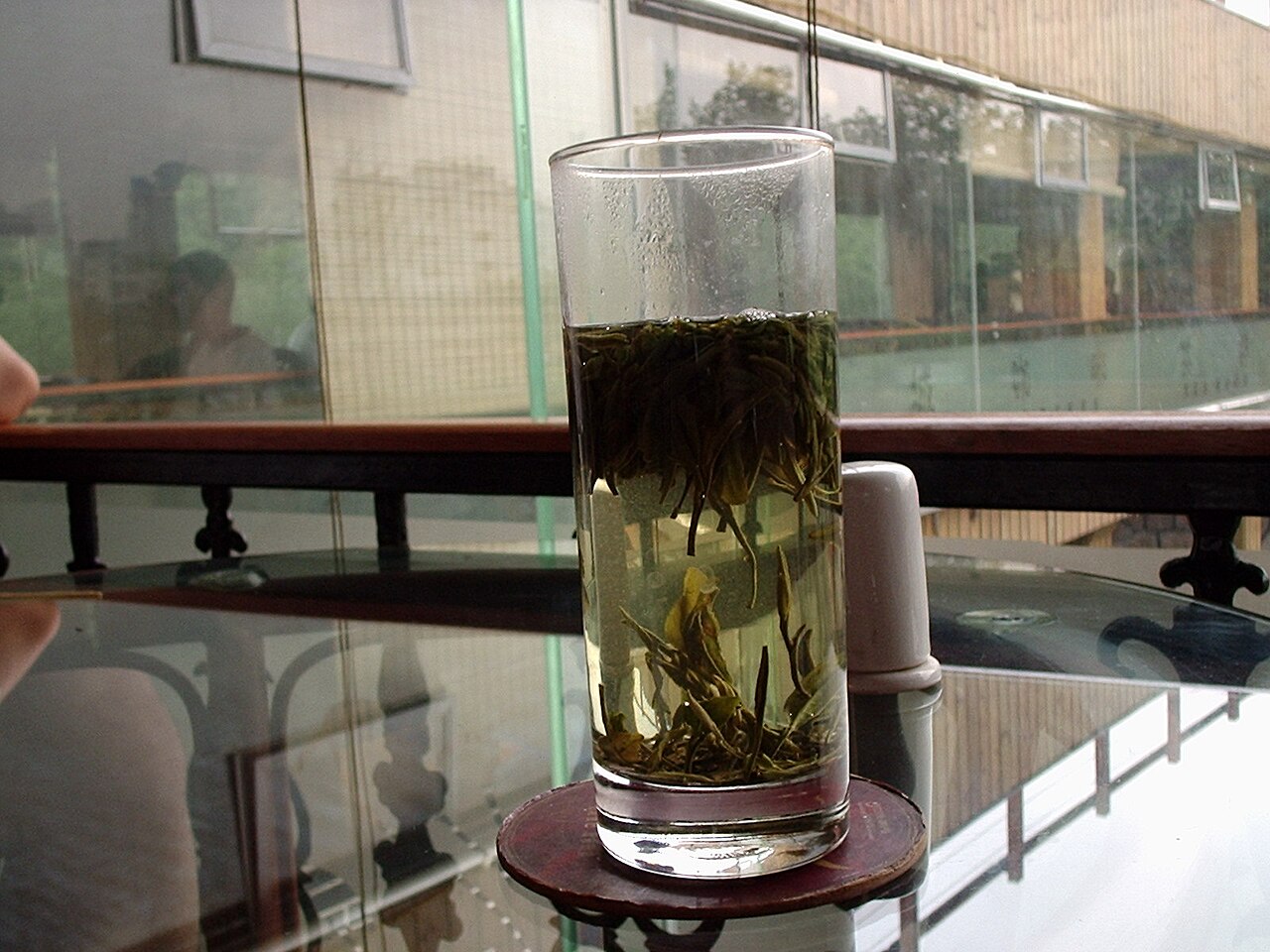
Common descriptions of Haimagong tea say that its strands are tightly curled, its hairs show clearly, its liquor is bright yellow-green, its infused leaves are tender yellow and even, its taste is mellow, and its aftertaste turns sweet. Each phrase is simple enough, but they are most useful when read as a set. Tightly curled strands indicate strong finishing work rather than loose, casual leaf handling. Bright yellow-green liquor shows that the tea has entered yellow tea logic without becoming dull or muddy. A mellow palate means it is not trying to win with green-tea sharpness. Sweet aftertaste means that this smoothness is not empty softness but something with persistence.
That is why Haimagong tea should not be judged from the first brew alone. In the opening infusion—especially with a slightly heavier dose or slightly hotter water—a touch of grip is not unusual. But if the tea is well made, that grip does not harden into roughness. Instead it opens out over the next infusions, with fragrance loosening, sweetness becoming clearer, and the mouthfeel evening out. It is not a tea that gets weaker and thinner as you continue. It is more often a tea that gets more coherent.
Where is Haimagong tea most easily confused with green tea, and how should readers separate them?
The confusion usually starts because the raw material is still relatively fine, the liquor can remain bright, and some aroma descriptions still use words like “clean” or “high.” That makes many readers instinctively place it near green tea. But the real dividing line is not whether it looks similar; it is whether the process goal and drinking result behave similarly. Green tea usually wants to preserve a more direct freshness, brightness, and immediacy, especially in fine early-spring styles. Haimagong tea, by contrast, is trying to gather that freshness in and turn it into something smoother, more rounded, and more sweet in the aftertaste. You could say that green tea often chases the first bright flash of spring, while Haimagong tea organizes that spring feeling into a more settled sentence.
So do not judge by color and tenderness alone. Ask instead whether the tea still feels too green and sharp, whether the tail becomes smoother, whether the sweetness is only superficial or develops later, and whether the tea holds together over multiple infusions. Once those questions are in place, Haimagong tea and green tea are not actually that hard to distinguish.

How should Haimagong tea be brewed, and why should it not be turned into a heavy, stuffy “old yellow tea” fantasy?
Haimagong tea is best understood in a glass or a gaiwan. A glass makes it easier to observe the bright yellow-green liquor and the opening leaf structure; a gaiwan is better for comparing the first several infusions carefully. In terms of water temperature, starting around 80°C to 90°C is usually safe, with small adjustments depending on leaf tenderness and drying completion. This is not a tea that needs brute force brewing to prove it has body, and it is not a good candidate for the “let’s steep it hard and see if it survives” approach. Its value lies in how smoothly it unfolds, not in how much punishment it can take.
In a gaiwan, about 3 grams per 100 to 120 milliliters of water is a stable starting point. Keep the first two infusions relatively short, then watch whether the aroma stays clean and whether the third and later infusions become sweeter and more integrated. Good Haimagong tea should feel more complete as you continue, not dramatically best in the first brew and flat afterward. Its endurance comes from order, not from brute concentration.
What are the most common mistakes when buying Haimagong tea?
The first mistake is buying it as nothing more than a “Guizhou yellow tea specialty.” That approach remembers the place-name but never really evaluates the tea. The second is chasing it with green tea standards: the greener, sharper, and more direct, the better. If Haimagong tea really behaves that way, the yellow tea logic has probably not been completed properly. The third mistake is the reverse—imagining that the more yellow, heavier, and older it feels, the more authentic it must be. That is another misreading. Good Haimagong tea should be yellow without being stuffy, smooth without going woody, sweet without getting cloying, and bright without turning thin.
The fourth mistake is to let the story replace the cup. Tribute-tea stories, local gazetteers, high-altitude claims, and old-tree narratives can all add depth, but none of them should substitute for cup evaluation. The useful questions remain simple: are the strands finished well, is the liquor bright, is the mouthfeel mellow, does the tea turn sweeter across several infusions, and are the infused leaves even and tender-yellow? For a regional yellow tea like Haimagong, the story matters—but the cup still has the final word.
Why does Haimagong tea deserve to stand as its own article in the tea section?
Because it fills a structural gap rather than merely adding “one more local tea.” The site already has yellow tea at the category level, and it already has a yellow small tea framework. But without a concrete, sensory, regionally grounded example like Haimagong tea, a reader’s understanding of yellow tea’s middle register still risks staying abstract. Haimagong tea can do that concrete work. It is neither a top national prestige tea nor a page that survives only on local legend. It is a tea that can clearly explain yellow tea process logic, raw material grading, local origin, and cup rhythm all at once.
It is also especially well suited to bilingual mirroring. The Chinese source article naturally organizes the tea through Guizhou Dafang, high-altitude local origin, small local tea populations, Guyu-season picking, and pile-yellowing with repeated re-firing and re-rolling. The English article can follow exactly the same factual spine and conclusion, simply adding context where needed for readers less familiar with Chinese tea categories. That makes Haimagong tea not just a local topic, but a very useful example for explaining why the middle register of yellow tea exists at all.
Source references
- Wikipedia (Chinese): Haimagong tea
- Baidu Baike: Haimagong tea
- Cross-read public Chinese-language references on Haimagong tea’s altitude and humid microclimate, local small tea populations with visible hairs, Guyu-season picking standards, the kill-green → initial rolling → pile-yellowing → re-firing and re-rolling → drying and sorting process, and common sensory descriptions such as tightly curled strands, bright yellow-green liquor, mellow taste, and a sweet finish.