Fresh tea drink observation
Why osmanthus Longjing is worth writing about again in 2026: it does not make Longjing sweeter, it rewrites it as a lighter, straighter, more urban cup for late spring and early summer
If you line up 2026 tea-shop products built around “green tea + floral aroma,” one of the easiest to overlook is osmanthus Longjing. It does not carry the explicit cool-aroma tag of white magnolia, the emotional seasonal filter of gardenia, or the clearly tea-forward identity of Longjing spring light milk. At first glance it can even look a little old-fashioned: osmanthus is already familiar, Longjing is an over-familiar famous-tea word, and together they can seem like no more than a safe floral green tea. But in 2026 it is worth separating out again because shops are no longer treating it as a convenient pairing. They are managing it as a very specific structure: Longjing supplies freshness, bean-note clarity, and spring-tea backbone; osmanthus softens the edges, lifts the aroma, and moves the drink from “slightly raw green tea” toward a more urban daytime cup built for high-frequency use.
This is worth writing not because osmanthus suddenly became the loudest trend again, but because its role has changed. In earlier tea-drink logic, osmanthus more often worked as a sweet-aroma interpreter: it made drinks feel warmer, softer, and closer to familiar Chinese dessert memory. Longjing, meanwhile, was often used as a shortcut for famous-tea prestige. But once shops started selling lighter, clearer, more daytime-friendly drinks built for second cups and workday refills, osmanthus Longjing stopped being just two traditional words placed side by side. It became an unusually useful middle-layer answer. It is not as front-loaded as stronger floral lines, and it is not as straight, green, or demanding as Longjing on its own. It finds a more urban balance between the two.
That balance matters enormously in 2026. Competition is no longer only about novelty. It is about who can make lightness feel substantial, make real tea feel approachable, and make daytime drinking feel interesting instead of bland. Osmanthus Longjing solves that with unusual precision. Osmanthus does not cover Longjing; it smooths it. Longjing is not there merely to give osmanthus status; it remains the main structural frame. The result is not a sweet floral tea or a hollow famous-tea concept, but a rounded, bright, structurally intact everyday tea-drink style.
What this article looks at
Core question: why osmanthus Longjing in 2026 deserves to be separated from both the larger osmanthus return and the Longjing spring-tea story Signals: Molly Tea osmanthus Longjing, spring Longjing, pan-fired bean notes, osmanthus sweetness, clear brightness, daytime city cups, second cups, workday refill logic Who this is for: readers trying to understand why shops are taking seriously a product structure that feels softer than pure Longjing, more structured than ordinary osmanthus tea, and better suited to high-frequency urban use than generic floral green tea
1. Why is 2026 the moment when osmanthus Longjing becomes worth separating out again?
Because the industry has reached a stage where even light tea drinks need finer subdivision. The previous round of change taught chains how to manage floral tea, real tea-base language, and the subtle differences between light milk structures and cleaner tea structures: white magnolia became a colder floral line, gardenia became a mood-heavy and more humid line, and Longjing spring light milk became a clearer daytime branch. At that point, shops can no longer stop at saying “we also have osmanthus tea” or “we also have Longjing.” They have to answer more precise questions: is your osmanthus warm and sweet, or light and bright? Is your Longjing there for prestige, or for a high-frequency daytime green-tea backbone? Osmanthus Longjing reappears exactly where those two questions intersect.
Its importance comes from a practical problem. As chains keep trying to sell drinks that feel clean, light, real, and smooth, many products start to blur together. Pure osmanthus can easily fall back into warm sweet familiarity, while pure Longjing can feel too direct and too demanding. Osmanthus Longjing is useful because it keeps Longjing readable while using osmanthus to soften that overly straight green-tea edge. For tea shops in 2026, that distinction is valuable precisely because it does not depend on more toppings, more milk, or louder flavor. It depends on careful structural adjustment: a drink that feels smoother but not empty, clearer but not personality-free.
In other words, osmanthus Longjing matters again not because it is the newest idea, but because it perfectly fits the product logic most needed right now: it does not need to be dramatic, but it must be durable; it does not need to be heavy, but it cannot be thin; it should not look like a one-off seasonal stunt, yet it must work especially well in the late-spring-to-early-summer transition.
2. What it really sells is not the cleverness of “osmanthus plus famous tea,” but a Longjing structure rounded off by floral aroma
Osmanthus Longjing is often misread as a drink that simply sounds safe: osmanthus provides sweetness, Longjing provides refinement, and together they make a floral green tea that few people would reject. But in 2026 what actually makes it work is not that surface formula. It is its role inside the cup. Longjing still contributes the essential things: pan-fired bean notes, spring freshness, the directness and clarity of green tea. Osmanthus contributes something more precise. It does not try to steal the lead role. It brightens the drink, rounds the sharper edges, and helps the first sip become easier to read without interrupting Longjing’s main frame.
That matters because many consumers today do not reject tea character itself. They reject tea character when it feels too distant or too difficult to enter. Pure Longjing, if handled too straight, can feel raw, green, thin, or overly serious; osmanthus, if pushed too warm or too sweet, can quickly drag the whole cup back toward old sweet-floral comfort. The best version of osmanthus Longjing lives between those two failures. Osmanthus is there to make Longjing easier to enter, not to falsify it. Longjing remains the backbone, but it no longer feels forbiddingly direct.
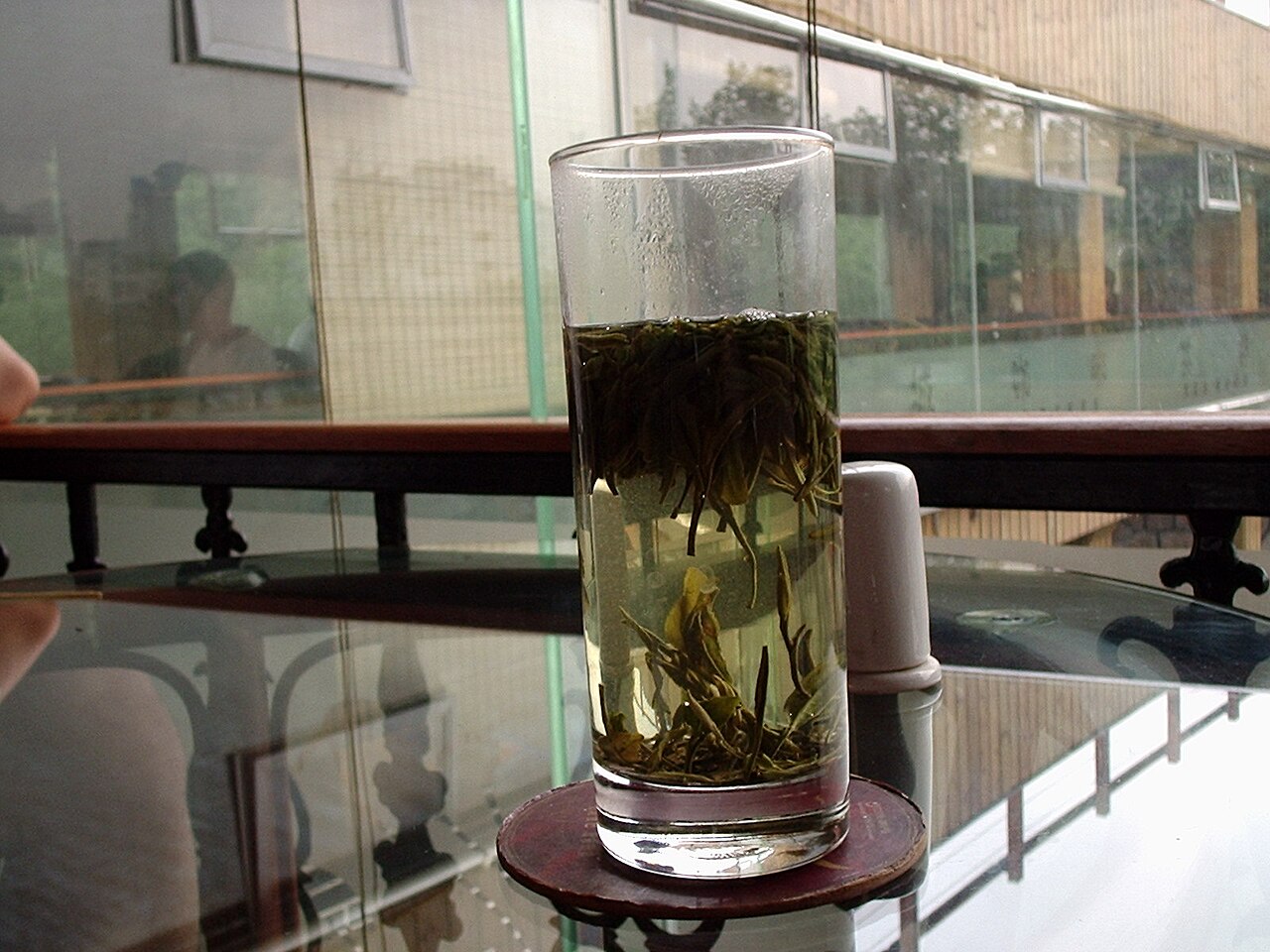
Molly Tea’s own description of osmanthus Longjing is useful here. The brand describes tender Longjing grown in high-mountain cloud and mist conditions, picked as one bud and one leaf, then lightly paired with golden osmanthus so that the tea soup feels clear and bright while osmanthus sweetness lingers. What matters most is not the four words “osmanthus Longjing” themselves, but the direction of the sentence. First comes Longjing’s tenderness, clarity, and brightness. Then comes osmanthus as a softer aromatic support. In other words, what osmanthus Longjing really sells today is not heaviness or old-fashioned sweetness. It is “clear brightness” made more approachable.
3. Why does it fit late spring and early summer so well, instead of only fitting the autumn osmanthus season?
This is one of the most interesting things about osmanthus Longjing in 2026. In older seasonal intuition, osmanthus naturally belongs to autumn: ripe, warm, sweet, and tied to pastry-like Chinese seasonal memory. But when osmanthus enters a greener, fresher, lighter Longjing context, its function changes. It no longer mainly carries autumnal richness. It starts helping a lighter green tea feel softer and more complete. That is exactly why osmanthus Longjing works so well in late spring and early summer. Consumers at this point in the year often no longer want drinks that feel too milky, too warm, or too heavy, but they are not fully committed to extremely cold, ultra-minimal tea either. They want something smoother, lighter, and more capable of carrying a daytime state.
In that sense, osmanthus Longjing is less of an osmanthus-season special and more of a seasonal interface. It puts spring tea freshness and osmanthus softness into the same cup, allowing the drink to retain spring’s detail while moving gently toward the high-frequency refreshing logic needed for summer. It does not throw the consumer straight into peak-summer fruit logic, and it does not remain trapped inside the softer, slower floral filter of spring. It occupies a very useful middle value: aromatic but not stuffy, tea-driven but not hard, seasonal without relying too heavily on seasonal marketing.
That is also why it deserves attention. It reveals a larger industry direction: shops increasingly need products that can carry seasonal transition. Those products are not always the loudest, but they are often the most useful for moving consumers from one phase into the next. Osmanthus Longjing is exactly that kind of transitional product.
4. Why does it feel more like an urban everyday cup than many floral green teas?
By “urban everyday cup,” I do not mean the cheapest or the most generic. I mean a very specific consumption tone: something that fits workdays, commuting, afternoons, office districts, and second-cup scenarios without feeling out of place. White magnolia is colder, gardenia is more mood-heavy, jasmine is more mass-market, and pure Longjing is more direct. Osmanthus Longjing pulls those extremes slightly toward the middle. It does not need strong social-display energy. It does not require photo-first atmosphere. It does not depend on huge contrast to leave an impression. Its strength is much simpler: it is easy to carry, easy to drink, and still feels believable after the moment of novelty passes.
That is especially important today because more and more chains are competing not over the first trial, but over whether you will order it again tomorrow at work, refill in the afternoon, or feel that it still lands well after lunch. Osmanthus Longjing is well suited to exactly that position. It does not become a burden the way extra-milky or topping-heavy drinks can. But it also does not demand the interpretive effort of a very minimal straight tea. It uses osmanthus to smooth Longjing, and it uses Longjing to pull osmanthus back toward the fresh side. What emerges is a middle-layer product personality unusually well suited to repeat purchase.
In other words, what makes osmanthus Longjing modern is not novelty. It is how well it handles one of the most common needs of urban life right now: I want something lighter, but not boring; cleaner, but not cold; aromatic, but not dessert-like; tea-based, but not like homework. Any chain that can stabilize that middle demand is more likely to win a lasting place in high-frequency consumption. Osmanthus Longjing is becoming one answer to that problem.
5. How does it relate to the “osmanthus return” and the “Longjing spring light-milk line”? Connected, but not identical
If you place it back inside the site’s broader 2026 drinks map, osmanthus Longjing is clearly connected to two larger lines. The first is the return of osmanthus tea drinks: osmanthus re-entering menus not merely as old sweet fragrance, but as a lighter, finer, more modern menu language. The second is the Longjing spring light-milk line: Longjing being rewritten as a daytime, clearer, more tea-forward base for high-frequency use. Osmanthus Longjing lands where those two lines intersect, but it is not simply equal to either one.
It is not the same as the broader osmanthus return, because it is not simply repackaging osmanthus sweetness in a more fashionable way. It only works if Longjing remains visible as the backbone. It is also not the same as the Longjing spring light-milk line, because it does not always depend on milk structure, nor is its main question how dairy supports tea. Osmanthus Longjing is more specifically about how floral aroma reshapes Longjing—moving it from a straight spring-tea expression toward a more rounded urban tea-drink expression. In that sense, it pushes Longjing one step beyond “real-tea upgrade” and toward “high-frequency urban tea character.”
That is why it deserves a separate article. What it exposes is not just one flavor combination, but a clear method of product organization: shops are no longer satisfied with saying “this is Longjing” or “this is osmanthus.” They are paying closer attention to the relation between the two—who provides the frame, who softens the edges, who creates the first impression, and who carries the finish. For truly mature menus, that relation work is often more valuable than any single ingredient name.
6. Where are the limits of this trend?
First, osmanthus Longjing is very easy to make sound better than it drinks. It comes with a naturally attractive vocabulary set: osmanthus, Longjing, brightness, clarity, spring tea, floral aroma. Those words already do half the work in naming and posters. But if the Longjing itself lacks freshness, if the osmanthus turns too warm, if sweetness runs too high, or if aroma floats on the surface, the drink quickly falls from “softened fresh structure” into “ordinary sweet floral green tea.” Consumers may not diagnose the failure precisely, but they will summarize it efficiently: good name, ordinary cup.
Second, osmanthus Longjing does not automatically mean healthier or lower-burden. It is easy to read as clear, light, and bright, but that is first a flavor-structure reading, not an automatic nutritional truth. Real burden still depends on sugar, cup size, formula, milk use, and drinking frequency. Shops can use osmanthus Longjing to manage a more daytime-friendly and high-frequency product position, but they cannot treat the phrase itself as a shortcut to lightness.
Third, the more popular it becomes, the more it tests a chain’s internal ability to differentiate. If every brand starts writing osmanthus Longjing, clear brightness, tender spring tea, and lingering sweet aroma, then the real difference still comes down to who can keep Longjing’s backbone legible, who can hold osmanthus at exactly the right level, and who can make the drink truly work in workday and second-cup scenes. Osmanthus Longjing is not a shortcut. It is simply a very promising middle-layer entrance.
7. Why does this matter inside 2026 Chinese tea-drink culture more broadly?
Because it once again shows that contemporary Chinese tea-drink culture is not choosing between “traditional” and “modern” in any simple way. It is constantly reorganizing interfaces. Longjing of course still has its place in traditional straight-tea culture, and osmanthus still has its place in seasonal memory, pastry, and fragrance. But in today’s urban tea shops the two are being reorganized into a product that is high-frequency, takeaway-friendly, daytime-friendly, and workday-compatible. This is not a direct copy of tradition, but it is not an empty commercial shell either. It is a practical modern translation: taking something that might otherwise feel distant, specialist, or knowledge-heavy and putting it back into daily life.
Osmanthus Longjing shows this especially clearly because it is neither the most dramatic new product nor the most avant-garde flavor experiment. It is the kind of combination that can look a little too familiar, even a little too stable, and yet in 2026 that familiarity is exactly where new value appears. Its value lies in how seriously shops are now taking the question of whether familiar materials can be reorganized into a more contemporary daytime language. Osmanthus Longjing answers yes—and not by making the drink heavier, but by making the relation between the parts more precise.
In the end, osmanthus Longjing deserves renewed attention in 2026 not because it is the loudest line, but because it represents this round of fine menu rearrangement so well. The industry is moving away from winning attention through slogans, heaviness, and shock, and toward winning a stable place through structure, scene fit, and high-frequency usability. For mature menus, that shift often matters more than yet another louder hit name.
Continue reading: Why osmanthus returned to the main line of tea drinks in 2026, Why a “Longjing spring tea light milk” line started making sense in shops, Why light milk tea became a main character again, and Why tea drinks started seriously competing for the “second cup”.
Sources
- Molly Tea | Product categories (including osmanthus Longjing, white magnolia, and gardenia descriptions)
- CHAGEE | Fresh milk tea series (including product-identity style descriptions such as Xing Shi Chun Shan and Shan Ye Zhi Zi)
- Related in-site features on the return of osmanthus tea drinks, the Longjing spring light-milk line, light milk tea, and second-cup scenes (April 2026).