Flower Tea Feature
Fuzhou jasmine tea is more than “a very fragrant flower tea”: tea base, scenting, rock sugar sweetness, and the city culture behind China’s most underestimated jasmine tradition
In many basic introductions to Chinese tea, jasmine tea sits in an odd position. Almost everyone has heard of it. Many people have drunk it. For quite a few drinkers, one of their earliest memories of “tea taste” begins with a cup marked by clear floral fragrance. Yet once tea discussion becomes even slightly more systematic, attention often shifts quickly toward green tea, oolong, white tea, pu’er, rock tea, dancong, and other categories that are more easily framed as “serious tea.” Jasmine tea then gets flattened into one light sentence: it is simply a fragrant, common, everyday flower tea. That is not entirely wrong, but it is nowhere near enough. And when the subject is Fuzhou jasmine tea, stopping at the word “fragrant” is especially inadequate.
What makes Fuzhou jasmine tea worth explaining carefully is that it has never been as simple as “putting flowers into tea.” It is a complete and mature Chinese flower-tea route. At the front end there is a clear logic for choosing the tea base. In the middle there is a scenting craft built around the rhythm by which fresh jasmine blossoms release aroma. At the back end there are established judgments about whether fragrance has truly entered the bone of the tea, whether the liquor carries the distinctive Fuzhou sensation often described as “rock sugar sweetness,” and whether the finish remains clean and open. At a wider scale, the tea also connects to Fuzhou as a city: its spatial layout, port memory, the historical encounter between flowers and tea, local systems of craft secrecy and transmission, and the way jasmine tea entered ordinary daily life in modern times. That is exactly why Fuzhou jasmine tea is so easy to misread as something “everyone already understands.” In reality, it is one of those Chinese teas with enormous name recognition and surprisingly shallow public explanation.
What kind of tea is Fuzhou jasmine tea, and why is it both a flower tea and a reprocessed tea?
It helps to clarify identity first. Fuzhou jasmine tea belongs to flower tea, and at the same time it belongs to the category of reprocessed tea within the broader Chinese tea system. It is not a new tea species floating outside the six major tea categories. Instead, it begins with an already made tea base and then uses fresh jasmine blossoms and scenting work to let floral fragrance enter that tea body. This reprocessed identity explains the most important thing about Fuzhou jasmine tea: its quality can never be judged by floral aroma alone. What matters is whether the tea base and the floral scent, once combined, actually become one coherent tea.
In other words, Fuzhou jasmine tea should not be understood as “tea leaves serving merely as a carrier for fragrance.” If that were the real logic, the tea would easily drift toward a style that smells busy and dramatic but tastes hollow. Mature Fuzhou jasmine tea works by a different principle: the tea provides the bones, the flower gives the spirit, and the fragrance must enter the bones rather than float on the surface. That is also why public and local descriptions repeatedly emphasize an ideal often paraphrased as “you see tea leaves but not flowers, yet the jasmine fragrance is there.” Good jasmine tea is not about leaving blossoms in the cup for visual proof. It is about letting the tea base absorb and transform the fragrance released by the flowers. Only then does the aroma become real in the liquor.
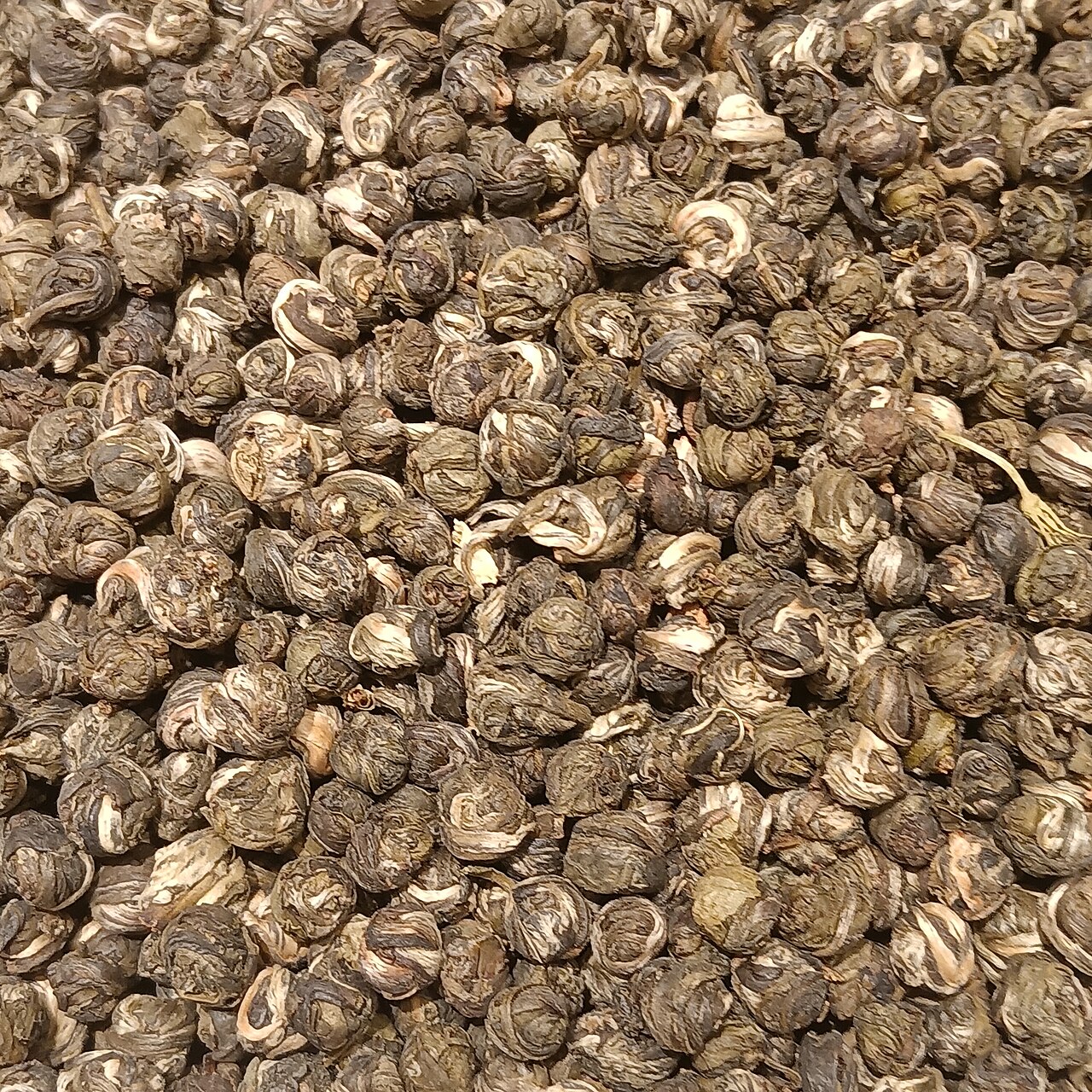
Why is Fuzhou so often described as the key origin of jasmine tea?
China has more than one jasmine-tea producing region, but Fuzhou holds an unusually special place in this tradition. Public references widely treat it as one of the crucial origin contexts for Chinese jasmine tea, and that is not simply a local marketing claim. Fuzhou long developed the full set of urban and agricultural conditions that allowed flowers and tea to meet in a stable way: a river-and-sea-facing port environment, the historical introduction and rooting of jasmine, the distribution of flower fields around the city, the spatial pairing between hill tea gardens and riverside jasmine cultivation, and a processing and commercial network built around scenting. A phrase often used in local reporting—roughly, “tea planted on the hills, jasmine grown along the rivers”—captures this city-industry relationship with unusual precision.
This origin significance is not only about who came first. It is about the fact that Fuzhou turned jasmine tea into a true line of local civilization. It did not merely produce a popular drink by accident. It formed a stable order involving tea-base preparation, flower harvesting, nighttime scenting, flower removal and refiring, finished-tea sale, and daily consumption. In 2014, the “Fuzhou Jasmine and Tea Culture System” was listed by the FAO as a Globally Important Agricultural Heritage System. In 2022, Fuzhou jasmine tea scenting craft, as part of “traditional tea processing techniques and associated social practices in China,” was included on UNESCO’s Representative List of the Intangible Cultural Heritage of Humanity. Put together, these milestones show that Fuzhou matters not only because it makes jasmine tea, but because it organized flowers, tea, urban life, and craft into one long-standing system.
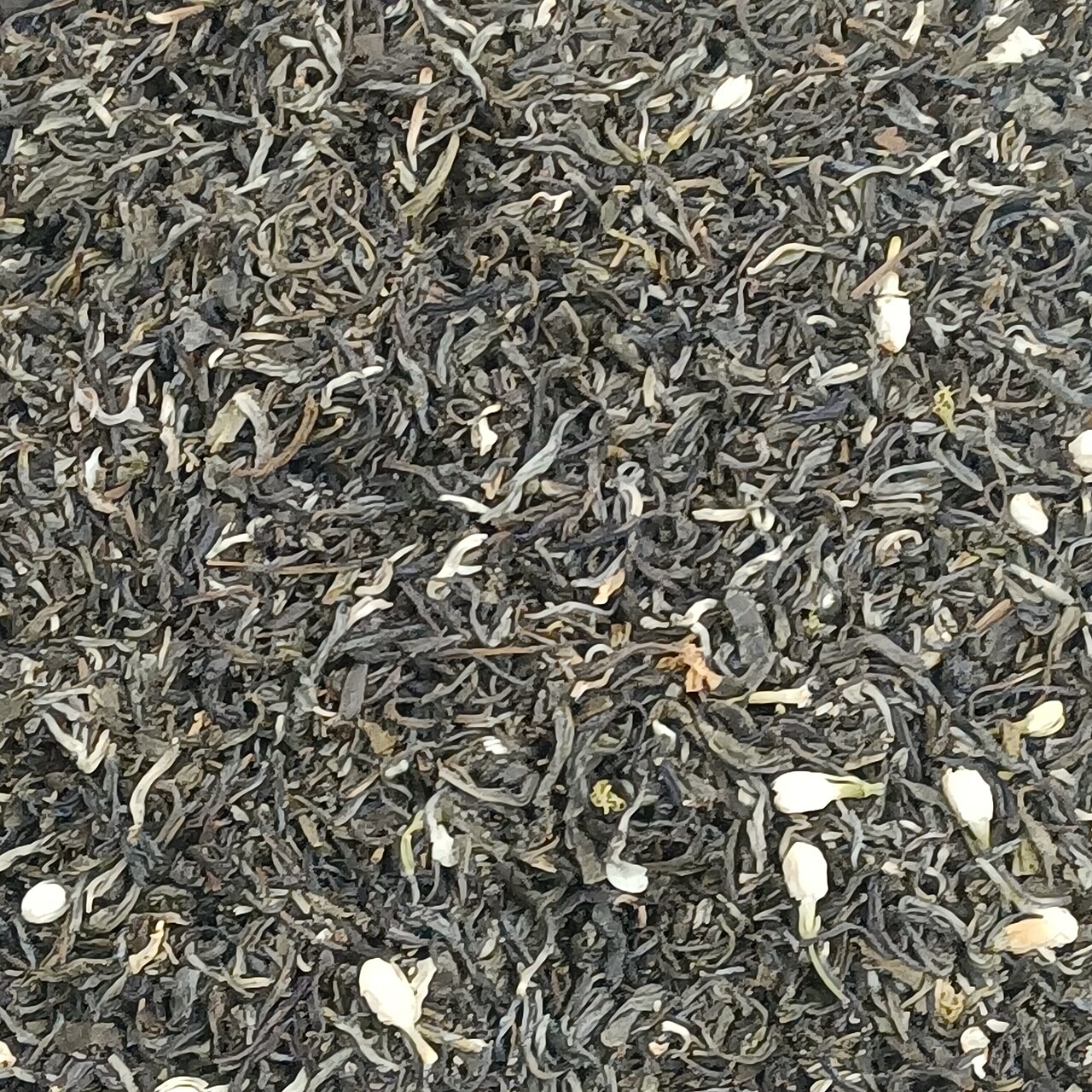
Why does the tea base almost set the upper limit of Fuzhou jasmine tea?
Many first encounters with flower tea focus entirely on the blossoms, as if strong floral fragrance alone could guarantee quality. But people who really understand Fuzhou jasmine tea often begin somewhere else: they ask whether the tea base itself can stand. Scenting is not about spraying aroma onto a finished product. It requires the tea base to receive, absorb, and transform the fragrance released by fresh flowers at the right moment. If the tea base is too thin, too loose, too coarse, or already carries杂味—impurities or stray rough notes—the added fragrance often becomes floating, stuffy, or greasy, and the liquor loses its structure.
That is why the logic of Fuzhou jasmine tea has never been that flowers simply cover the tea. The tea base must have enough carrying strength first, and only then can floral fragrance awaken it. Different grades and styles may use different base-tea routes, but the underlying principles remain similar: the tea must be clean, structurally stable, and able to withstand repeated rounds of scenting and later finishing work. In that sense, Fuzhou jasmine tea is not a tea that easily hides raw-material weakness. It often exposes it more clearly. The more serious the fragrance work becomes, the less room there is for an empty tea body underneath.
How is Fuzhou jasmine tea made, and why is scenting a full rhythm of control rather than a one-time addition of aroma?
The core craft of Fuzhou jasmine tea is scenting. In simple terms, a tea base prepared to the right state is mixed with fresh jasmine blossoms that are still closed or just ready to open, so that the tea can absorb aroma at the period when the flowers release it most intensely. After that come flower removal, sorting, and refiring steps. On the surface this looks like “letting tea absorb fragrance,” but the real difficulty lies in timing. When exactly do the blossoms open? When is the fragrance strongest? When has the tea absorbed enough? When must the flowers be removed? When should refiring settle the tea? None of this can be solved by one fixed formula.
That is also why the fragrance of Fuzhou jasmine tea is never meant to be a cheap straight-line aroma. In traditional higher-grade routes, the work often involves repeated rounds of scenting. The purpose is not simply to stack the fragrance higher and higher, but to let it enter the tea in layers, so that the final tea smells fresh and alive while also tasting like tea rather than floral vapor. Good scenting creates mutual reinforcement between aroma, liquor, and finish. Poor scenting often produces the opposite: a tea that smells explosive but drinks loose, or one that opens with strong floral impact but turns stuffy and greasy later. In short, scenting is not about “making tea smell like flowers.” It is about “making fragrance become part of the tea.”
Why do people say good Fuzhou jasmine tea should show tea leaves but not visible flowers?
Because that phrase captures the dividing line between mature Fuzhou jasmine tea and many shallow “floral teas.” For beginners, seeing lots of blossoms in the cup may feel like visible proof of authenticity. But in a serious processing tradition, the presence of many flowers in the finished tea is not itself a sign of quality. What matters is that once the flowers have released their fragrance and the tea base has absorbed it, the flowers should step back and the tea should remain. What reaches the cup should still be tea in body and structure, only now carrying a stable and clean jasmine fragrance.
Behind this lies a mature aesthetic judgment. Fuzhou jasmine tea is not trying to make the drinker “see flowers.” It is trying to make the drinker “taste flowers through tea.” You do not need to count petals in the vessel. Instead, you should encounter a natural, clean, lasting jasmine impression in the steam, in the mouth, and after swallowing. For that reason, the style most feared in serious Fuzhou jasmine tea is exactly the one that makes aroma sharp, greasy, and perfume-like, as if scent were pasted onto the tea surface. Its real refinement lies in the fact that aroma never leaves the tea body, and the tea body is never erased by aroma.
What is “rock sugar sweetness,” and why does it tell us more than simply saying the tea is fragrant?
If one had to choose a single phrase with strong local character to describe the ideal taste of Fuzhou jasmine tea, many Fuzhou descriptions would point to “rock sugar sweetness”. This does not mean the tea literally tastes of added sugar, nor does it refer to a sugary beverage sweetness. It points instead to a clean, soft, transparent sweetness that appears from the middle of the liquor into the finish, after the fragrance has already awakened the palate. It is sweet without becoming greasy, gentle without becoming weak, and often carries a lightly cooling clarity.
This matters because it reminds us that Fuzhou jasmine tea cannot be judged by smell alone. It is not very hard to produce something that smells strongly floral. What is difficult is whether the tea carries a real sweet润 support in the mouth and whether the aftertaste remains clean and extended. Public reporting on the Fuzhou tradition also notes that a properly made local jasmine tea should awaken the senses with fragrance but land in this “rock sugar sweetness.” That reveals an important hierarchy in local experience: fragrance is the entrance, but sweetness and clean liquor are the destination. In other words, truly good Fuzhou jasmine tea does not leave you at the nose. It takes you into the liquor.
What should Fuzhou jasmine tea smell and taste like at its best?
If one had to reduce the standard to a single line, then good Fuzhou jasmine tea should usually be fresh and lively in aroma without becoming showy, clear and moist in liquor without becoming thin, and sweet-clean in the finish without turning greasy. In hot aroma, the jasmine scent should rise naturally, fresh and clean rather than stuffy or piercing. Once it reaches the mouth, the liquor should be able to carry that fragrance instead of letting it float above an empty cup. After swallowing, there should be a relaxed clean sweetness rather than only a short, intense floral flash.
Different grades and different base-tea routes can vary in shape, intensity, and appearance. Some are finer, some more tightly curled, some more plainly everyday in style. But mature examples share several traits: the fragrance is not dirty or muddy, the liquor is not watery, the late palate is not sour or greasy, and repeated smelling and drinking continue to feel orderly and clean. What becomes clear is that the tea is not really judged by one isolated data point. It is judged by completion. That is also why Fuzhou jasmine tea, while seeming friendly and familiar, actually demands a high level of judgment about how flowers and tea should belong to one another.
Why is it so often misunderstood as a tea with aroma but little technique behind it?
One practical reason is that Fuzhou jasmine tea is too close to everyday life. For a long time it has lived in homes, teahouses, dining tables, gifts, and city memory. The more common it becomes, the easier it is to treat as something that needs no explanation. Add to that the fact that jasmine fragrance is highly recognizable, and many people can identify it immediately and then assume they already understand it. But this very recognizability often hides the difficult parts: how the tea base is chosen, how fresh flowers are matched, how the number and timing of scenting rounds are controlled, how refiring settles the tea, how fragrance moves from surface impression into the bone of the tea, and how sweetness appears in the finish.
Another reason is that flower tea is often pushed, almost unconsciously, into a category of the “light,” the “mass,” or the “less serious,” as if it were naturally less worth studying than teas defined by single mountains, single origins, or single craft routes. That judgment is shallow. Fuzhou jasmine tea shows exactly the opposite. Reprocessed tea does not mean low technical content. In fact, once flower and tea are expected to truly fuse, the judgment involved often becomes more complex. That is precisely why it deserves a dedicated place in the tea section: it is both deeply woven into everyday life and built on substantial technical and cultural depth.

How should it be brewed if you want to see whether the fragrance has really entered the tea?
Fuzhou jasmine tea works very well in either a gaiwan or a glass. A glass helps display strip shape, curled form, and how the leaves open. A gaiwan makes it easier to judge carefully how aroma and liquor relate from infusion to infusion. As a flower tea that relies on the tea base to carry fragrance, it does not do well when brewed with too little leaf until the cup becomes empty, nor when it is oversteeped until only heavy floral force remains. A steadier approach is to use the hotter water range commonly used for green tea and flower tea, then adjust according to vessel and material, first observing whether the opening fragrance is fresh and clean, and then whether the middle of the liquor shows real sweet, moist support.
In a gaiwan, a small vessel with enough leaf concentration often makes it easier to judge whether a tea has fragrance only on the surface or whether the fragrance has truly entered the liquor. The early rounds do not need to be dragged out. The key things to watch are these: first, whether the hot aroma is clean and lively; second, whether the first sip immediately shows clear sweet moisture; third, whether the aroma remains steady across several infusions or falls apart quickly; and fourth, whether the aftertaste is open and clean rather than stuffy and sticky. Truly good Fuzhou jasmine tea should become clearer the more you brew it, not reach its peak in the first fragrant moment and then leave only a hollow aromatic shell.
What are the easiest buying mistakes to make?
The first mistake is to treat “the more fragrant the better” as the only standard. Aroma can be high and lifted, but if it becomes piercing, floating, or greasy while the liquor offers no support, that is usually not a high-level result. The second mistake is to treat visible blossoms as proof of quality. As noted above, serious Fuzhou jasmine tea is judged by whether fragrance enters the tea leaves, not by whether many flowers remain in the finished product. The third mistake is to ignore the tea base and treat the tea as a purely aromatic item. If the tea base is weak, even energetic scenting work rarely produces a complete tea.
The fourth mistake is to collapse all jasmine tea into one vague category and fail to distinguish the Fuzhou craft ideal from other faster, more commercialized scent routes. The value of Fuzhou jasmine tea lies precisely in the fact that it does not stop at “making something that tastes like jasmine.” It asks fragrance, liquor, sweetness, and cleanliness to stand together. If one judges only by a single question—does it smell floral enough?—then the most worthwhile examples are easy to miss.
Why does Fuzhou jasmine tea deserve its own new article in the tea section?
Because on the map of Chinese tea it occupies a position that looks everyday but is actually central. Looking upward, it helps readers understand that flower tea and reprocessed tea are not marginal add-ons but complete technical branches within Chinese tea. Looking downward, it gathers together Fuzhou’s port history, local flower fields, tea-base logic, the rhythm of nighttime scenting, and the culture of daily drinking. It is both a tea and a line of urban culture. Without it, the story of Chinese tea too easily becomes a map made only of “serious” peaks inside the major categories, while losing the part that truly entered ordinary life and yet kept a high technical threshold.
More importantly, it can illuminate the site’s existing structure in a natural way. It can stand alongside the green tea overview and the general guide to Chinese tea categories to show how reprocessed tea is built on foundational tea types. It can also sit beside more origin-and-craft-driven famous-tea articles to remind readers that tea complexity does not live only in mountains and cultivars. It also lives in the way flowers and tea complete one another over time. To explain Fuzhou jasmine tea well is not merely to add a flower-tea entry. It is to make the whole map of Chinese tea more complete.