Green Tea Feature
Lushan Cloud-Mist: how mountain fog makes a green tea feel deeper, quieter, and later-harvested
When people first think of Chinese green tea, many imagine the bright, early-spring clarity of Longjing. But Chinese green tea does not move along only one aesthetic line. Lushan Cloud-Mist offers another very Chinese answer. It is still unmistakably green tea, yet it places mountain height, mist, later budding, fuller liquor, and quieter aroma at the center of its identity.
If Longjing can be read as a sharply lit slice of spring, Lushan Cloud-Mist feels more like a mountain slowly pressing vapor, shade, altitude, and harvest rhythm into the leaf. It does not win by being the earliest tea to market, by chasing the tiniest buds, or by projecting the loudest fragrance. Its distinction comes from a later mountain harvest, the savory freshness built in cooler high-elevation conditions, and a style that is at once clear and substantial.
What kind of tea is Lushan Cloud-Mist?
Lushan Cloud-Mist is a Chinese green tea. More specifically, it is a representative high-mountain green tea from the Lushan area of Jiangxi. As a green tea, it follows the same basic logic as other Chinese greens: the leaves are heated early to deactivate enzymes and preserve a fresh green profile. But the finished style is not identical to the light, transparent, straightforward model that many international drinkers imagine when they hear the phrase “green tea.” Lushan Cloud-Mist often has sturdier leaf shape, more visible down, thicker liquor, and a more restrained, lingering fragrance.
That makes it an excellent entry point into the internal diversity of Chinese green tea. The category changes dramatically depending on altitude, harvest timing, leaf standard, and processing style. Flat pan-fired teas, curled teas, visibly downy teas, and mountain-grown teas do not drink the same way. Lushan Cloud-Mist matters because it reminds readers that “green tea” is not one flavor word. It is a whole spectrum supported by place, climate, season, and craft.
Why is it called “Cloud-Mist”? The point is not just poetic branding
The name Lushan Cloud-Mist is not meaningful only because it sounds beautiful. Lushan, in Jiujiang, Jiangxi, rises near the Yangtze River and Poyang Lake. The mountain mass, abundant moisture, and deeply cut terrain help create frequent mist and cloud cover. Public references repeatedly point to higher-elevation tea zones around places such as Hanpokou, Wulaofeng, Hanyang Peak, and Xiaotianci as part of the tea’s environmental context.
What does that mean for the tea plant? First, spring warming is slower, so budding often comes later than in lower tea regions. Second, diffused light and humid air help keep shoots tender rather than letting them harden too quickly. Third, the combination of altitude, temperature shifts, and a longer growing rhythm often gives the finished tea not only freshness, but also more body, more savoriness, and a quieter sense of depth. In other words, “Cloud-Mist” is not just a label. It is part of the flavor explanation.
Why is the harvest usually later?
Many beginners hear the phrase famous tea and immediately assume earlier always means better. Lushan Cloud-Mist is a useful correction to that idea. Because Lushan’s higher tea zones warm up slowly in spring, the tea bushes often bud later than those in many lower green-tea regions. Public materials commonly place the main picking window around the period after Grain Rain and before or around the start of summer. That means the value of Lushan Cloud-Mist is not built on extreme earliness. It is built on being harvested in rhythm with its own mountain conditions.
This matters because it helps readers understand that the quality of fine green tea does not come only from racing toward the earliest possible pick. It also comes from timing that actually suits the mountain, the plant, and the desired flavor. In Lushan Cloud-Mist, later budding and later harvest are not disadvantages. They are part of the tea’s structure.
How is it made, and why do body and visible down matter so much?
Lushan Cloud-Mist belongs to the classic Chinese fine-green-tea processing tradition. Fresh leaves are picked, lightly rested, heated to halt oxidation, shaped, rolled or arranged, and then dried into their final form. Individual makers and workshops vary in detail, but public descriptions commonly emphasize a fresh-leaf standard close to one bud with one newly opened leaf, along with processing that preserves visible down, coherent leaf lines, stable fragrance, and careful moisture control.
Unlike Longjing, which strongly foregrounds flat pressing, Lushan Cloud-Mist more often retains the plumpness of the bud-and-leaf set, visible fuzz, and a stronger sense of linear leaf form. Because of that, the first impression is often not geometric neatness but mountain structure: the leaf looks alive, and once brewed it can feel both fresh and full. A good Lushan Cloud-Mist does not need to make aroma explode. Its achievement lies in balancing freshness, body, clarity, quiet fragrance, and moderate endurance over several infusions.
What does it smell and taste like?
Public descriptions often summarize Lushan Cloud-Mist with phrases like rich taste, emerald color, fragrant aroma, and clear liquor, and also mention sturdy leaf lines, abundant down, and long-lasting fragrance. In practical tasting language, this usually means the dry tea shows visible fuzz and relatively plump buds and leaves, while the brewed tea offers an aroma that is not violently loud but clear, refined, and persistent. Some lots are described in floral terms, even orchid-like, though the overall impression is usually still collected rather than showy.
On the palate, its charm lies not in freshness alone, but in freshness with savoriness and body. The liquor stays clear without feeling empty, and fuller without becoming muddy or heavy. That is one of the signatures of a mountain green tea: the mouth feels clean, but the tea still has substance. Poorer examples can turn harsh, obviously bitter, overly toasty, or short in aroma, leaving only a vague impression of “this is green tea” and nothing more.
How should you brew it without making it feel hard or rough?
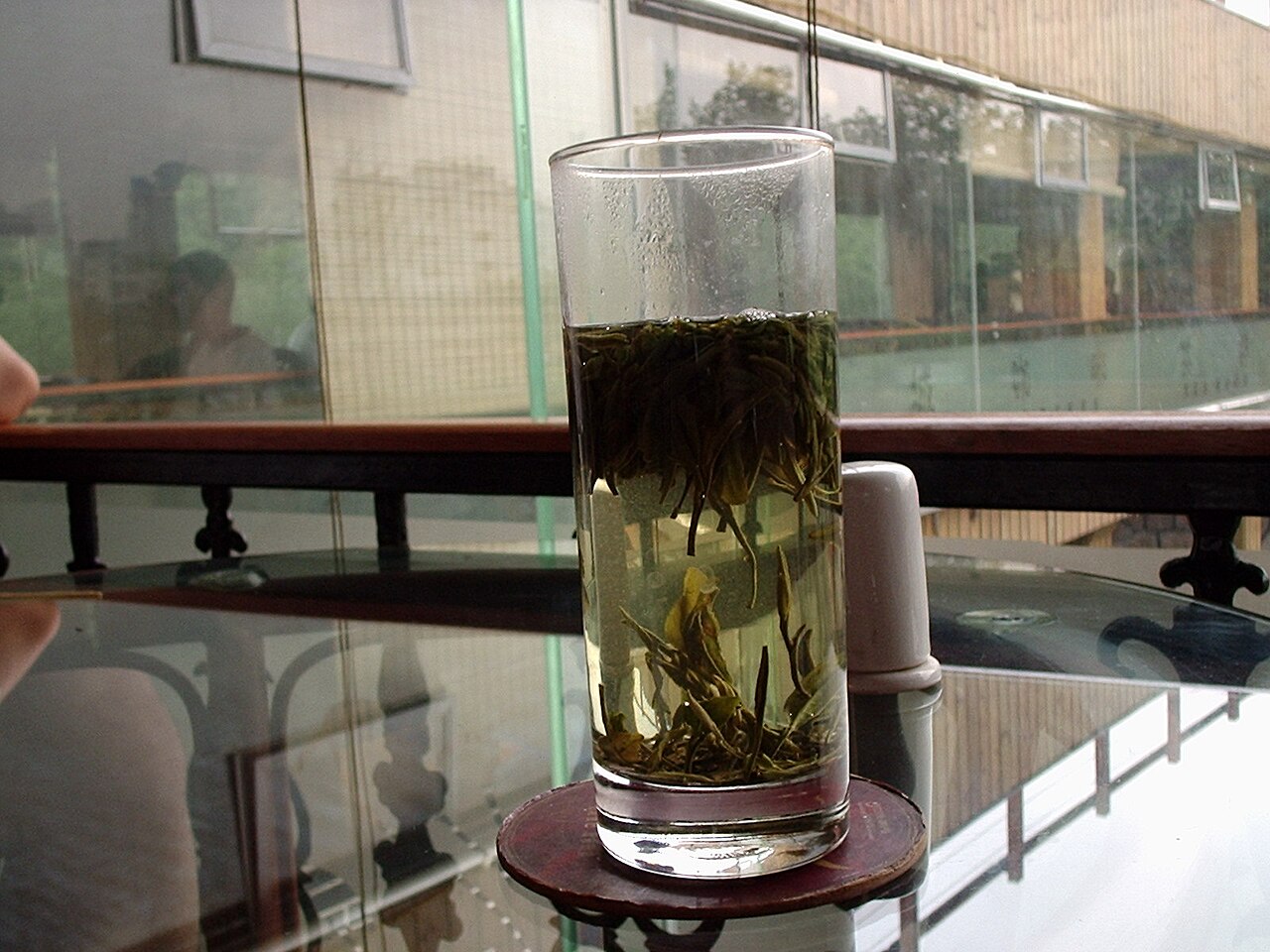
Lushan Cloud-Mist works well in a glass or a gaiwan. A glass is ideal for watching downy green tea leaves open slowly, while a gaiwan gives better control over extraction. Public recommendations often suggest water around 85°C rather than a full rolling boil. That advice makes sense. Water that is too hot can flatten the tea’s delicate freshness, scatter its quiet fragrance, and pull bitterness and roughness forward too quickly.
In a gaiwan, you can begin around 3 grams of tea for 100 to 120 ml of water, with a short first infusion and slightly longer later ones. In a glass, an upper-drop method also works well: add hot water first, then add the leaves and let them descend and unfold gradually. Lushan Cloud-Mist is usually not a tea for long steeps and brute force. Its beauty comes from gradual unfolding, not from brewing intensity for its own sake.
How is it different from Longjing or Bi Luo Chun?
Compared with Longjing, Lushan Cloud-Mist usually puts less emphasis on flat pan-fired shape, bean-like roast notes, and the extreme transparency of the opening cups. Instead, it leans more toward mountain-grown freshness with body, visible down, and a quieter, longer fragrance. Compared with Bi Luo Chun, it often shows less immediate floral-fruity lift and more of the steadiness and weight associated with a mountain-style green tea. In other words, it may not be the green tea that dazzles most in the first second, but it is one of the best teas for understanding what “mountain character” means inside Chinese green tea.
That is also why it deserves a distinct place within the site. If the library already contains articles on Longjing, Bi Luo Chun, Huangshan Maofeng, and Xinyang Maojian, then Lushan Cloud-Mist helps complete another dimension: how altitude, mist, and slower spring rhythm reshape the category from within. It shows that green tea is not a simple linear contest of earlier, lighter, and more delicate.
Why does Lushan Cloud-Mist deserve a standalone article?
Because it binds together several themes that sit at the center of Chinese tea culture but are often oversimplified: mountain terrain, mist-driven microclimate, later picking rhythm, green-tea processing, visible down, and the sensory goal of being clear without thinness and substantial without muddiness. Many teas are marketed vaguely as “high mountain green tea,” but readers do not automatically understand what that phrase should mean. Lushan Cloud-Mist is one of the teas that can make the phrase concrete.
When written well, it teaches more than a tea name. It teaches a larger principle: in Chinese tea, flavor never exists apart from geography and time. Lushan Cloud-Mist matters not because it happens to come from a famous scenic mountain, but because Lushan’s altitude, humidity, fog, spring temperature rhythm, and processing choices genuinely shape the cup.
Source references: Baidu Baike: Lushan Cloud-Mist Tea, Wikipedia (Chinese): Lushan Cloud-Mist Tea. This article is an edited reader-facing rewrite based on public reference material.