Dark Tea Feature
Why Jingyang Fu Tea deserves its own article: not just “fu brick tea with a different place name,” but a key entry into Jingyang’s processing history, border-trade context, and golden-flower dark tea expression
If the site’s fu brick tea article works as the broader guide to golden flowers, flowering, heimaocha, brick compression, and practical quality judgment, then Jingyang Fu Tea deserves a separate page because it is not just a trivial name swap. Many readers first meet the term and instinctively reduce it either to “a local version of fu brick tea” or, more loosely, to “the Shaanxi golden-flower dark tea.” Neither summary is totally empty, but both are too thin. What really matters is that Jingyang Fu Tea is not important only because it is a brick tea associated with a place. It matters because Jingyang long occupied a key role in the historical circulation, reprocessing, brick-making, and distribution memory of fu tea. That gives it a more complex identity than an ordinary place-name tea.
Because of that, Jingyang Fu Tea is usually pushed off balance in two ways. One reading turns it into a purely local Shaanxi specialty, as if the place name alone explained everything. The other turns it into a story about the miracle of golden flowers, as if Jingyang mattered only because it offers a stronger myth around flowering. A better reading is more balanced: Jingyang Fu Tea is first a dark-tea expression deeply tied to fu tea distribution history, border-trade memory, reprocessing experience, and regional consumption habits; only after that does it become one of the most visible modern entry points into golden flowers, flowering, and the public image of fu tea. Once that is clear, readers stop treating Jingyang Fu Tea as a marketing slogan and stop imagining it as something fundamentally opposed to Anhua dark tea or the broader fu brick tea tradition.
What kind of tea is Jingyang Fu Tea, and how does it relate to fu tea and fu brick tea?
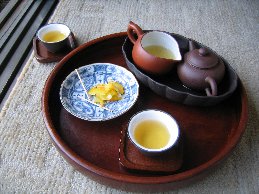
The first thing to stabilize is the category relationship. Jingyang Fu Tea is not a new tea family outside the dark-tea system. It belongs first to Chinese dark tea, and more specifically to the fu tea / fu brick tea branch. A practical definition would be this: Jingyang Fu Tea usually refers to a dark tea made from heimaocha-based raw material, pressed or built into brick-like forms, shaped through a flowering stage into a recognizable fu tea profile, and marked by the historical and regional context of Jingyang in Shaanxi. In other words, the name carries both tea-category information and regional-historical information at the same time.
That is why it should not be reduced to the phrase “fu brick tea produced in Jingyang.” The important point is not only that the place name appears on the packaging. The important point is what that place name connects to: northwest consumption, border-trade routes, reprocessing and brick-making experience, and the wider public image of “Shaanxi fu tea.” Put differently, fu tea names the craft and tea-type logic, while Jingyang Fu Tea adds the historical position and regional memory of Jingyang on top of that logic. If those two layers are not separated, readers end up turning it sometimes into pure craft and sometimes into pure origin, which means neither side is explained properly.
Why is the “Anhua raw material — Jingyang reprocessing” line so hard to avoid?
This is the point most worth explaining clearly and one of the points most often blurred. Many modern introductions to Jingyang Fu Tea mention both Shaanxi Jingyang and Hunan Anhua. On the surface that can look like a conflict over who gets to claim the tea. But once the wider history of Chinese dark tea is brought back in, the sharper and more useful explanation is different. The raw-material and dark-tea craft line behind fu tea has long been deeply connected with the Anhua heimaocha system, while Jingyang historically played a key role in later processing, brick-making, distribution, and northwest-oriented circulation. These are not mutually cancelling facts. Together they are part of the reason Jingyang Fu Tea makes sense at all.
This matters because it changes how readers understand the weight of Jingyang itself. Jingyang’s importance is not just that tea was also made there. It is that the place became strongly associated with fu tea through redistribution, reprocessing, and long-term market acceptance. In that sense, Jingyang Fu Tea is not the kind of tea built only through mountain-origin leaf mythology. It is better read as a dark tea that became mature through circulation, through reprocessing, and through regional consumption memory. Once that is understood, readers stop seeing “Anhua raw material” and “Jingyang Fu Tea” as contradictory facts and start seeing them as part of fu tea’s historical complexity.
Why did Jingyang become so important in the history of fu tea?
For many Chinese teas, the crucial word is mountain. For Jingyang Fu Tea, the crucial word is often node. Jingyang sits in the Guanzhong region and has long been closely tied to northwest-oriented markets. That made it highly suitable for playing a role in the processing, redistribution, and movement of border-sale tea. For dark tea, especially compressed brick tea, transport, storage, durability, and later handling are not side topics. They are part of what the category is. Jingyang happened to stand right on that line: not a tea built mainly through tender spring fantasy, but one built through long-distance trade, repeated reprocessing, consumer acceptance, and practical drinkability.
That is also why Jingyang Fu Tea carries a strongly practical dark-tea personality. It is not a tea that exists only as a regional culture symbol in a display case. It belongs in storage, daily brewing, shared drinking, and boiling. That practical side is worth emphasizing because it reminds readers that Jingyang Fu Tea survived not because it had a romantic slogan, but because it was repeatedly drunk, moved, processed, accepted, and made again. Teas that pass through history successfully usually do not survive on story alone.
What do the “golden flowers” mean here? Why are they important without being the whole story?
Any discussion of Jingyang Fu Tea will almost certainly bring up golden flowers. That is perfectly reasonable, because the characteristic flowering inside fu tea is one of its strongest public recognition points. The so-called golden flowers usually refer to flowering associated with Eurotium cristatum, and they are closely tied to the later organization of flavor in fu tea. In Jingyang Fu Tea, their importance is especially visible because they sit at the center not only of quality language, but also of the wider public image of “Shaanxi fu tea.”
But this is exactly where distortion begins. Golden flowers are highly visible, and highly visible things are easy to mythologize. Many readers slide too quickly into a single rule: if there are more flowers, the tea must be better; if flowers are present, the tea must already be mature; if the tea can tell a strong golden-flower story, then Jingyang Fu Tea automatically stands. In reality, mature judgment never works like that. The flowers matter because they contribute to a better cup when the whole process is clean and stable. The real question is whether they help move the tea toward more mellowness, more smoothness, more cleanliness, and a more orderly structure. If the discussion never returns to the cup and remains only at the level of visible flowers inside a brick, then the tea has already been turned into a display object.
What does Jingyang Fu Tea usually taste like? Where do its strengths really lie?
Good Jingyang Fu Tea is usually not a tea that wins by sudden high aroma in the first sip. More often its strengths lie in a liquor that feels mellow, smooth, clean, and stable, with an aromatic structure combining floral-microbial notes, aged woodiness, and a rounded sweet finish. In the later cups there is often a gentle returning sweetness and a calm, settled afterfeel. The point is not “loud fragrance,” but something closer to “the more you drink, the steadier it becomes.”
Because of that, Jingyang Fu Tea most fears not a lack of spectacle, but a lack of cleanliness. If flowering, drying, storage, or raw material is mishandled, the tea can drift very quickly toward muddiness: stuffy soup, damp notes, blocked mouthfeel, and the kind of mixed warehouse character that beginners sometimes mistake for mature dark-tea depth. Good Jingyang Fu Tea should deliver a sense of maturity that has been organized, not a sense of oldness that has gone cloudy. It does not aim for brute heaviness. It aims for clean maturity.
Why is Jingyang Fu Tea usually so suitable for boiling?
The answer follows directly from its tea logic. Jingyang Fu Tea is a later-structure dark tea. Its value is not built on fragile fresh delicacy, but on compression, flowering, later-stage ordering, and practical drinkability. Compared with many fine green or yellow teas, it can usually take high temperature much more naturally, and boiling often helps its body and sweet roundedness open up more fully. Many people do not truly find it convincing until they have tasted it brewed seriously or brought to a boil and allowed to round out.
Still, “good for boiling” does not mean “safe to boil carelessly.” The steadier method is to brew first and boil later. Use a gaiwan or a small pot with boiling water for several quick rounds, check whether the tea is clean and free of stuffy storage problems, and only then move toward boiling. That approach screens defects early. Good Jingyang Fu Tea becomes rounder, fuller, and more coherent when boiled; weaker tea simply has its flaws enlarged.
Compared with a general fu brick tea article, what is the distinct value of this Jingyang Fu Tea page?
The fu brick tea article works as a broader overview: what fu brick tea is, how golden flowers should be read, how flowering works, how flavor should be judged. This Jingyang Fu Tea page pushes the discussion one step further by asking a more specific question: why does Jingyang, in particular, become such a high-frequency place-name gateway when people try to understand fu tea? Without a page focused on that question, readers keep Jingyang Fu Tea trapped at the level of “regional golden-flower dark tea” and miss both its connection to the Anhua raw-material line and its importance inside border-trade and reprocessing history.
More concretely, Jingyang Fu Tea works as a corrective node inside the site. It corrects three common misunderstandings at once. First, Jingyang Fu Tea is not conceptually opposed to fu brick tea or Anhua dark tea. Second, Jingyang matters not only because of modern branding, but because of historical circulation and processing. Third, golden flowers are not the whole tea; quality has to land in the liquor. Once those points are set in place, the site’s dark-tea structure becomes much stronger: there is a general overview, an Anhua system article, a fu brick process article, a Liu Bao route, and now a page that explains why Jingyang itself carries weight inside the larger map.
What are the most common buying mistakes?
The first mistake is treating the word “Jingyang” itself as a guarantee of quality. The place matters, but it never replaces raw material, process, flowering quality, or storage judgment. The second mistake is looking only at the quantity of golden flowers and ignoring the cleanliness of the liquor. As already noted, the flowers are part of quality structure, not a shortcut around it. The third mistake is to mistake every mature or aged note for “authentic Jingyang character.” If the tea feels stuffy, damp, sour, woody in a dead way, or unclear in the finish, that is usually not regional identity but a problem.
Another common trap is to treat it as a purely collectible “the older the better” dark tea. Time can matter, of course, but time is never an automatic value engine. What matters is whether the tea is already clean, coordinated, and drinkable now, and whether it has the basis to continue developing well. For ordinary readers, several simpler questions are often far more useful than packaging, myths, or exaggerated age claims: Does it taste good? Is it clean? Does it boil well? Does it stay stable in the later cups? Those questions usually tell the truth more clearly than grand market language.
Why is this article worth adding to the tea section now?
Because the site’s dark-tea line already includes a general overview, Anhua, fu brick tea, and Liu Bao. But without a Jingyang Fu Tea page, readers can still come away with a structure that is too purely technical: raw material belongs to Anhua, golden flowers belong to fu brick tea, and the place names are just labels. In reality, Jingyang is not an optional tag. It is one of the key interfaces through which regional circulation, reprocessing experience, border-sale memory, and contemporary public recognition all meet. Once this article is in place, the dark-tea section becomes less like a list of teas and more like a map of relationships.
It also strengthens the bilingual structure. Chinese readers can enter through Shaanxi, the northwest, border-sale history, and the memory of fu tea in Jingyang. English readers are more likely to enter through questions about Jingyang, fu tea, golden flowers, compressed dark tea, and historical processing hubs. If the two versions stay aligned—as they should—this becomes a strong bridge article: not simply a page about one place name, but a page explaining why that place name actually matters inside Chinese dark tea.
Source references
- Baidu Baike: Jingyang Fu Tea
- Baidu Baike: fu brick tea / fu tea
- Baidu Baike: Eurotium cristatum / golden flowers
- Wikipedia: dark tea
- Public Chinese-language reference material on the historical circulation context of Jingyang Fu Tea, the Anhua heimaocha raw-material line, Jingyang reprocessing and flowering, and the quality characteristics associated with Jingyang Fu Tea.