Why Teahouses Matter Again Today: From Qing Public Life and Chengdu Teahouses to the Return of the Urban Third Space
Published: · Updated:
In recent years, Chinese-language discussion of “tea culture revival” has usually focused on the most photogenic elements: whisked tea, tea froth painting, Song-style objects, stove-boiled tea, matcha revival. All of those matter. But if you step back a little, another return comes into view: the teahouse itself. More and more people are not simply returning to tea as a drink. They are returning to the teahouse as a place to sit, slow down, meet someone, or remain somewhere without being hurried along. The real question, then, is not whether teahouses are “hot” again. It is why they have become necessary again.
This matters because it is different from many other tea-culture topics already circulating online. Whisked tea, tea froth art, bamboo whisks, and stove-boiled tea are usually centered on a technique, a tool, or a visual style. A teahouse is something larger. It is not one action and not one object. It is a spatial structure that holds tea, furniture, conversation, time, public life, and social relations inside the same frame. Once that is clear, it becomes easier to understand why teahouses return whenever social life speeds up, urban space becomes more expensive and more functionalized, and people begin to feel that there are fewer places left simply to stay.
The history of the teahouse is also far more complex than “an old place where people drank tea.” It is tied to urban society, market streets, mobility, and everyday public life from the Qing period onward. It is both a leisure space and an information space, both a resting place and a place of business. It can absorb the rhythms of labor, idleness, storytelling, and social ritual at once. To write about teahouses is not really to write about a building. It is to write about how tea moved from the cup into shared life—and why that movement matters again today.
What returns today is not only tea drinking, but a public rhythm built around sitting, lingering, watching people, talking, and letting time stretch a little.
1. Why are teahouses still a live topic in 2026? Because the real subject is where people can still sit down
Current discussion around teahouses in Chinese-language media is often scattered across several themes. Some people talk about old teahouses, some about new Chinese-style spaces, some about younger consumers returning to tea, and some about whether a teahouse revival can happen after the era of the coffee shop. Behind these different conversations lies a more basic urban question: in a fast, efficient, highly monetized city, how many places remain where ordinary people can stay for a long time, at relatively low pressure, without having to keep performing or consuming at speed?
This is exactly where the teahouse becomes important again. Many modern venues are organized around speed, turnover, novelty, and throughput. The teahouse is organized around duration. A pot of tea is not finished in one movement. It is poured, talked over, refilled, resumed. Its rhythm naturally resists compression. That is why the return of the teahouse does not look strange at all. The modern city offers countless spaces, but fewer and fewer that allow low-pressure presence. The teahouse matters again because that kind of space matters again.
2. To understand the teahouse today, we cannot begin only with elegance; we have to begin with urban everyday life
When many people imagine a teahouse, they begin with refinement: wooden tables, gaiwan cups, bamboo chairs, storytelling, opera, leisurely talk, old-world grace. None of that is false, but it is incomplete. Historically, teahouses endured not because they were always elegant, but because they were useful, ordinary, and deeply embedded in urban society. They belonged first to everyday civic life, and only then to cultivated style.
Especially from the Qing period onward, as market networks, town life, commerce, and mobility expanded, teahouses became stable parts of daily life in many regions. They served travelers, craftsmen, traders, neighbors, clerks, storytellers, performers, and idlers. They were not museum-like “cultural rooms.” They were mixed public spaces where people waited, met, heard news, talked business, watched performances, and spent an afternoon. The teahouse survived because it was usable before it was picturesque.
3. Why does Chengdu always come up? Because Chengdu preserves the teahouse as a social structure, not just a shop
Any serious discussion of Chinese teahouses eventually arrives in Chengdu. That is not because other regions lacked teahouses, but because Chengdu preserves with unusual clarity the social logic of the teahouse. There, the teahouse is not merely a themed venue. It is a longstanding extension of urban daily life.
In Chengdu, people do not enter teahouses only for “cultural experience.” They meet there, rest there, gossip there, listen there, negotiate there, and pass time there. The teahouse functions as a semi-open city living room. It is neither private like a home nor rigid like an office. It sits between them. That is why Chengdu matters so much in the history of Chinese tea culture. It preserves the fact that a teahouse is not mainly about old furniture or nostalgic décor. It is about a social way of using time together.
The teahouse was never valuable only because it was old. It mattered because it was a real public place where people could sit, wait, talk, hear news, and occupy time without urgency.
4. Why do Jiangnan and Shanghai matter too? Because teahouses were also modern urban public spaces
If Chengdu helps us see the teahouse as a deeply lived everyday structure, Jiangnan and Shanghai help us see the teahouse as part of modern urban public life. It is a mistake to treat teahouses as if they belonged only to a premodern world. In many commercial cities, teahouses and tea pavilions were fully part of modern public culture.
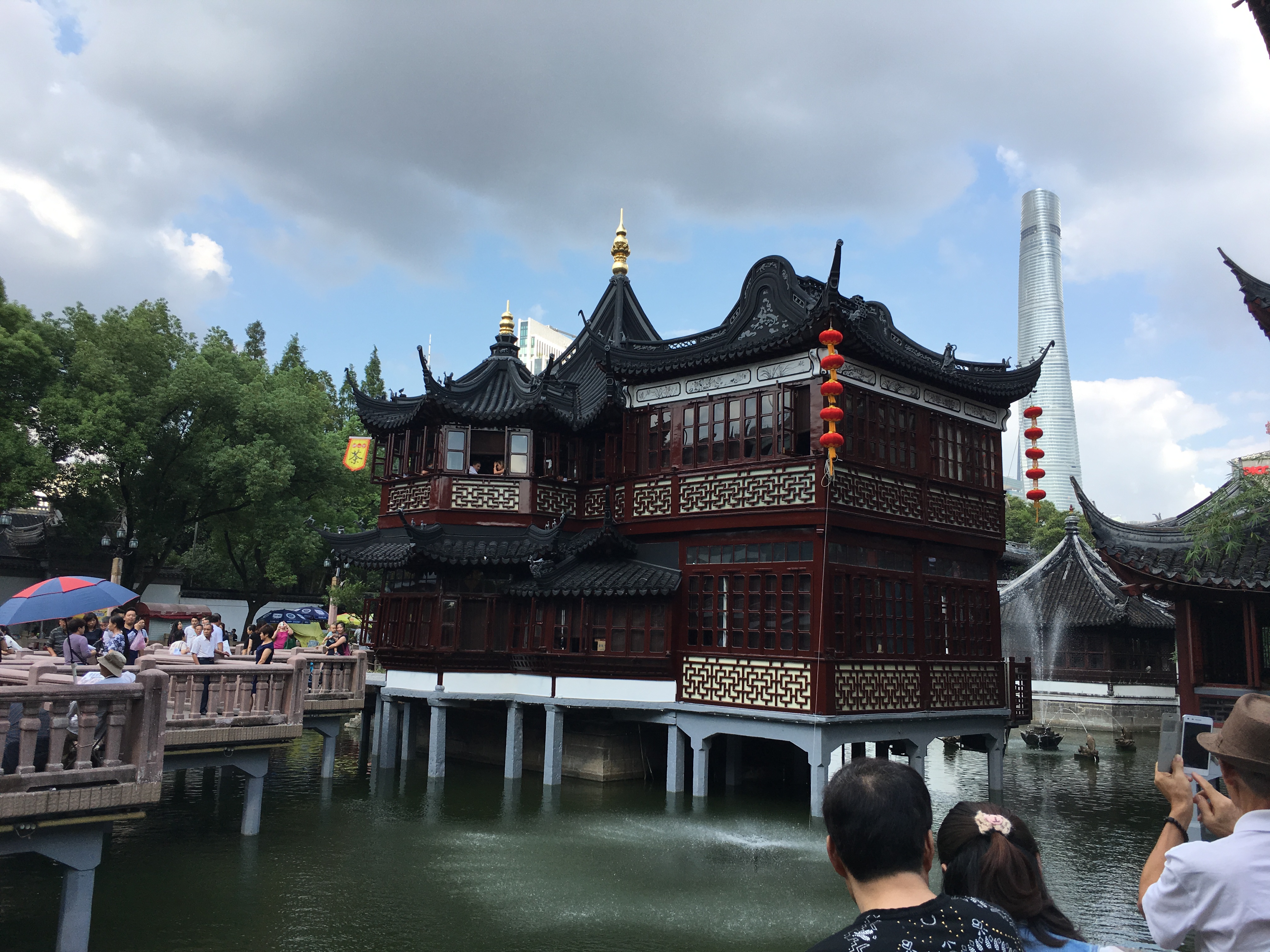
In Jiangnan and Shanghai, teahouses connected older drinking traditions to newer forms of urban leisure, commerce, meeting, and strolling. Places such as Shanghai’s Huxinting Teahouse mattered not only because they were visually beautiful, but because they sat inside the city’s circulation of visitors, residents, conversations, and urban spectacle. They remind us that the teahouse was never simply the opposite of modernity. It was one of modern Chinese urban life’s own public forms.
Teahouses like Huxinting show that the Chinese teahouse was not merely a relic of the past. It was also part of the social and visual fabric of the modern city.
5. Why did the teahouse later seem less central? Not because tea disappeared, but because public lingering was reorganized elsewhere
The teahouse did not remain central forever. As modern urban life became more specialized, many of its earlier functions were split apart. Information moved into other media. Business moved into more formal venues. Leisure moved into other industries. Urban space became more segmented and more tightly managed. Tea remained, but the social necessity of “going to the teahouse” weakened for a time.
This does not mean teahouses became obsolete in any simple sense. It means the social structure that once made them essential was altered. Historically, teahouses mattered because they could hold many functions at once. Later, cities increasingly separated those functions. The mixed-use social room lost some of its structural centrality. But precisely because that mixed form receded, it has become newly attractive again.
6. Why is today’s teahouse revival really a return of the third space?
Today people often describe desirable urban venues as “third spaces”: not home, not office, but somewhere in between. In modern urban theory this sounds contemporary, but in Chinese social history the teahouse was already one of the most durable examples of such a space. The term may be modern, but the structure is older.
A teahouse is public without being entirely impersonal. It permits both speech and silence. It supports company without demanding constant performance. You can meet someone, sit alone, pause between obligations, or simply remain present. For people whose lives are increasingly cut into fragments by schedules and screens, such spaces feel rare and valuable. That is why the return of the teahouse is not merely a return of “tradition.” It is the return of an older spatial answer to a continuing human need.
7. Why are younger people returning to teahouses? Because they need forms of offline company that do not require constant display
Many younger visitors do not begin from formal tea knowledge. Some arrive through space and atmosphere, some through broader interest in Chinese cultural forms, some because they want an alternative to the coffee shop or the high-intensity meal. But their reasons often converge. The teahouse offers a way of being together that does not demand constant performance.
Many contemporary social settings carry hidden pressure. A formal meal can feel too structured. A drinking occasion can feel too forceful. A café often implies speed, productivity, or short stays. The teahouse offers another arrangement. A pot of tea sits in the middle. Conversation can gather around it, pause around it, and resume around it. Tea acts as a social buffer. It helps people share time without having to fill every second with speech.
This logic overlaps with the recent fascination with stove-boiled tea. What many people are really missing is not a single historical method but the possibility of sitting around something together and letting time thicken. Stove-boiled tea is seasonal and visually dramatic. The teahouse is steadier and more durable. It can enter everyday life rather than remain only an event.
A teahouse works not because it looks old, but because it lets relationships unfold slowly around tea: sit first, speak later, refill, then continue.
8. Why do new teahouses feel both like cultural revival and like consumer experiments?
Today’s new teahouses do not simply reproduce old ones. They borrow visual languages from historical teahouses, tea pavilions, tea rooms, and regional traditions, but they also face modern pressures: rent, turnover, discoverability, social media visibility, and the need to welcome newcomers without overwhelming them. That means they are both cultural spaces and commercial experiments.
The real challenge is not whether they look traditional enough. It is whether they can translate older spatial logic into something genuinely usable now. A successful contemporary teahouse cannot rely only on antique atmosphere. It must remain livable, legible, and socially breathable. It must make tea culture accessible without flattening it into pure decoration.
9. Why is the teahouse a particularly strong long-form history topic?
Many tea histories focus on technique, vessels, or taste. Those are essential. But the teahouse offers another scale. It returns tea to social history, urban history, and the history of public life. Once you write about teahouses, you are no longer writing only about what tea tastes like or which object is used to prepare it. You are writing about how cities organize time, how people share space, how commerce and culture overlap, and how old public forms are translated into new ones.
That is also why this topic is clearly distinct from existing history pieces on this site such as the tea whisk revival, tea froth art, matcha history, and the Wanli Tea Road. Those articles deal more with technique, visual revival, or trade networks. The teahouse turns the focus toward space itself: how tea becomes a way of arranging people together.
10. To understand the teahouse today is not to indulge nostalgia, but to admit that people still need places where they are allowed to remain
At bottom, the teahouse matters again not because everyone has suddenly become nostalgic, but because people still need places where they are allowed to remain. Digital life and high efficiency have not erased that need. In some ways they have intensified it. We may first describe the need through newer language—third space, slow living, community culture, new Chinese-style life—but eventually we recognize that Chinese society long had one answer to it already: the teahouse.
That is why the teahouse is worth rewriting now. It is not a dead cultural specimen. It is a living spatial tradition that can still adapt, still be translated, and still be used. As long as people need somewhere to sit, tea will not stay only in the cup, and the teahouse will not remain only in the past.