How Ming loose-leaf tea rewrote the Chinese way of drinking tea: from the end of tribute cakes to gaiwans and Yixing pots
Created: · Updated:
Much of the most visible tea-history revival on the Chinese internet now points back to the Song: whisked tea, tea baixi, Jian ware, tea whisks, Song-style elegance, and pictorial scenes of refined gatherings. People love to ask how premodern drinkers made tea froth bloom across the bowl. But the equally important question is the other half of the story: why did mainstream China later stop drinking tea that way? Why do most Chinese tea drinkers today instinctively think in terms of steeping, aroma, leaf expansion, timed pours, gaiwans, and pots rather than powdered tea and bowl-surface competition? To answer that, the most revealing place to return is not another Song revival story, but the Ming turn toward loose-leaf tea.
What makes the Ming shift historically decisive is not only the familiar summary phrase about ending compressed tribute cakes and promoting loose tea. More important is that the entire center of gravity of tea drinking moved. Tea gradually shifted away from a world organized around grinding, whisking, and judging foam on the bowl surface, and toward a world organized around loose leaves, hot water, vessel control, infusion timing, aroma layers, and repeatable daily use. Tea moved from a system deeply tied to tribute structures, precise processing, and visible performance into one that was easier to circulate, easier to adapt to literati life, easier to bring into cities, and easier to absorb into ordinary households.
That is exactly why it deserves a deep feature now. Because whenever we admire Song revival and then return to daily life with gaiwans, pots, fairness pitchers, and multi-round infusions, we are already living inside the outcome of that Ming reorganization. Without the rise of loose-leaf tea, the modern Chinese idea of what it means to “know tea” would look completely different.
The tea order most Chinese drinkers now find natural—gaiwan, pitcher, cups, repeated pours—was not timeless. It became thinkable only after loose-leaf tea moved into the center.
Ming tea historyloose-leaf teasteepinggaiwanYixing
1. Why rewrite the Ming loose-leaf turn now? Because everyone is looking back at whisked tea, but fewer people ask why China stopped drinking tea that way
If you line up the Chinese internet’s most visible tea-culture keywords of recent years, a pattern appears quickly: the truly photogenic topics are mostly Song ones. Tea baixi works beautifully in short video. Jian bowls reward close-up shots. Tea whisks suit tutorial formats. Foam and surface texture are easy to watch. Stove-boiled tea combines historical atmosphere with instantly legible social staging. By contrast, Ming loose-leaf tea can seem less dramatic. It offers no single spectacular gesture comparable to whisking a bowl into white froth, no one-moment reveal as visually striking as painting on foam.
But that is exactly why it is worth writing. The Ming shift does not merely give us another beautiful technique. It explains a much deeper and broader reorganization of habit. It determined what later Chinese tea drinkers would mean by “drinking tea” at all: not judging foam patterns, but judging leaves and liquor; not whisking powder, but managing steeping; not centering the bowl surface, but centering vessel choice, aroma release, infusion timing, and changes across rounds. Nearly every modern Chinese tea-table intuition stands on that older shift.
So the value of Ming loose-leaf tea lies less in staging one more historical tableau than in explaining why Chinese tea moved from a highly procedural, performance-heavy world into one more adaptable to daily life, literati study culture, urban routine, and long-term mass continuity. It is the foundation of why tea is usually understood today the way it is.
2. Why is “ending tribute cakes and promoting loose tea” repeated so often? Because it was not only a policy change, but a reorganization of taste, training, and social order
In simplified tea-history summaries, one phrase comes up constantly: the founding Ming emperor ended tribute cake tea and turned toward loose tea. That is not false, but it is far too thin if left there. Compressed cake tea—especially as it functioned within Song-Yuan tribute and elite processing systems—was not just one format of raw material. It belonged to a whole world of making, grinding, whisking, showing, comparing, and regulating tea through institutions and refined practice.
That is why the historical significance of the Ming break is larger than an administrative order. It interrupted the centrality of one organized world. Cake tea did not vanish overnight, nor did powdered tea memory disappear instantly. But from the standpoint of mainstream habit and official orientation, the center began to move. The age no longer privileged the same system built around compressed cakes, powdered processing, whisked preparation, spectacle, and tightly structured forms of elite comparison. It increasingly favored tea that was easier to handle as loose leaf, easier to steep directly, easier to circulate, and easier to absorb into ordinary life.
Seen this way, the Ming turn is not merely a note about form. It is a change in sensory education. Earlier drinkers learned to judge froth, surface stability, bowl contrast, powder fineness, and whisking skill. Later drinkers increasingly learned to read leaves, smell aroma, assess firing, control water, manage infusion rhythm, and compare how a tea unfolded over time. On the surface it might look like a change from cakes to leaves. In reality it was a change in the standards of what counted as knowing tea.
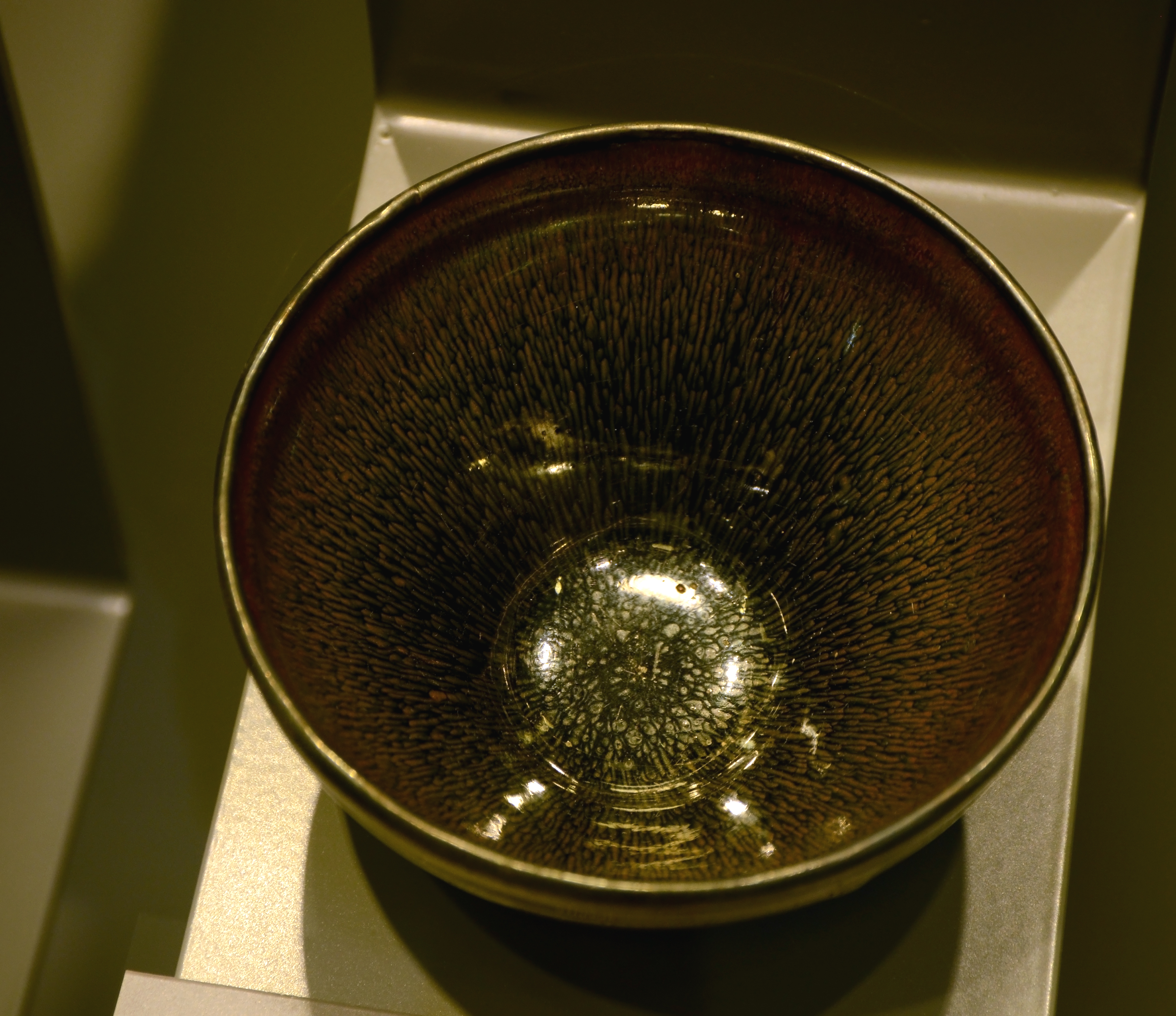
Jian ware mattered so much in Song tea culture because the center of judgment often sat on the bowl surface. Once loose-leaf steeping became dominant, that center gradually shifted elsewhere.
3. Why was the Song whisked-tea world eventually displaced? Not because it was inferior, but because it depended on a system that no longer stood at the center
It is easy to fall into one of two lazy stories. One says whisked tea belonged to an earlier, less developed phase that later methods surpassed. The other turns it into a lost golden age supposedly abandoned by later generations who no longer understood refinement. Both stories miss the real point. The whisked-tea world flourished because a larger system supported it: tribute structures, processing practices, vessel traditions, aesthetic training, and social forms that made bowl-surface judgment meaningful. Its later retreat does not mean it suddenly became crude or obsolete. It means the system that sustained it no longer occupied the same central place.
Whisked tea was powerful, but it was also structurally dependent. It relied on finely processed tea, suitable powder, whisking skill, dark bowls that heightened white froth, and a culture willing to invest attention in visible surface comparison. That could be intensely sophisticated under the right conditions. But once production patterns, institutional priorities, and rhythms of everyday life changed, it became less well suited to serving as the most widely usable, broadly distributable, and socially flexible mode of tea drinking.
Loose-leaf tea did not win because it was inherently more elegant. It won because it fit later social conditions better. It was friendlier to circulation, to ordinary brewing, to urban households, to literati studies, and to the development of a new vessel order. Its rise was not merely an aesthetic replacement. It was a victory of fit.
4. Why did loose-leaf tea suit post-Ming China so well? Because it let tea move from tribute-centered order back into everyday life
To understand why loose-leaf tea truly rewrote Chinese tea culture, the key is that it made tea easier to return to life as a daily practice. Cake tea, powdered tea, and whisking systems could certainly enter daily use, but they remained more deeply entangled with hierarchy, formal process, and specialized procedure. Loose-leaf tea pointed more naturally in another direction. It was easier to store, easier to portion, easier to steep, and easier to adapt across different regions, classes, rooms, tempos, and routines.
That matters enormously because the enduring strength of later Chinese tea culture does not lie only in courtly excellence. It lies in tea’s broad ability to move into the lives of scholars, merchants, monks, city residents, travelers, and households. Loose-leaf tea made that expansion easier. It could be brewed quietly in a study, replenished in a teahouse, simplified on the road, or elaborated at home with growing vessel systems. It did not require every occasion to center on a refined performance. It gave more agency back to the drinker.
In that sense, the rise of loose-leaf tea can be read as one of the great moments when Chinese tea moved away from a tightly structured central order and more durably into ordinary life. It turned tea from “the successful completion of a specific procedure” into “a repeatable daily practice that can inhabit many situations.” That sounds modest. Historically, it changed everything.
The deeper power of loose-leaf tea is that it entered many kinds of life at once: study, teahouse, home, travel. It let tea spread from institutional centers into durable daily habit.
5. Why is steeping such a crucial keyword in this shift? Because the core act changed from whisking a visible surface to drawing tea out of the leaf itself
If the phrase about tribute cakes and loose tea describes a shift in material and institutional emphasis, steeping describes the new method at the level of practice. What matters in steeping is the use of hot water to open the leaf, release aroma and taste, and let the tea itself unfold. It is not merely the generic act of “brewing.” It is a method logic. Drinkers no longer primarily organize attention around powder and froth. They organize attention around the relation among leaf, water, vessel, time, and liquor.
That means the center of evaluation changes. Tea is no longer judged mainly by whether the whisked surface held beautifully across a dark bowl. It is increasingly judged by whether the leaf opens well, how aroma rises, how the liquor feels, how firing reads, how long a tea carries across rounds, and how the brewer manages pace. The center of tea judgment moves from visible surface performance toward inner release.
Historically, that is enormous. It converts tea from something closer to a highly refined live technique into something that can combine deeply with room, time, vessel, and habit. Later gongfu-style brewing, pot brewing, gaiwan brewing, repeated short infusions, and comparative tasting all depend on this underlying logic. Without steeping becoming the new base method, much of what later Chinese tea culture takes for granted could never have formed.
6. Why did gaiwans and Yixing pots become so important later? Because the loose-leaf age needed new vessels to support new ways of judging tea
No major change in tea method remains confined to the leaf. It inevitably rewrites vessels too. The Song whisked-tea world had its own bowl, whisk, mill, and bowl-surface-centered tool order. The age of loose-leaf tea required something else: vessels able to support soaking, opening, pouring, smelling, and comparing. The later force of gaiwans, pots, cups, and fairness pitchers belongs to that historical direction.
The gaiwan matters not just because it is convenient, but because it suits loose-leaf observation beautifully. It allows the drinker to approach the leaf and the liquor directly while controlling timing with flexibility. It holds openness and control together. Yixing pots matter not only because of later myths about clay, but because they support a brewing world attentive to gathered aroma, hand-feel, vessel memory, and the long relationship between tea type and pot use. Together they show a simple truth: once method changes, the center of the table changes too.
That is why it is inadequate to say the loose-leaf revolution merely swapped cakes for leaves. What was really rewritten was the structure of the table itself. Which vessel sits at the center, how a tea is watched, when it is poured, how it is shared, how one discusses early and later rounds—these are all basic actions of later Chinese tea life, and they became intelligible only after loose-leaf tea moved to the center.
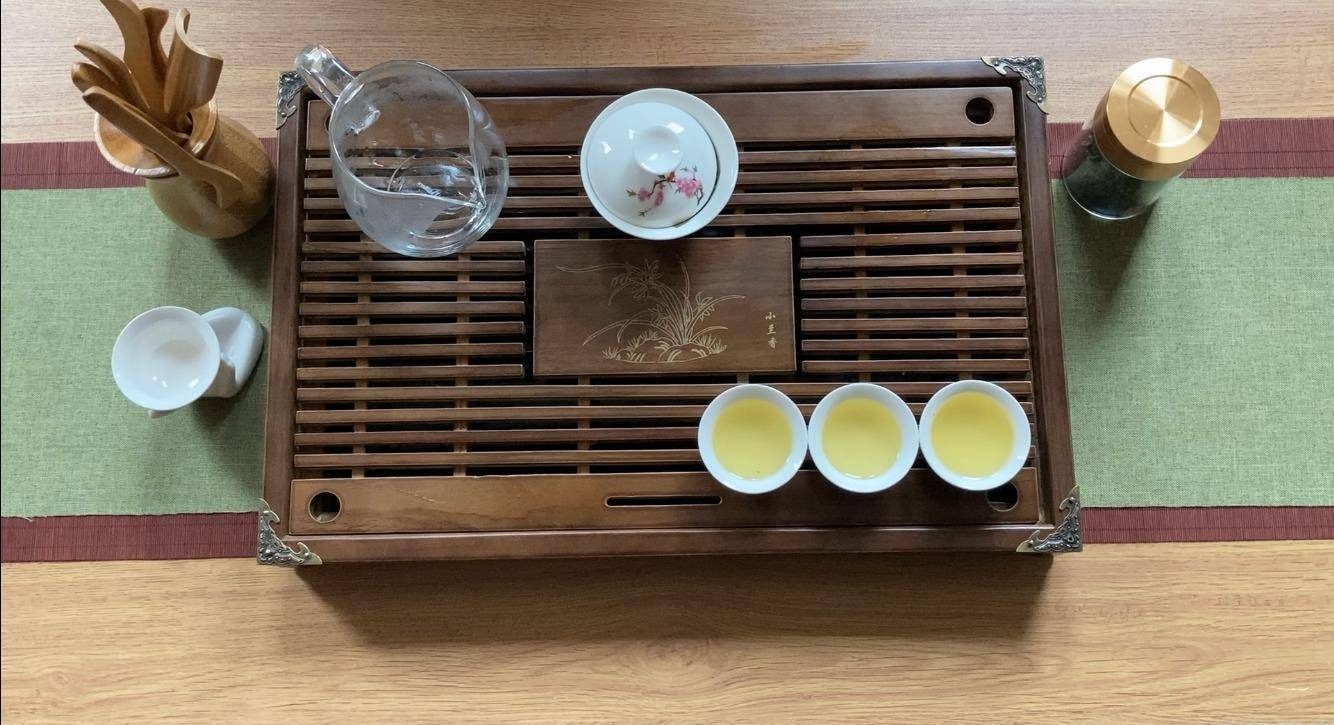
In the gaiwan age, attention no longer rests mainly on the spectacle of surface froth. It falls instead on the relation between leaf and liquor, the control of pouring, the release of aroma, and the comparison across rounds.
7. Why did Ming-Qing literati help stabilize this new order? Because loose-leaf tea suited studies, conversation, and a quieter kind of refinement
The long-term dominance of loose-leaf tea also has much to do with literati taste. Song elegance certainly had its own world, but loose-leaf tea allowed “scholar’s tea” to become something different. It no longer depended so strongly on competitive surface display. It fit better with study-room pacing, with subtle attention to water, vessel, and timing, with preference for measured spaces, and with reflective comparison across repeated infusions.
This aligned beautifully with one side of Ming-Qing literati culture. The goal was often not a single dramatic climax, but a sustainable order of everyday refinement: how pot, cup, incense, book, and flower sat together on a desk; how tea accompanied solitude, waiting, conversation, and self-cultivation. Loose-leaf tea did not need to create a visible spectacle every time. It could become the background texture of an entire day, season, and life.
In that sense, the age of loose-leaf tea did not remove aesthetics from tea. It relocated aesthetics from competitive bowl-surface display to the subtle measure of life itself. That measure later shaped Chinese tea culture deeply: less can be more, vessels must fit the hand, liquor should be stable, conversation need not be loud, and the real skill often lies in repeated familiarity rather than one dazzling performance. That atmosphere belongs strongly to the loose-leaf turn.
8. Why did loose-leaf tea ultimately become today’s Chinese tea common sense? Because it was easier to copy, spread, localize, and adapt across tea types
Another crucial reason is that loose-leaf logic is remarkably extensible. The later richness of Chinese tea categories—green, black, oolong, white, dark tea, and countless local process variants—fits more naturally inside a loose-leaf steeping framework. Different teas call for different methods, of course, but they can still be understood within the broader relation of leaf, water, vessel, and time. By contrast, the whisked-powder world is a denser, more specialized universe built around particular forms of processing and particular aesthetics. It is powerful, but less likely to become a universal daily method broad enough to organize later diversity.
Loose-leaf tea won partly because it was structurally open. It allowed different places to use different vessels, different tea kinds to generate different habits, and a broad spectrum from very simple brewing to highly refined brewing to coexist. One could brew roughly or carefully; in a teahouse with large bowls or in a study with a small gaiwan. That flexibility is precisely why it became such a durable underlying protocol.
So when modern Chinese drinkers across regions still share a common intuition about brewing, pouring, smelling, tasting, and re-infusing even while using different teas and vessels, they are participating in an order built by the age of loose-leaf tea. Its triumph was not a temporary fashion. It was structural.
Why could later Chinese tea develop such rich yet legible brewing diversity? Largely because loose-leaf logic was open enough to absorb variation while still keeping a shared brewing grammar.
9. Why should today’s “Song-style revival” be written together with the Ming shift? Because without that shift, the meaning of revival itself stays unclear
This is the missing layer the current conversation often needs. It is not strange that people love whisked tea, tea baixi, and Song-style aesthetics. Those forms offer strong visibility and a powerful way of making tradition legible again. But if we keep returning to the Song while skipping the Ming reorganization that followed, we create a false picture of tea history: as if Chinese tea culture ought to have remained centered on whisked tea and everything after that were only loss.
That is not what happened. Ming loose-leaf tea was not a decline. It was another creation. It did not continue the Song by imitation. It built a new order whose later reach proved even wider. The most interesting thing about today’s Song revival is therefore not simply that the past returns. It is that people living in a world already structured by loose-leaf habits turn back to look at a system that had already receded. In other words, current whisked-tea revival is not the ancient world resuming where it left off. It is loose-leaf-age people, using loose-leaf-age media and assumptions, looking back at an earlier tea world.
Once the Ming turn is restored to the story, many present-day contradictions become easier to read. Why do people practice whisked tea and still brew rock oolong in gaiwans? Why are they drawn to Song-style vessels while continuing to judge daily tea by aroma, leaf, and infusion rhythm? Why can whisked tea thrive as an aesthetic and experiential revival without displacing mainstream tea drinking? Because the deeper operating logic of everyday Chinese tea still belongs to the loose-leaf world built after the Ming turn.
10. What Ming loose-leaf tea really left behind was not only one brewing method, but the deepest daily structure through which China now understands tea
In the end, the importance of Ming loose-leaf tea lies in the fact that it shifted Chinese tea culture from a highly developed powdered and whisked system into a more open order capable of sustaining local variation, daily life, vessel innovation, and the expansion of tea categories over the long run. What it rewrote was not just how one cup was made, but how tea was watched, smelled, discussed, shared, and installed inside ordinary life.
That is why it deserves to be written now as a long-form feature. Once we understand this turn, we see more clearly that today’s Chinese tea common sense is not some timeless tradition that always existed. It is the result of a historical choice that became so successful it now feels natural. Gaiwans, pot brewing, multiple short pours, shared cups, leaf-bottom observation, firing talk, aroma comparison—these gestures, which now seem almost self-evident, all stand behind that Ming reorganization.