Why tea strainers deserve serious attention again: single-hole filters, mesh, broken leaf, pour speed, and today’s biggest mistakes
Created: · Updated:
In contemporary Chinese tea discussion, arguments about teaware no longer stop at which vessel looks more refined or which kiln sounds more prestigious. More and more attention has shifted to a small, previously overlooked detail: the tea strainer. Some drinkers insist that a well-made pot or a properly handled gaiwan should need no extra filter at all. Others treat an external strainer as essential for daily brewing. Online debate now circles around single-hole filters, multi-hole filters, mesh strainers, broken leaf control, pour speed, and cleaning difficulty. The return of this topic shows that tea culture is paying closer attention to working logic, not just surface symbolism.
A tea strainer deserves a full article precisely because it is small. It reveals how deeply someone actually understands brewing flow. Your view of strainers immediately exposes your assumptions about pour speed, leaf integrity, sediment control, table neatness, shared serving order, and the division of labor between vessels. It looks like an accessory, but in practice it sits at one of the most contested junctions in the entire brewing system.
It is also a perfect example of an object detail that has become newly visible today. As dry-style tea tables have spread, surfaces have become cleaner, rhythms more deliberate, and people more attentive to how an inner spout filter, a gaiwan lid gap, an external mesh strainer, and a fairness pitcher work together. What used to be dismissed with “just strain it somehow” has become a marker of practical maturity.
What matters about a tea strainer is not whether the accessory exists, but where it sits in the workflow, what problem it solves, and what trade-offs it introduces. If it slows the pour, traps aroma, or becomes annoying to wash, the whole tea-table rhythm changes.
1. Why have tea strainers become a high-frequency topic again?
One clear reason is that today’s tea table increasingly values control. In earlier years, people often discussed teaware through the language of famous kilns, material prestige, vessel shape, and visual style. Current discussion more often focuses on working differences: whether a pot pours fast enough, whether a gaiwan actually keeps leaves back, whether a fairness pitcher should receive tea through a separate filter, and whether a broken-leaf-heavy tea sample really needs extra straining. As teaware discussion moves from object worship toward process verification, strainers naturally return to view.
Another reason is visual media. Video and image platforms amplify the appeal of a clean, bright liquor surface with no floating particles. Strainers therefore move from backstage to foreground. They may not be as visually glamorous as jianzhan, porcelain, or tea pets, but they have an immediate effect on what the tea looks like in the cup. Because the effect is so direct, opinions become polarized. For some people, strainers signal care and professionalism. For others, they look like a patch that compensates for weak vessel choice or weak technique.
2. What is a tea strainer actually filtering?
Many people think a strainer merely stops leaves from falling into the cup. That is only the shallowest part of the story. A strainer usually deals with at least three things. First, it intercepts visible leaf fragments so the poured liquor looks cleaner. Second, it catches smaller broken particles and dust-like debris that affect texture, finish, and perceived cleanliness on the palate. Third, it stabilizes the workflow itself. If the tea is fragile, broken, or awkward to pour cleanly, the strainer makes serving more predictable.
That is why a strainer should be understood as a correction tool rather than a universally mandatory tool. It enters when the tea, the brewing vessel, the condition of the leaves, and the desired result do not fully align on their own. It is not always necessary, but it is certainly not automatically redundant. The mature question is not “should a strainer be used or not?” but “what exactly am I trying to filter out, and what am I willing to give up in return?” Every filtering action has a price: it may reduce speed, alter aroma lift, or create extra cleaning work.
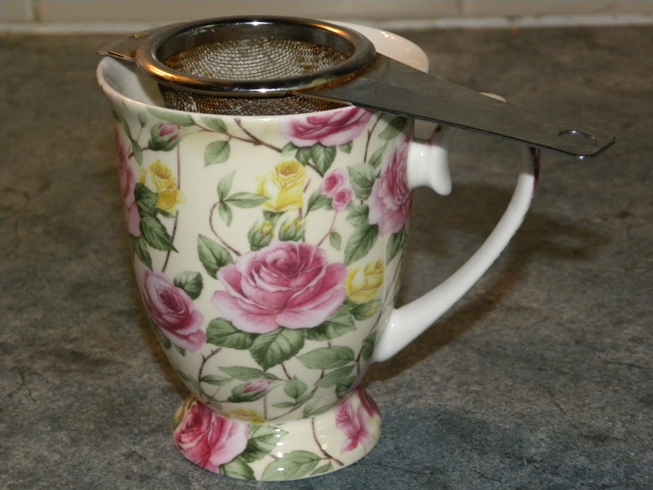
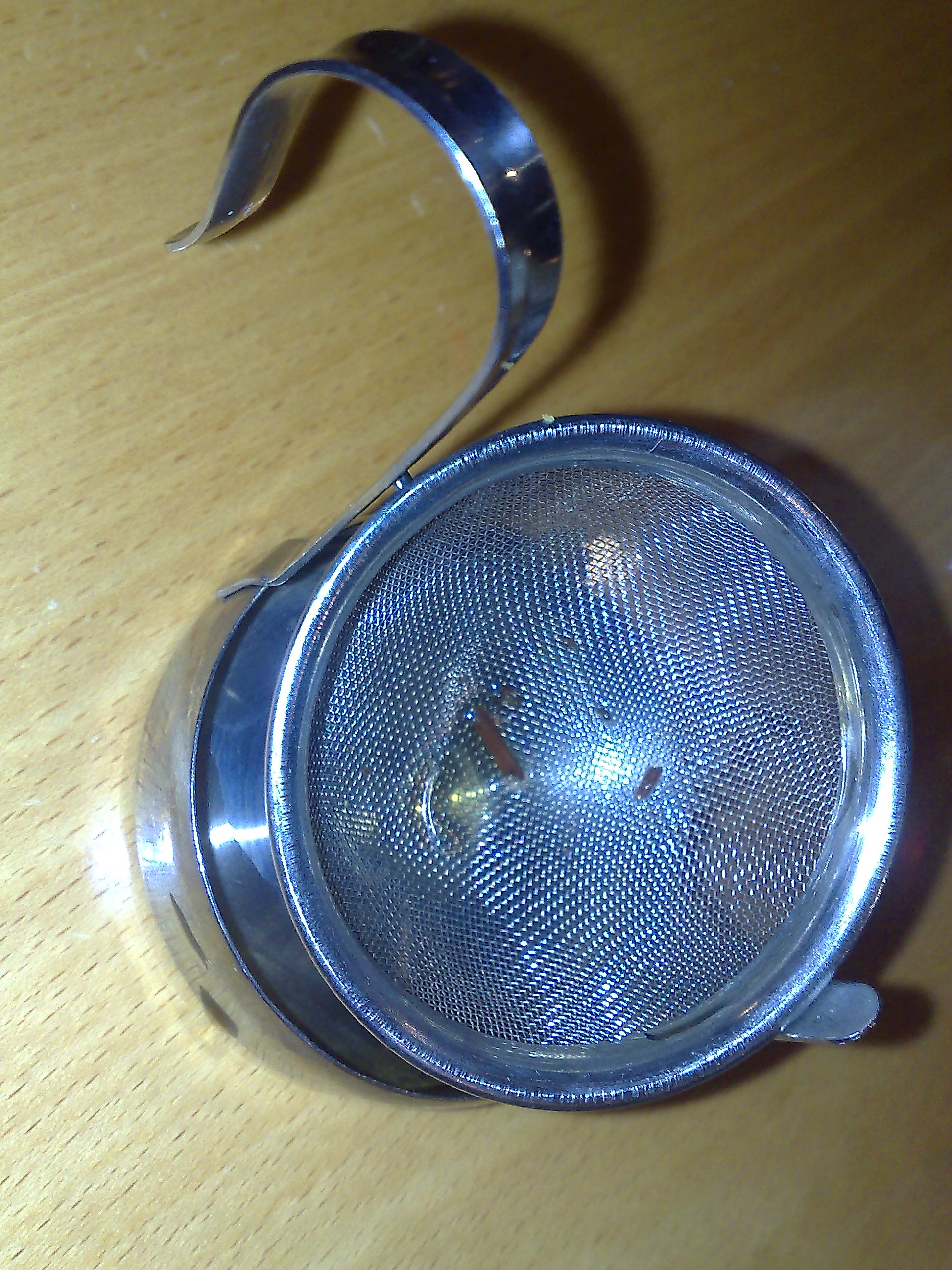
A tea strainer looks simple, but every detail matters. Pore size affects how much sediment is blocked, basket depth affects flow and leaf buildup, and the handle or support shape determines whether it actually works smoothly over a pitcher or cup.
3. Single-hole filters, multi-hole filters, mesh strainers: what do these structures change?
Much of the present argument starts inside the vessel itself. Single-hole internal filters attract strong opinions because they seem to represent a kind of minimalist purity. Their supporters praise speed, clean flow, and easy cleaning. Critics point out that they are less forgiving with broken leaf and may become unstable when fragments collect around the only opening.
Multi-hole or ball-hole structures usually aim at compromise. They increase leaf retention and reduce the chance of one opening being blocked immediately, but they can also trap residue more easily and demand more precise manufacturing. External mesh strainers set the boundary most clearly of all: they do not ask the pot or gaiwan to complete every part of the filtering task. Instead, they separate “cleaning the pour” into its own stage. But once the mesh becomes too fine, too deep, or too packed with leaf fragments, flow slows down. No structure wins in every direction. Each one arranges the priorities of cleanliness, speed, stability, and ease of washing differently.
4. Why do some people reject external strainers while others treat them as indispensable?
This is not merely an aesthetic disagreement. It is a clash between two philosophies of use. One side places trust in the vessel itself. If the inner filter is well designed, the gaiwan is handled properly, and the drinker understands leaf behavior, then adding an external strainer can look like an unnecessary intervention that slows the pour, traps aroma, and interrupts a clean division of labor. This position values the completeness of the vessel doing its own work.
The other side is more result-oriented. It accepts that real brewing does not always happen under ideal conditions. A tea sample may contain lots of broken material. A casual group may strongly prefer very clean cups. In such settings, the external strainer works like a safety valve, making shared pouring more stable and visually tidy. Neither side is simply wrong. They just rank object integrity and practical stability differently. The real mistake is absolutism: treating strainers as always useless, or as the default answer for every tea, every vessel, and every situation.
The greatest advantage of the external strainer is clarity of responsibility: it takes filtration out of the pot or gaiwan and gives it its own stage. The cost is one more movement and one more tool to clean.The finer the filter, the cleaner the cup may become—but the higher the risk of slower flow, trapped aroma, residual liquor, and annoying maintenance. Tea strainers are never a case of “more filtering equals more refinement.”
5. How does a tea strainer affect pour speed, aroma, and taste?
This is the layer that matters most. Beginners often focus only on visible leaf particles, but a strainer also rewrites the timing of the pour. In teas where fast decanting matters—certain fragrant oolongs, for example—an overly fine or overloaded mesh can clearly delay the final stage of the pour. Many people think they are “only filtering a little,” when in fact they have extended contact time enough to change the cup.
A strainer also changes the path of aroma. Fragrance that would otherwise leap directly into a fairness pitcher or cup now meets an extra surface that can trap droplets, hold residual liquor, and slightly flatten the movement of volatile aromatics. Some teas with thicker body or clingier liquor leave obvious residue on the mesh, further altering the concentration and rhythm of what is actually drunk. That is why the subject cannot be reduced to cleanliness alone. The real lesson is that clarity, speed, aroma, and texture move together. No advantage comes without exchange.
6. In which teas and situations does the strainer matter more?
With intact leaves and a vessel that already manages leaf retention well, an additional strainer is often unnecessary. Large-leaf teas in the hands of a skilled brewer may pour perfectly well through the pot spout or the controlled lid gap of a gaiwan. But when the tea is broken, sample-packed, dusty with older fragments, or being shared among people who strongly prefer visually clean cups, the usefulness of the strainer rises sharply.
There is also a very common practical scenario: simplified office or home brewing. In these settings, the goal is often not the fullest expression of vessel purity but a stable, tidy, low-error routine. Here, a strainer that pours well and washes easily may matter more than many heavier prestige objects. It may not make tea more elevated, but it can make daily life more frictionless. That is one reason younger tea drinkers discuss it again now: not to decorate tradition, but to solve real routine problems.
7. Why does aesthetics enter the discussion too?
At first glance, a strainer seems too functional to become an aesthetic issue. But dry-style tea tables have made order, negative space, and line continuity more important. An external strainer is an inserted tool. It can either cooperate with the table or interrupt it. Some drinkers find metal mesh too reminiscent of kitchen equipment and therefore visually out of place. Others prefer ceramic or bamboo-supported forms that work effectively while retreating more gracefully from view.
This reveals something important about contemporary tea aesthetics. The question is no longer only whether a precious object looks good in isolation. It is whether working tools can preserve order while they work. If a strainer is clumsy, slow, or visually loud, the whole table begins to feel hesitant. If it is light, stable, and easy to remove, it can make the workflow look more coherent rather than less. Aesthetic maturity is often not about hiding functional tools, but about knowing how and how much they should appear.
8. The biggest misconceptions around tea strainers
The first misconception is treating “absolutely zero leaf particles in the cup” as an unquestionable ideal. For some teas, chasing that standard forces the user into overly fine filters and overly slow pouring, sacrificing aroma and rhythm in the process. The second misconception is believing that expensive vessels automatically remove the need for a strainer. In reality, whether a strainer helps depends much more on the tea material and the context than on the price tag of the vessel.
The third misconception is ignoring maintenance. Because strainers are small, people often give them a quick rinse and put them away, even when residue remains. Over time that leads to retained smell, visible buildup, and discoloration. The fourth misconception is assuming that such a small tool does not deserve careful selection. In practice, it deserves exactly that. Basket depth, mesh fineness, support shape, and how well it fits over a pitcher or cup all determine whether repeated daily use feels smooth or irritating.
9. Why is the tea strainer one of the best tests of practical judgement?
Because it forces trade-offs into the open. Larger vessels can sometimes enter the tea table through taste, material preference, or cultural imagination before their practical limits are fully confronted. A strainer offers no such luxury. The moment you use one, you must answer difficult questions. Do I want more speed or more clarity? Fewer movements or more stable results? Do I want the vessel itself to complete the task, or am I willing to add an external step in exchange for order?
There is no single correct answer, but the object quickly reveals whether someone is truly thinking through brewing. That is why strainers deserve renewed attention. Not because they are the grandest tools on the table, but because they expose the quality of judgement behind the table. They are small objects, but not small questions.